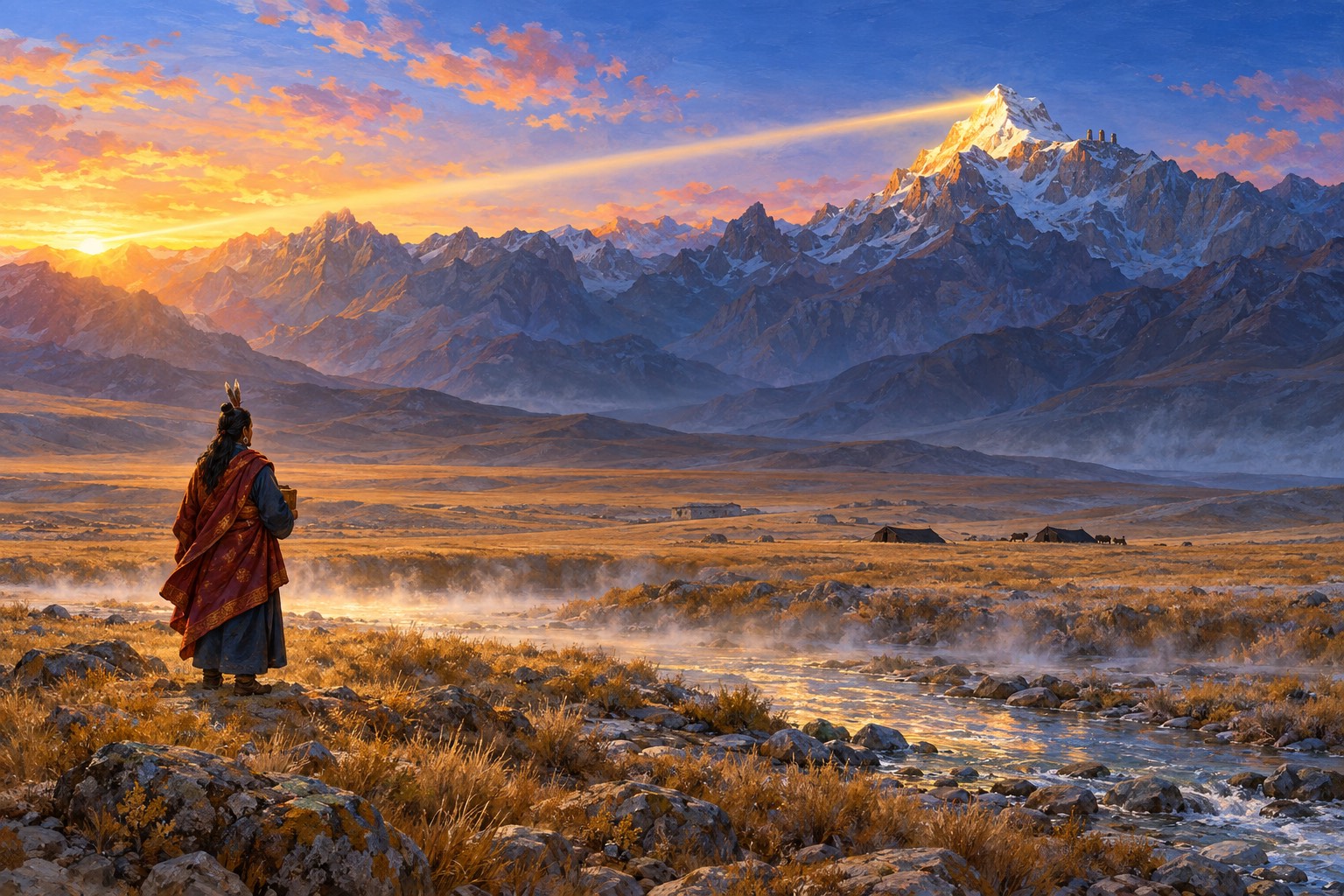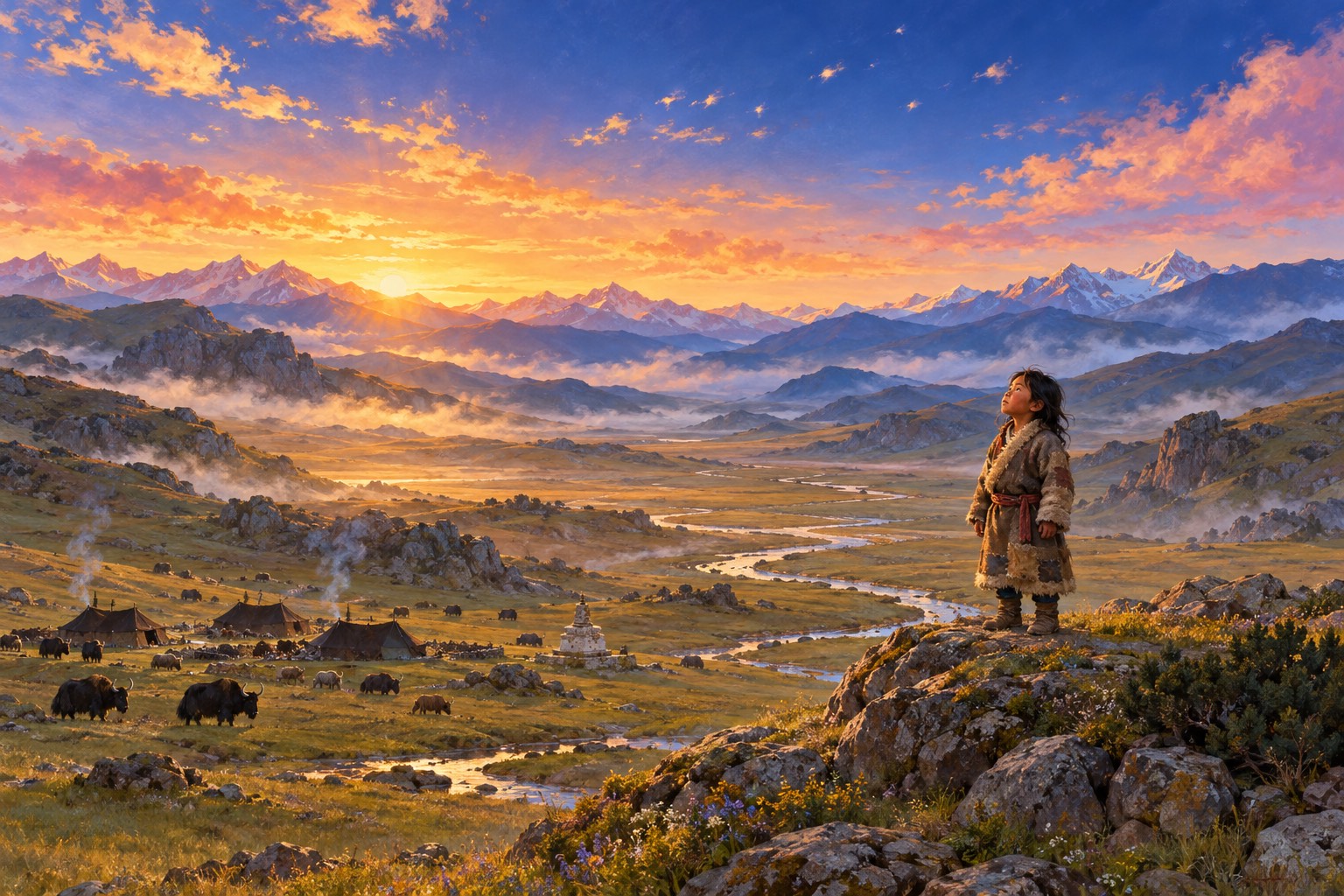
High in the Himalaya, the old stories say, there are valleys that stay hidden until their time comes. Mist lies across their mouths. Snow closes their passes. Rivers run through gorges so steep that no path seems possible.
Beyond, the tradition says, lies a green and sheltered land where people can live and practise in peace. Tibetans call such a place a beyul, a "hidden land" or "hidden valley."
This is a gentle walk through what the tradition says about them: who is said to have hidden them, how the old guidebooks describe the way in, and a few of the people who went looking.
Set aside for hard times
In the Nyingma school, the oldest school of Tibetan Buddhism, the beyul are remembered as lands that Guru Rinpoche blessed and sealed. Guru Rinpoche, "Precious Teacher," is Padmasambhava, the eighth-century master to whom the Seven-Line Prayer is addressed.
The accounts say he travelled through the mountains blessing caves and valleys, and set certain lands apart as refuges for later times of war, sickness and trouble, to be opened only when they were needed.
 Illustration in preparation
One telling, which Rigpa Wiki quotes from a modern history of Everest, has the Guru speak of such a valley to King Trisong Detsen, the Tibetan king who invited him. The valley was called Khenbalung. It came into being, the story goes, where a lotus flower fell to earth, a gift from the king of the gods that went astray.
Illustration in preparationKhenbalung is real ground, on the steep slopes above the Arun river in eastern Nepal, below Everest. The gorge is so deep that the monsoon rains reach far into the mountains. Juniper, silver fir, birch and great rhododendrons cover the lower hillsides.
Higher up, in summer, red and blue poppies bloom on the open slopes. The same account says these poppies are that very lotus, fallen from the gods.
The tradition names many such places. Around the Everest region alone, Wikipedia lists Khenbalung, Rolwaling and Rongshar among them. Further east lie Sikkim, which Tibetans call Demojong, and Pemakö, the "Lotus Array," in the great gorges of south-eastern Tibet. Rigpa Wiki calls Pemakö perhaps the most famous of all. One guidebook counts sixteen great hidden lands; other counts differ.
A key hidden with each valley
A hidden valley, the tradition says, came with its own key. Along with the teachings he concealed as terma, "treasure," Guru Rinpoche is said to have hidden guides to the beyul under rocks and inside caves, temples and stupas.
Illustration in preparationThese guides are called neyik, "guides to a place," or lamyik, "guides to the path." They were to be found at the right time by tertöns, "treasure revealers," and each one tells of a road, its dangers and its signs.
Wikipedia's summary adds that each valley has guardians. The protecting forces, it says, can show themselves as snowstorms, mist or snow leopards, and those who try to force their way in may fail.
How a guidebook reads
Lotsawa House has translated what is said to be the first guide to Pemakö, a treasure brought out from a cave in Kongpo by the seventeenth-century revealer Jatsön Nyingpo. It opens with dark prophecy: famine, war and sickness in times to come, and very few able to escape. Then it turns to the road.
East of Samye, it says, follow the river into Dakpo, to a valley shaped like a scorpion lying on its belly. At the tip of its tail is a sacred site called Gyala. Then come a charnel ground, boundary stones, and four doors into the sacred land.
There will be a great eddy in the river, and a fragrant tree two arm-spans thick that can be felled to make a bridge. "Sharpen your tools," the guide adds (as the translators render it), a wonderfully practical line in a book of prophecy.
Illustration in preparationFurther on, the guide says, is a cliff that shows the reflection of everyone who gazes at it, and a place where every vision seems real. The land beyond is ringed by snow and rock, sealed by passes, rivers and cliffs. It tells of fruit as big as a horse's head, and radishes so large that people can barely lift them.
Illustration in preparationLike many such texts, the guidebook makes great promises about what the place can do for those who reach it. Those are the tradition's own words about a sacred land; this page only reports them and promises nothing.
And amid all its prophecy, the guide returns to one simple thing that needs no map: in hard times, remember the Guru, and call on him from the heart.
The gates of Sikkim
Illustration in preparationThe histories kept in Sikkim tell how the Guru came to the forested hills below Kangchenjunga, blessed its sacred places, and named the hill of Tashiding the heart of the land. They speak of four great caves in the four directions, and of masters entering through gates: from the north in 1373, then in the 1640s from the west, the south and again the north.
A twentieth-century guide on Lotsawa House calls Sikkim the "king of hidden lands." The journeys of its first openers are told in their own stories on this site: Rigdzin Gödem and the Hidden Valleys and Lhatsün Namkha Jigme and the Hidden Land of Sikkim.
The Hidden Lotus Grove
Closer to Kathmandu lies Yolmo, the Helambu region, home of the Hyolmo people. The Nekhor pilgrimage guide calls its beyul the Hidden Lotus Grove, named because its valleys open like a lotus.
Nekhor tells how it was opened. In 1523, with Mongol armies troubling Tibet, Chokden Gönpo, a heart disciple of the treasure revealer Pema Lingpa, travelled to Kyirong on the Nepal border. There he found the master Ngakchang Shakya Zangpo meditating in a cave.
Illustration in preparationChokden Gönpo spoke of the need for safe places to practise, gave him the treasure guides to the Lotus Grove, and urged him to find it. Nekhor says frankly that no biography tells of the hardships on the way. It says only that Shakya Zangpo followed the guide and opened the valley.
He is the same master who restored the Great Stupa of Boudha, as told in that story. Rigpa Wiki sums up his work here in one plain line: he opened the hidden land of Yolmo.
Illustration in preparationLater masters loved the place. One great yogi of the last century, who spent decades in retreat there, wrote of mountains rising like spikes toward the sun, and of a valley ringed by water, earth and rock, always graced by cloud, mist and rain.
The long road to Pemakö
Pemakö drew seekers for centuries. Jatsön Nyingpo sent his student Düddul Dorje toward it, as told in the story of Jatsön Nyingpo. Dudjom Lingpa longed to go and could not, and foretold that his successor would be born there; his own story tells the rest.
One journey has left a clear trail of writings. In 1729 a learned lama named Lelung Zhepai Dorje, remembered as open to many traditions, travelled to Pemakö. The Treasury of Lives notes the journey, and a scholar has written a whole study of it.
Illustration in preparationFour years later a patron family asked him for a prayer on behalf of the monks of a retreat centre inside Pemakö, and he dictated one to his scribe. Lotsawa House has translated it.
It asks to reach the hidden land, where sickness and strife are scarce. It names as the land's openers Zhepai Dorje and a woman, Lhachik Dorje Kyabje. And it asks that all the weary ones who struggle to reach the place be watched over by the Guru and the dakinis, female wisdom beings.
Illustration in preparationValleys with people in them
The hidden lands were never empty. Wikipedia notes that Tshangla-speaking people, some of whose ancestors came from eastern Bhutan, made their home in Pemakö, and that Tibetans fleeing turmoil later settled among them. Sherpa oral tradition, it adds, remembers their ancestors' journey from Tibet as a search for hidden valleys.
Today villages, monasteries and small retreat houses stand in several of these valleys. People farm there, raise children and keep the old stories. A modern pilgrimage guide says simply that in Yolmo the Guru's blessings are still palpable.
Illustration in preparationA refuge you can carry
Most of us will never cross a snowy pass into a hidden valley, and the tradition itself warns against forcing the way. But the guides and prayers keep returning to the same quiet thread: remembering Guru Rinpoche, and calling on him with longing.
Illustration in preparationAbout the art
Most of the pictures on this page are landscapes, because the hidden valleys are places before they are stories. They are painted from the descriptions in the sources: the deep Arun gorge and its poppies for Khenbalung, the forested ridges under Kangchenjunga for Sikkim, valleys that fan out like petals for Yolmo, and the steep cloud-forest gorges of Pemakö. The opening and closing image of a valley's mouth is a composite, not a portrait of any one place.
The flowers in the Khenbalung picture are Himalayan blue poppies, not lotuses. The account on Rigpa Wiki says these poppies are the lotus that the king of the gods let fall, so the picture shows the flower as it grows, and leaves the story to the words.
Guidebooks and scrolls appear only closed and tied, with nothing written showing, because the site never puts script in its images. The great tree, the river eddy and the reflecting cliff are drawn from the landmarks named in Jatsön Nyingpo's guidebook, not from any photograph of the real route.
Guru Rinpoche appears twice. By lamplight at Samye he is shown in his main form, wearing the lotus hat with a half-vajra and a single vulture feather and holding a five-pronged vajra, the scepter of the indestructible, at his heart. In the closing image he sits within a sphere of rainbow light above the valley, with a skull cup holding a small vase of long life in his lap and the khatvanga staff against his left shoulder. King Trisong Detsen is seen only from behind, in the cream turban and medallion robe of the Tibetan imperial court. Travellers and present-day villagers are shown small and without faces; prayer flags appear only in the present-day scene.
Why this matters for practice
The Seven-Line Prayer begins by naming a place, and the hidden valleys carry that same feeling: ground the tradition remembers as touched and kept by Guru Rinpoche for people in trouble. Few of us will ever reach one, but the guidebooks themselves point to something nearer, remembering the Guru and calling on him from the heart. Reciting the prayer, even once, is a simple way to do that wherever you are.
If something in this story stirred a longing for a sheltered, quiet place, you might pause tonight and recite the Seven-Line Prayer once, wherever you happen to be.
Sources and further reading
- Beyul, Wikipedia
- Hidden land; Pemakö, Rigpa Wiki (Internet Archive snapshots, 2021 and 2011)
- Khembalung, Rigpa Wiki (Internet Archive snapshot, 15 July 2024)
- The Guidebook to the Hidden Land of Pemokö, by Jatsön Nyingpo, trans. Tom Greensmith, Ryan Jacobson and Tenzin Choephel, Lotsawa House
- An Aspiration to Travel to the Hidden Land of Pemokö, by Lelung Zhepai Dorje, trans. Tom Greensmith, Tenzin Choephel and Ryan Jacobson, Lotsawa House
- Lelung Zhepai Dorje (biography page; author note and bibliography only), Treasury of Lives (Internet Archive snapshot, 2019)
- Guide to the Valley of Joy, Sikkim, by Jamyang Khyentse Chökyi Lodrö, trans. Adam Pearcey, Lotsawa House
- The Legacy of Guru Padmasambhava in the Dissemination of Buddhism in Sikkim, Sahapedia
- The Guru in Helambu; The Guru in West Sikkim, Nekhor
- Ngakchang Shakya Zangpo, Rigpa Wiki (Internet Archive snapshot, 2024)
- Mêdog County (Pemako); Helambu; Rolwaling Valley; Yarlung Tsangpo Grand Canyon; Sherpa people, Wikipedia
This retelling is waiting to be read by a knowledgeable practitioner. Where the traditional accounts differ, the story says so; if you notice a mistake, please tell us through Share Your Story.