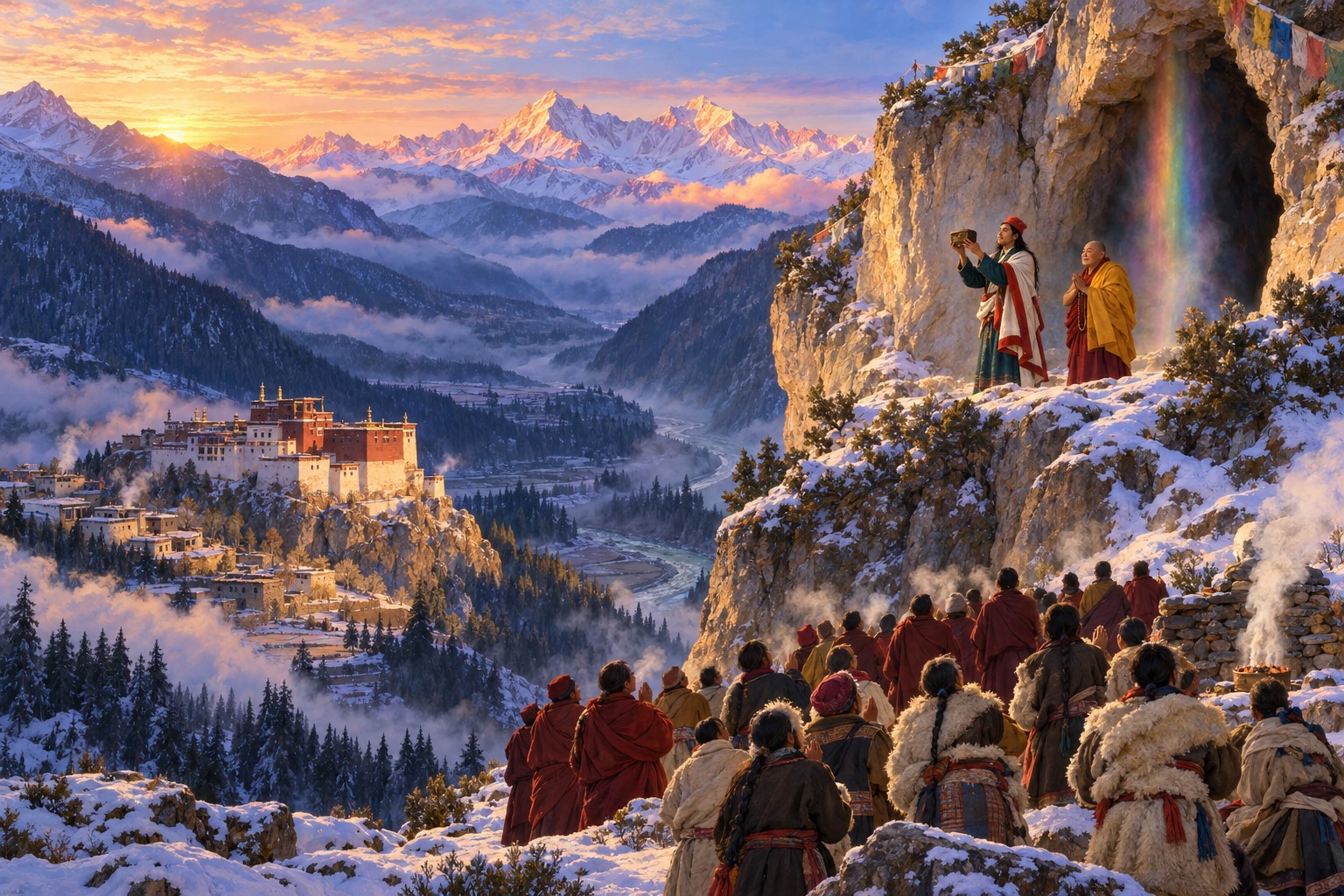
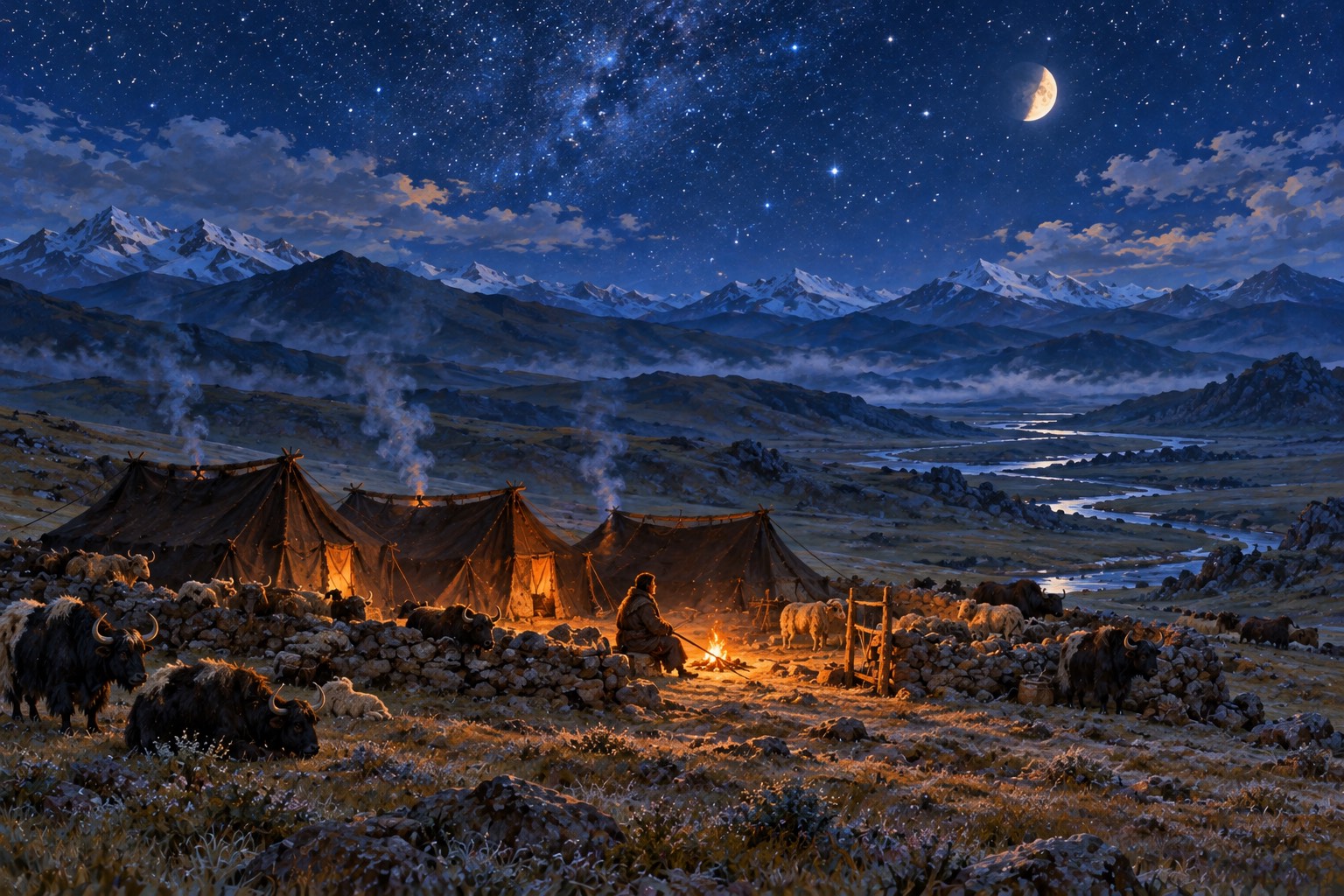
Far to the east of Lhasa, where the high grasslands of eastern Tibet roll on toward the edge of the sky, lies Golok. In the nineteenth century it was nomad country: black tents, herds of yak, long winters, and very few monasteries.
Here, in 1835, a boy was born who would never become a monk and never go to school, yet who became one of the best-loved masters of the Nyingma, the "ancient" school of Tibetan Buddhism that traces its teachings to Guru Rinpoche. He is remembered as Dudjom Lingpa.
A boy tied to the tent
He was born in the Serta valley of Golok, into the Nub clan. Pema Rigtsal Rinpoche's short biography, translated on Lotsawa House, names his father Aten and his mother Bodzok. Tradition holds that he was an emanation of Khyeuchung Lotsawa, one of Guru Rinpoche's twenty-five heart disciples.
His own life story, translated into English by Chönyi Drolma as A Clear Mirror, tells of visions from his very earliest memories. Not all of them were gentle. The Treasury of Lives biography, retelling it, says that as an infant he saw crowds of spirits as well as dakinis, female embodiments of awakened wisdom, and that the sights troubled him deeply.
One story from when he was three is especially tender. His mother had to go out to dig wild roots for food, so she tied him by a rope near the tent to keep him from wandering. As he sat there alone, the account says, a woman appeared whom he took to be a wisdom dakini, and she led him on a journey through pure lands.

Life in those years was hard. He grew up among poor nomad families, and, the same biography notes, he and the other herders of his youth often suffered at the hands of raiders, a common danger on the open grasslands.
Pema Rigtsal Rinpoche's account adds that from the age of two or three he saw Guru Rinpoche and the dakinis directly, and that he could read and write without being taught. Lama Tharchin Rinpoche, a modern teacher of this lineage, put it plainly: "No human guide educated Dudjom Lingpa."
In his visions, Lama Tharchin writes, it was Yeshe Tsogyal, Guru Rinpoche's great disciple and companion, who taught him his letters, and she was like a mother to him.

Taught by visions
The sources name almost no human teacher for him. Dudjom Lingpa himself credited Guru Rinpoche and Yeshe Tsogyal, buddhas and bodhisattvas such as Avalokiteshvara, Manjushri and Vajrapani, and earlier masters such as Saraha and Longchenpa, who he said appeared to him and taught him.
This made some people doubtful. A lay nomad with no monastery and no famous teacher, claiming instruction from Guru Rinpoche himself? According to the translator's introduction to A Clear Mirror, as summarized on Wikipedia, many accepted him only when his own students began to show clear signs of realization.
Treasures of the mind
A tertön is a "treasure revealer". The tradition holds that Guru Rinpoche and Yeshe Tsogyal hid teachings, called terma or treasures, to be found by destined people in later ages. Some are drawn from rocks, lakes or temples. Others, called mind treasures, arise directly in the revealer's mind.
In 1858, at twenty-three, Dudjom Lingpa moved from the lower Serta valley to the nearby Mar valley. A local family named Gili became his patrons, Rigpa Wiki says, and people began to call him the Gili Tertön.
In that same year of his life, he wrote, Avalokiteshvara, the bodhisattva of compassion, came to him in a dream as a white figure with a golden topknot and gave him a tiny crystal casket to swallow. Later Manjushri and Vajrapani gave him caskets of gold and turquoise in the same way. After that, his account says, three whole cycles of teaching arose in his mind, as clearly as if they had been copied there.

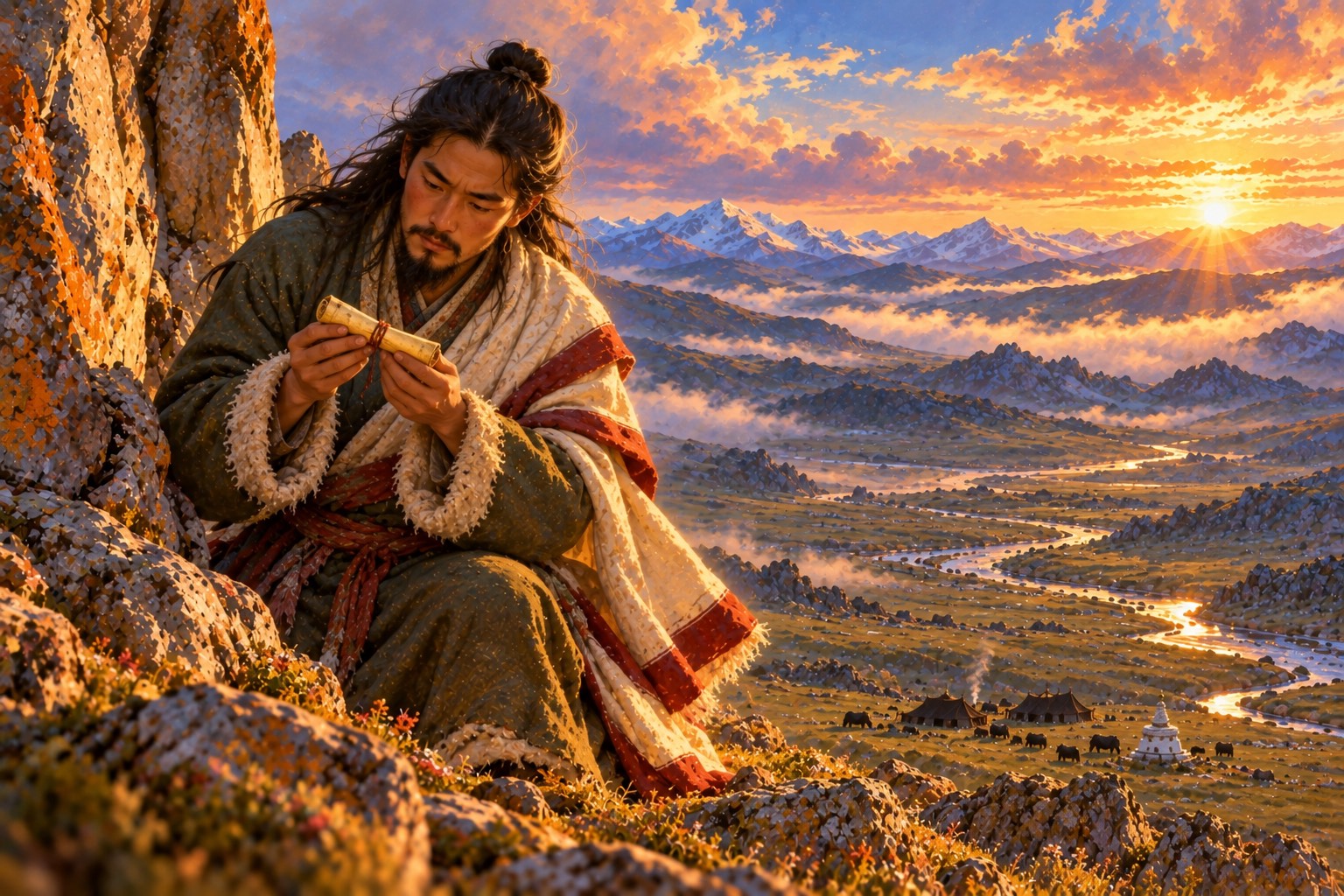
In 1860, at twenty-five, he drew from the rocks of the Mar valley his prophetic guide, a list showing where and when his other treasures were to be found. Over time he recovered tiny caskets of rock, bamboo, wax and wood from cliffs and stupas around the region. Together these became his earth treasure, the Heart Essence of the Dakinis.
Through it all, the tradition says, Guru Rinpoche was never far away. Treasury of Lives records that in visions Dudjom Lingpa journeyed to the Copper-Coloured Mountain, Guru Rinpoche's pure land, and received teaching from him there. A prophecy in his own revelations, spoken in Guru Rinpoche's voice, foretells an emanation "in the form of a hidden crazy yogi" in a later age.

The New Treasures of Dudjom
In all, his revelations fill about twenty volumes. Together with those of his successor, they are known as the Dudjom Tersar, the "New Treasures of Dudjom". Rigpa Wiki lists four major cycles from Dudjom Lingpa, among them the practices of the dakini Tröma Nakmo, and he also wrote treatises on the Great Perfection, or Dzogchen, the innermost teaching of the Nyingma school.
These are practices to be received from a qualified teacher, so this page only names them; the Find a Teacher page can help. The Seven-Line Prayer itself is open to anyone.
His autobiography tells one small, striking story about them. As he was writing out the dakini's practice, a great whirlwind rose and carried the pages off in every direction. He took it, he wrote, as a sign that these teachings would one day reach every land.

A householder's life
Dudjom Lingpa lived as a lay yogi, with long hair and a family, outside the great monasteries. He had many sons, and each of them was recognized as a tulku, the rebirth of an earlier master. Rigpa Wiki counts eight; the older Treasury of Lives biography says seven.
The eldest became the Third Dodrupchen, Jigme Tenpe Nyima (1865–1926), a great holder of Jigme Lingpa's teachings. Another, Tulku Drimé Özer, carried on his father's seat. Another, Namkha Jigme, was recognized as the rebirth of Patrul Rinpoche, the wandering teacher of Dzachukha.
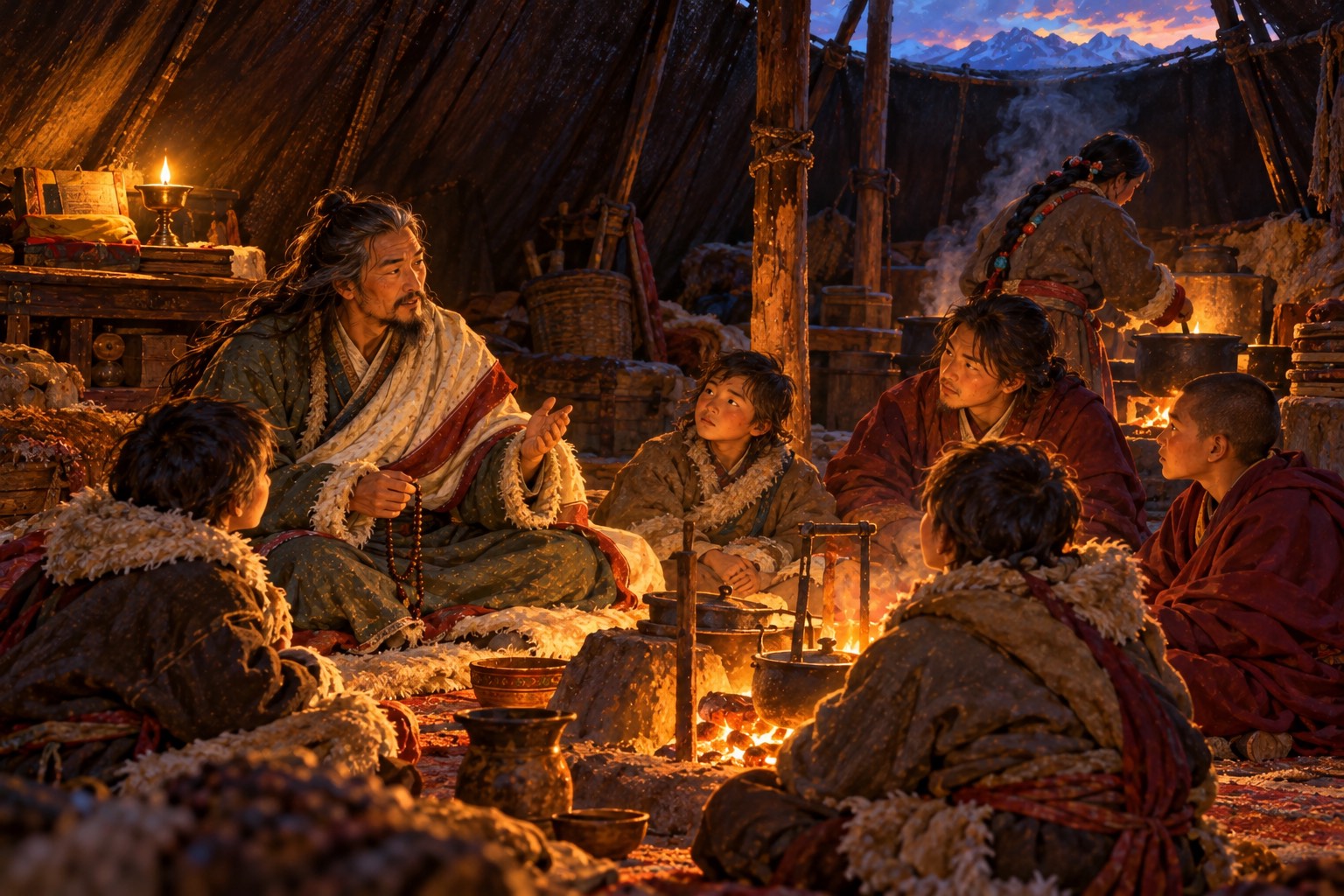
Around 1890 he was invited to lead Dartsang Kelzang, a small monastery in Serta founded some twenty years before. Treasury of Lives says he built it into a major centre of Nyingma practice. Some of his songs of advice, translated on Lotsawa House, were written for individual students who came to him, among them a nun named Chötso.
The rainbow body
His students are remembered above all for one thing. In the Great Perfection tradition, the rainbow body is described as a sign of the very highest realization: at death, it is said, the practitioner's body dissolves into light.
Pema Rigtsal Rinpoche's account states that thirteen of Dudjom Lingpa's disciples attained the rainbow body through these teachings. Rigpa Wiki passes on the same tradition, crediting it to oral lineage stories and prophecies in his biography, and names several of them, including Pema Lungtok Gyatso of Serta. They are accounts of the lineage, handed down with deep reverence, and they are offered here in that spirit.

Toward Pemakö
Late in life Dudjom Lingpa hoped to travel south to Pemakö, a hidden land of south-eastern Tibet blessed, the tradition says, by Guru Rinpoche. He was not able to go. Rigpa Wiki says he foretold that his successor would be born there and open that land himself.
He passed away soon after the turn of the century. The sources give the year as 1903 or 1904.

The line continues
In 1904 a boy was born in Pemakö who was recognized as Dudjom Lingpa's rebirth: Dudjom Rinpoche, Jigdral Yeshe Dorje (1904–1987). Rigpa Wiki notes that he was born even before his predecessor had passed away. Other emanations were recognized too, among them a grandson, Dzongter Kunzang Nyima.
Dudjom Rinpoche became one of the great Nyingma masters of the twentieth century: a scholar, poet and treasure revealer in his own right, whose revelations joined his predecessor's to complete the Dudjom Tersar. After 1959 he lived in exile in India and Nepal, became the first head of the Nyingma school in exile, and wrote a celebrated history of the school.
In the last decade of his life he taught in Europe, North America and East Asia, founding centres in France and the United States, and he spent his last years in France.
Through him, and through Dudjom Lingpa's sons and students, the Dudjom Tersar has become one of the most widely practised treasure lineages of the Nyingma school, Rigpa Wiki says, alongside the Longchen Nyingtik. Today it is kept in Tibet and the Himalayas, in Europe, the Americas and East Asia. Dudjom Rinpoche's eldest son, Thinley Norbu Rinpoche, wrote a commentary on the Seven-Line Prayer itself, The Sole Panacea.

The scattered pages, it seems, did travel.
About the art
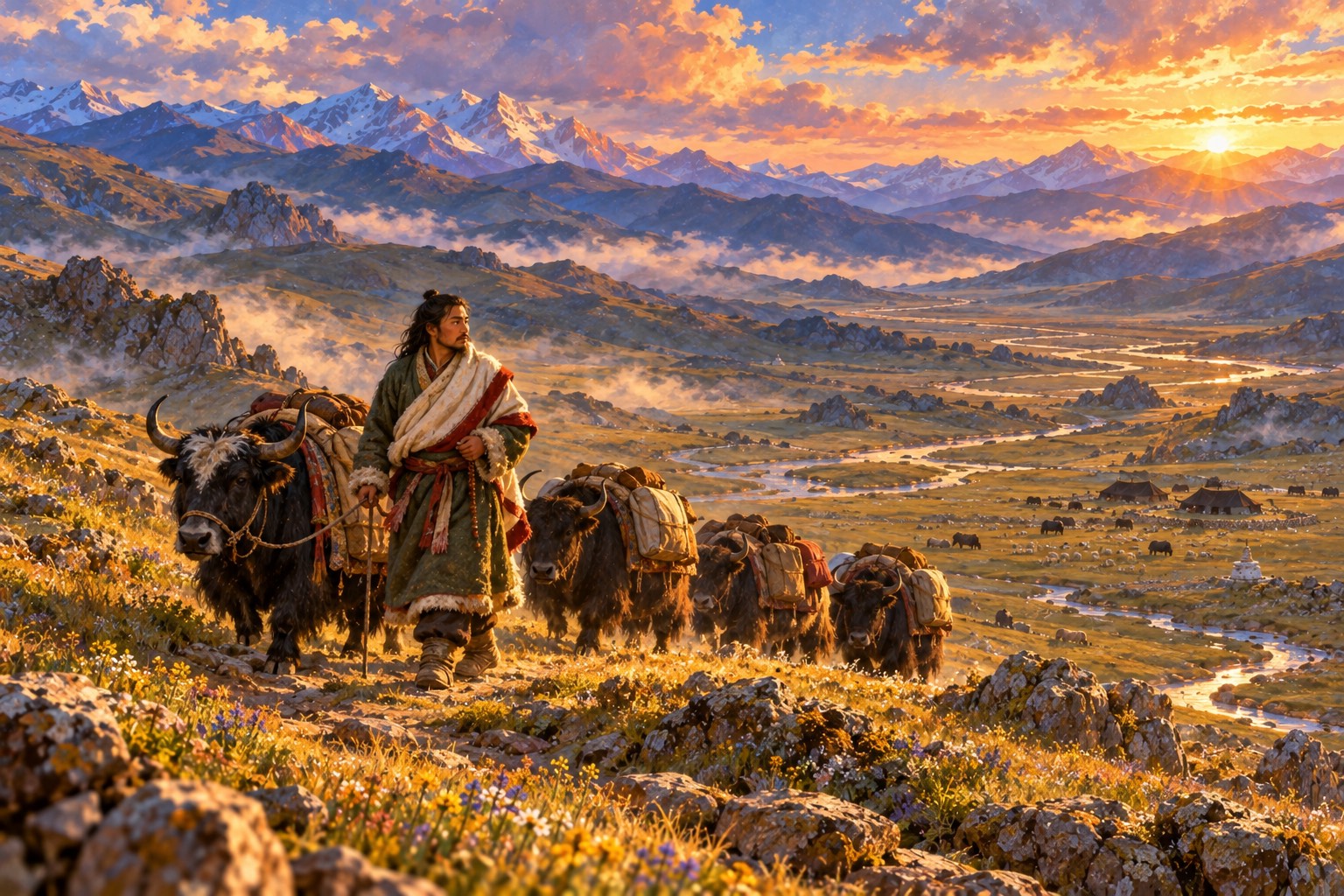
Dudjom Lingpa is drawn from an early twentieth-century painted portrait on Himalayan Art Resources (the same image heads his Lotsawa House page): a strong, broad face with a long thin moustache and small beard, long hair gathered in a topknot, a dark green gown and a broad white shawl. He was a lay yogi, never a monk, so he wears no monastic robes. The white shawl with a dark red border is the site's sign for a lay tantric practitioner. In his formal portraits he holds ritual implements; here he holds only a mala, because this page stays at the level of story.
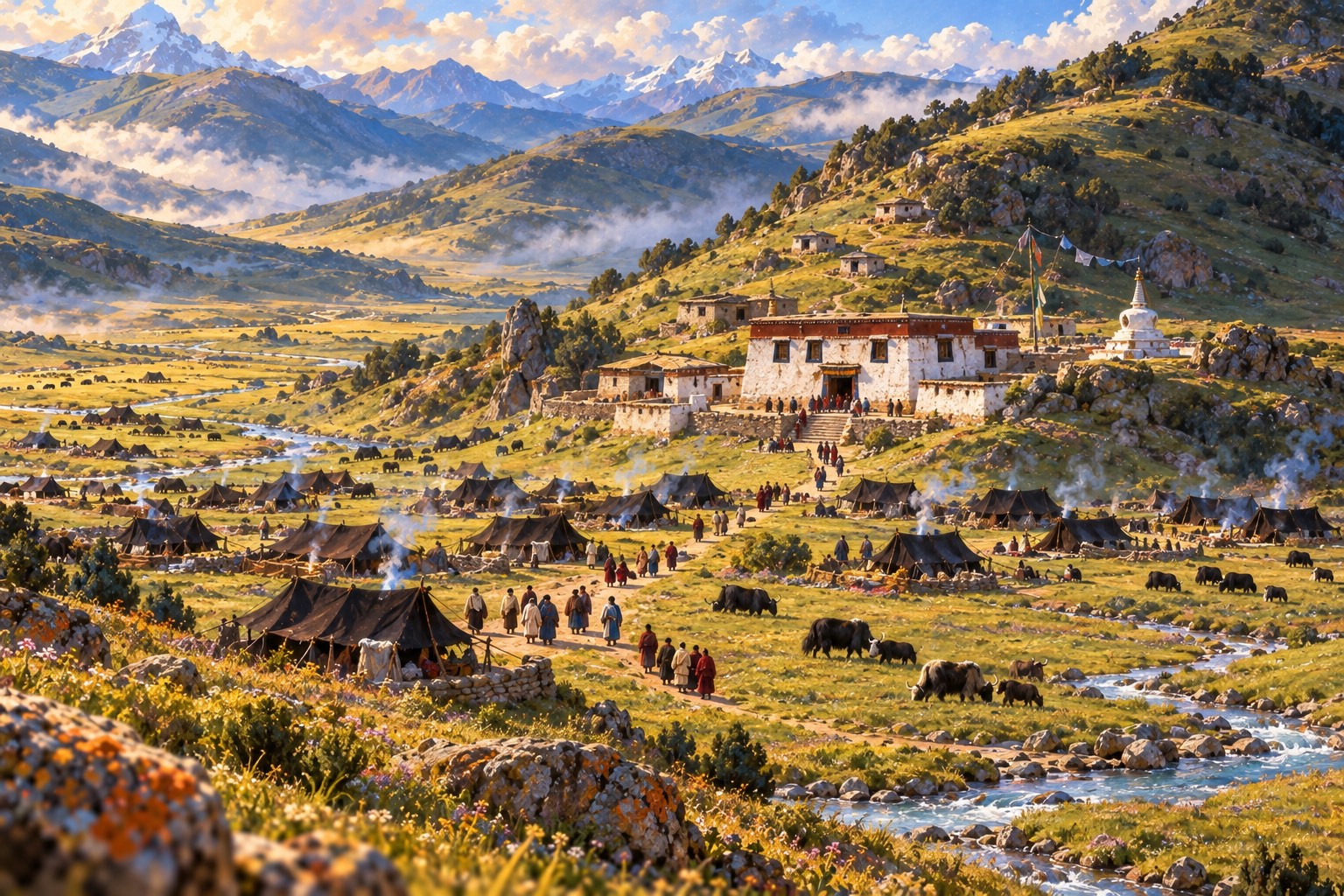
As a child he wears a patched sheepskin coat, the everyday dress of Golok nomads. The tents are woven from black yak hair, the pens are stone and turf, and the Serta and Mar valleys are drawn as high, open grassland. Prayer flags, where they appear, are small, faded and unlettered.
Guru Rinpoche appears once, in his main form: the lotus hat with a half-vajra and a vulture feather, a five-pronged vajra at his heart, a skull cup with a long-life vase in his lap, and the khatvanga staff resting against his left shoulder, seated on a lotus inside a rainbow sphere. Yeshe Tsogyal appears as an awakened dakini in white, blue and gold, and a single dakini in flowing silks appears to the child. Rainbow light is kept for these visions and for the image of the rainbow body.
The rainbow body is shown only as an empty cushion in dawn light, never as a figure dissolving. The caskets, pages and writing board are shown blank: the site never puts script, syllables or mantras into its pictures. Dudjom Rinpoche Jigdral Yeshe Dorje, a recent teacher, is not depicted at all; the closing picture shows only a lamp in a room somewhere far from Tibet.
Why this matters for practice
Dudjom Lingpa's story is one of the clearest pictures in Tibetan tradition of the fifth line of the Seven-Line Prayer: Guru Rinpoche surrounded by dakinis, who in this telling came to a poor nomad child and taught him when no human teacher did. The prayer is how Guru Rinpoche is called, and his life suggests that the call can come from anyone, anywhere, without rank or learning. Reciting the seven lines, even once, joins the many people in many lands who still call on him through this lineage.

If something in this story touched you, the nomad boy taught by visions or the pages carried off on the wind, you might pause tonight and recite the Seven-Line Prayer once, calling on the one Dudjom Lingpa said was never far from him.
Sources and further reading
- Dudjom Lingpa, by Ron Garry (August 2007), Treasury of Lives (Internet Archive snapshot, July 2013)
- Dudjom Lingpa, by Joseph McClellan (peer-reviewed revision), Treasury of Lives (only the page header could be opened)
- Dartsang Kelzang Monastery, Treasury of Lives (Internet Archive snapshot, February 2026)
- Dudjom Lingpa, Rigpa Wiki (Internet Archive snapshot, December 2024)
- Dudjom Tersar, Rigpa Wiki (Internet Archive snapshot, December 2024)
- Thirteen of Dudjom Lingpa's disciples who attained rainbow body, Rigpa Wiki (Internet Archive snapshot, July 2024)
- Dudjom Rinpoche, Rigpa Wiki (Internet Archive snapshot, December 2024)
- Brief Biography of the Great Treasure-Revealer Dudjom Lingpa, by Pema Rigtsal Rinpoche, tr. Laura Swan (2024), Lotsawa House
- Dudjom Lingpa Series, Lotsawa House
- Teacher (Lama): Dudjom Lingpa (1835–1904), item 4706, Himalayan Art Resources
- Dudjom Lingpa, Encyclopedia of Buddhism
- Dudjom Lingpa, Wikipedia
- The Sole Panacea, by Thinley Norbu, Penguin Random House (publisher's page)
- A Clear Mirror: The Visionary Autobiography of a Tibetan Master, by Traktung Dudjom Lingpa, tr. Chönyi Drolma (Rangjung Yeshe, 2011), Book (used only through the excerpts and summaries above)
This retelling is waiting to be read by a knowledgeable practitioner. Where the traditional accounts differ, the story says so; if you notice a mistake, please tell us through Share Your Story.