High on the cliff of Taktsang in Bhutan, at the top of a stone stairway, there is a small room with a white chörten in it, a dome-shaped shrine of the kind built over the remains of holy people. Pilgrims who know the story stop there before they go on to the caves.
It keeps the memory of a man whose name means "Glorious Lion": Langchen Palgyi Sengé, one of Guru Rinpoche's closest Tibetan disciples, and the first of many hermits the tradition remembers in the Tiger's Nest after the Guru himself.
Two lions
There are two disciples called Palgyi Sengé among the twenty-five. Rigpa Wiki's list, which follows Dudjom Rinpoche's history, and the list on Himalayan Art Resources both name a Shüpu Palgyi Sengé as well as this one. They are not the same man, and the old paintings do not always say which is which.
Ours carries the name of his family, the Lang clan. He is called Lang, or Langchen, Palgyi Sengé.
A family that tamed spirits
The Treasury of Lives, an online encyclopedia of Himalayan masters, gives his family in a few lines. His father was Ame Changchub Drekhol, himself a disciple of Guru Rinpoche, who took part in the taming of Tibet's local gods. His mother was Jomo Kaldenma.
That taming runs through the whole family story. When the first great temple was rising at Samye, the accounts say, the spirits of the land resisted, and Guru Rinpoche bound them by oath to protect the teachings instead. Palgyi Sengé was born into a household that had a part in that work.
 Illustration in preparation
The Lang were an old family, and they lasted. Centuries later a branch of the Lang governed the estate of Phagmodru in central Tibet, and in 1354 one of them, Tai Situ Changchub Gyaltsen, became ruler of much of the country. Histories of his rule describe the Lang as a noble house whose line reached back to ancient times. Palgyi Sengé belongs to the early chapters of that same clan.
A translator for the king
King Trisong Detsen, who invited Guru Rinpoche to Tibet and built Samye, needed Tibetans who could carry the teachings across languages. According to the Treasury of Lives, he sent Palgyi Sengé to India to serve as a translator. Rigpa Wiki counts him among the hundred and eight translators sent to India and to Oddiyana, Guru Rinpoche's homeland.
Illustration in preparationIt is hard now to picture what that asked of a young man: months of walking over the high passes, a new language learned in the hot plains, and bundles of palm-leaf pages carried home wrapped in cloth. The king's temple at Samye became the place where that work was gathered, where Sanskrit slowly became Tibetan.
Illustration in preparationWhere the flower fell
Later, the Treasury of Lives goes on, Guru Rinpoche gave him an empowerment, a ceremony that introduces a student to a meditation practice. A flower was cast, and where it landed showed the practice meant for him. His fell on Jikten Chötö, "Worldly Offering and Praise."
Jikten Chötö is counted among the eight great practices Guru Rinpoche taught in Tibet, and it concerns the proud and powerful spirits of the world. Its details belong between a teacher and a student, and this page leaves them there.
Illustration in preparationRigpa Wiki calls him a lay tantrika, a ngakpa: not a monk but a householder-yogi, with long hair and a family. The Treasury of Lives says he had three sons and passed his teachings on through them.
The cave in the cliff
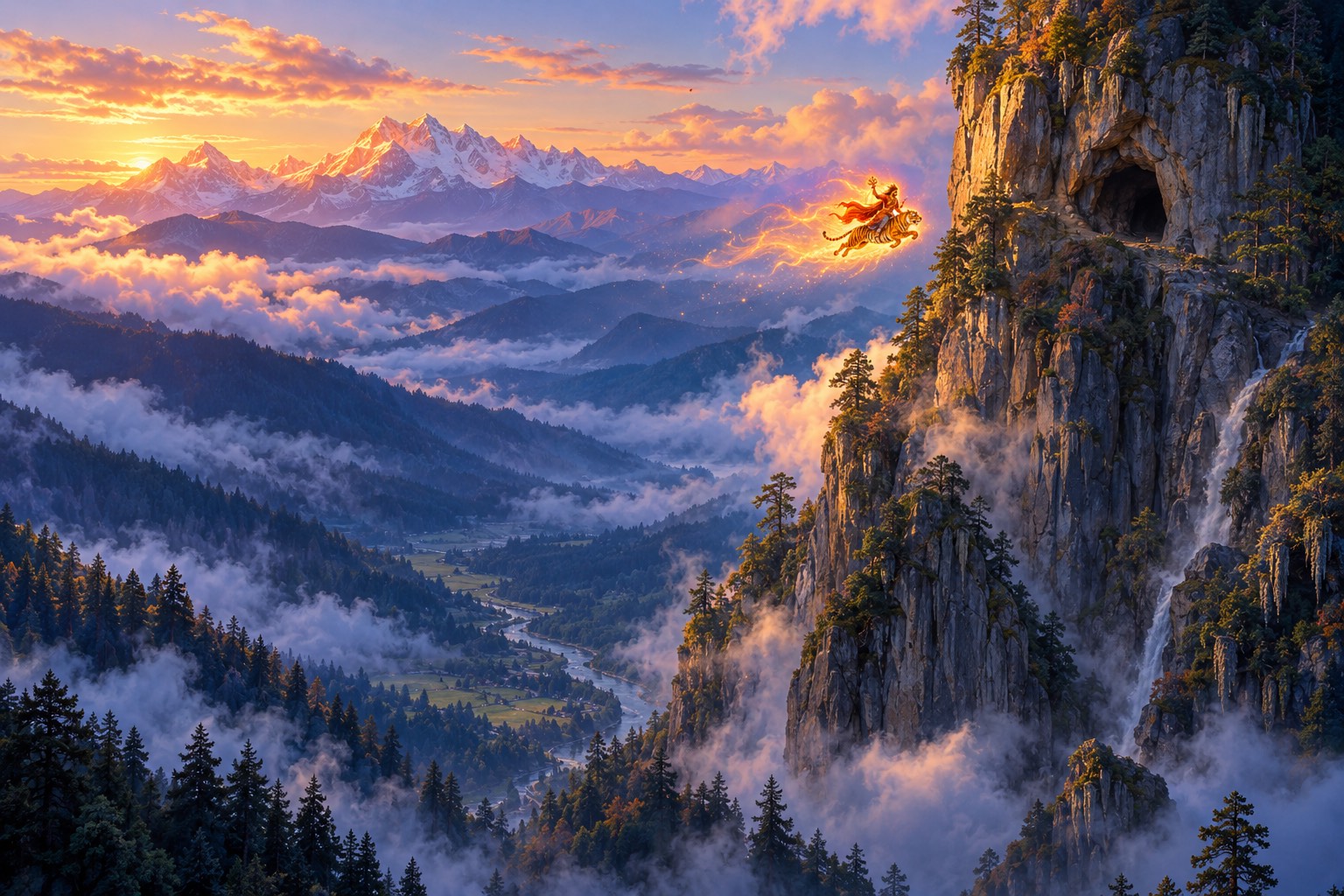
South of Tibet, in the green hill country Tibetans called Mon, rose the cliff of Taktsang. The traditional accounts say Guru Rinpoche had come there as Dorje Drolö, the "Wild Wrathful Vajra," riding a tigress, and bound the cliff's harmful spirits by oath. That story is told on its own page, "The Tiger's Nest."
Illustration in preparationBhutan's Paro district gives the next chapter. After Guru Rinpoche left, its account says, his spiritual son Langchen Palgyi Sengé came to the same cave and meditated there.
Bhutanese tellings tie the cliff closely to Vajrakilaya, a fierce protective deity. The same Paro account says Guru Rinpoche gave that practice there to Yeshe Tsogyal and to Tashi Kheudron of Mon, and ritual daggers are still kept in the cave. Palgyi Sengé is remembered in that company. The written lives used for this page, though, name his own practice as Jikten Chötö, and it is kind to say so.
Illustration in preparationIn the cave, the Treasury of Lives says, he had a vision of Drekpa Kundul, "Tamer of All the Arrogant Ones," the chief figure of the Jikten Chötö practice. He went on to gain both the ordinary and the supreme accomplishments. In this tradition the ordinary ones are worldly powers; the supreme one is awakening itself.
Illustration in preparationA prayer to the king and the twenty-five by the sixteenth-century master Changdak Tashi Tobgyal places him in a cave at Paro Taktsang called "Fulfilment of Wishes." It calls on him as the Palgyi Sengé "who enslaves gods and demons" (translated by Samye Translations). The Treasury of Lives says the eight classes of spirits came to serve him.
That is a hard word to modern ears. In the tradition's way of seeing, it means something gentler than it sounds: forces that once did harm, now turned to the service of the teachings and the people of the valley. It is the same work Dorje Drolö did on that cliff, carried on by a disciple.
Illustration in preparationA name in the rock
Wikipedia's article on Taktsang, drawing on Bhutanese sources, says he came to the cave in 853 and gave it his name: Pelphuk, "Pelkyi's cave," Pelkyi being another spelling of Palgyi. The whole monastery is still called Taktsang Pelphuk.
That date sits oddly with the rest of his life, since it falls some seventy years after Guru Rinpoche's time in Tibet. Old dates in these stories are soft, and the tradition holds both: a disciple of the Guru, and a hermit remembered at the cave long after.
Himalayan Art Resources gives Guru Rinpoche's own cave the name Sengé Samdrup, and the Paro account gives that name to the cliff's guardian deity. Readers may notice the word sengé, "lion," in it. The sources do not say whether it has anything to do with Palgyi Sengé, and neither will we.
The journey home
Late in his life, the Paro account says, he went back to Nepal and died there in meditation. His body was brought back to Taktsang, and a chörten was built over it. Wikipedia adds that the body was returned by the grace of a guardian deity, Dorje Lekpa.
The Paro account tells one more thing. The chörten was left without relics inside, it says, because on auspicious days the body was believed to rise into the empty space. People hold that a wish made beside it on those days does not go unfulfilled.
The chörten stands in a room to the left at the top of the entrance stairway. Himalayan Art Resources lists it among the shrines of the complex, and it was restored in 1982–83 and again in 2004.
Illustration in preparationThose who came after
After him, the Paro account goes on, others came. Milarepa, the poet-yogi, stayed three years. In 1219 Phajo Drugom Zhigpo arrived and stayed six, and in a vision, it says, Guru Rinpoche offered him all the sacred places he had blessed in the land. Phajo went on to plant the Drukpa school in Bhutan.
Wikipedia lists the Tiger's Nest, under the name Taktsang Sengye Samdrup Dzong, among twelve places of practice entrusted to Phajo. So the cave passed from hand to hand: Guru Rinpoche, his disciple, and the hermits of later centuries, each sitting where the last had sat.
Illustration in preparationPalgyi Sengé's line went on in another way too. The Treasury of Lives counts among his later rebirths Dzogchen Drubwang Pema Rigdzin (1625–1692), whose hermitage became Dzogchen Monastery in eastern Tibet. His story is told on this site.
The lion and the lamp
The temples on the cliff today date from 1692 and after, and pilgrims climb to them for hours through the pines. Most come for Guru Rinpoche's cave. Some stop first at the small white chörten, to greet the Glorious Lion who made the cliff his home.
The seventh line of the Seven-Line Prayer asks Guru Rinpoche to come and grant his blessings. Palgyi Sengé's life is one picture of how such a blessing can travel: into a family, a language, a cave, and down the centuries to whoever climbs the stair.
Illustration in preparationAbout the art
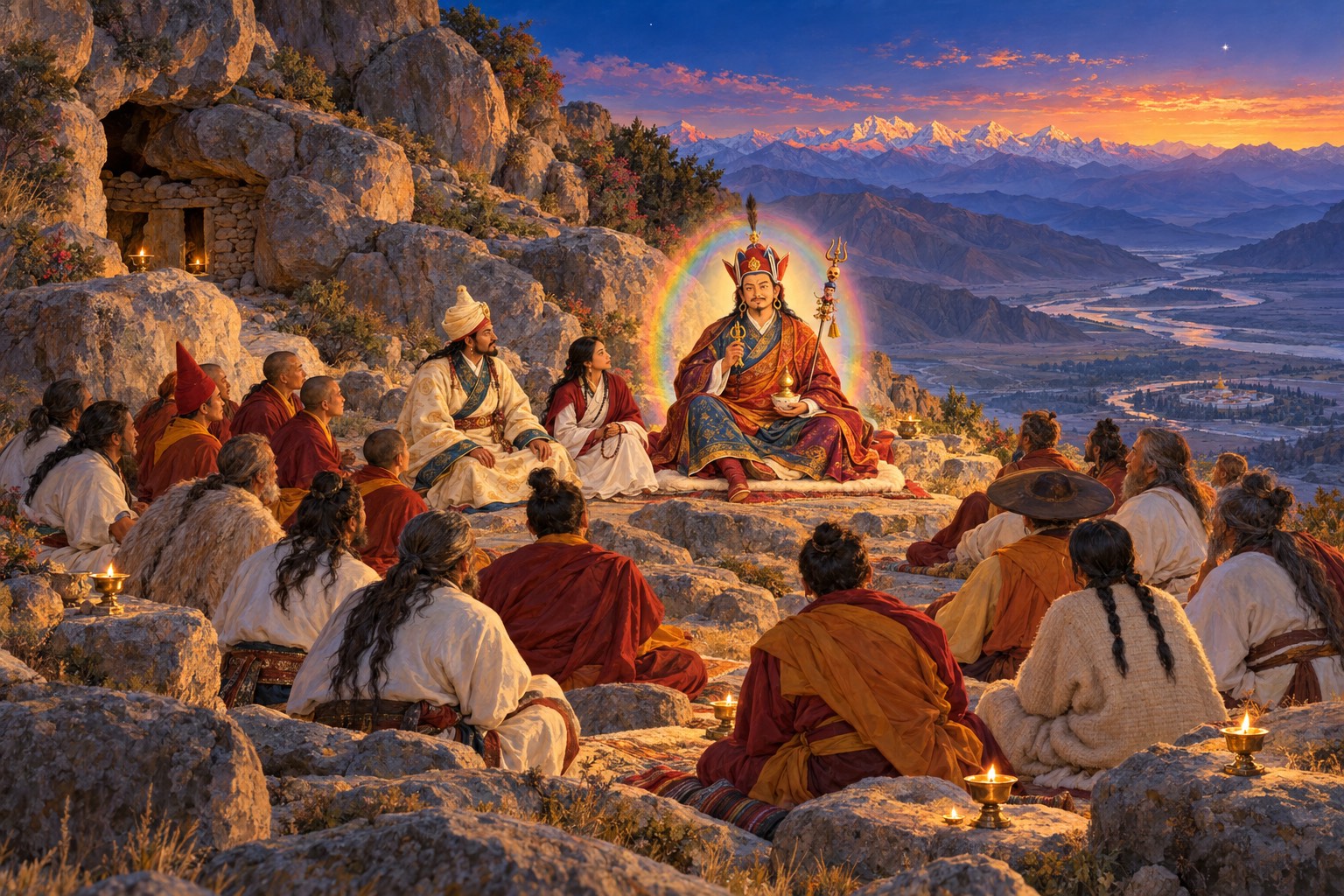
Palgyi Sengé is painted as a lay yogi, not a monk, following a nineteenth-century initiation card in the Shechen archives that the Treasury of Lives uses for his biography and Himalayan Art Resources catalogues: curling hair and beard, a fierce and steady gaze, and layered robes of cream, salmon-red, yellow and blue-green. On the card he holds out a small golden implement toward a crowd of spirits on clouds; we left the implement out and showed the spirits only as faceless shapes of mist, because the page stays with the story rather than the practice. As a young man of the Lang family he wears eighth-century Tibetan dress in plain colours, since no portrait of his youth exists.
Guru Rinpoche appears twice. At Chimphu he is in his main form, with the lotus hat crowned by a half-vajra and a single vulture feather, a five-pronged vajra at his heart and the khatvanga staff in the crook of his left arm. Above the cliff he appears faintly as Dorje Drolö, the deep maroon-red wrathful form who rides a tigress amid flames of wisdom, painted as a memory in the storm cloud. The empowerment is shown only as a single flower falling toward a plain red cloth; no mandala is drawn.
The Taktsang cliff is painted as it would have looked before 1692, with no buildings, steps or flags. The chörten room and the final view show the temples as they have stood since then. Prayer flags are left out everywhere, because they carry printed text, and no image contains writing of any kind.
Why this matters for practice
The seventh line of the Seven-Line Prayer asks Guru Rinpoche to come and grant his blessings. Palgyi Sengé's life shows one way the tradition sees such a blessing at work: received from a teacher, carried into a family and a language, and kept alive in a cave for later hermits to find. Reciting the prayer is a small way of asking for that same blessing tonight.
If something in this story moved you, the young translator on the road or the hermit in the cliff, you might pause and recite the prayer once, wherever you are tonight. Anything beyond recitation is best explored with a teacher.
Sources and further reading
- Lang Pelgyi Sengge (Arthur Mandelbaum, 2007), The Treasury of Lives (archived snapshot, 2015)
- Langchen Palgyi Sengé, Rigpa Wiki (archived snapshot)
- Twenty-five disciples of Guru Rinpoche, Rigpa Wiki (archived snapshot)
- Padmasambhava: Twenty-five Disciples Page, Himalayan Art Resources (archived snapshot)
- Bhutan: Taktsang (A. Maki Archive), Himalayan Art Resources (archived snapshot)
- Taktshang (Tiger Nest) Monastery, Paro Dzongkhag Administration (archived snapshot)
- Paro Taktsang, Wikipedia
- Prayer to the King and Twenty-Five Disciples, by Changdak Tashi Tobgyal (Samye Translations, 2016), Lotsawa House
- The Heart of Blessings, by Jamyang Khyentse Wangpo, Lotsawa House
- Tai Situ Changchub Gyaltsen, Wikipedia
- Phagmodrupa dynasty, Wikipedia
- Phajo Drugom Zhigpo, Wikipedia
This retelling is waiting to be read by a knowledgeable practitioner. Where the traditional accounts differ, the story says so; if you notice a mistake, please tell us through Share Your Story.