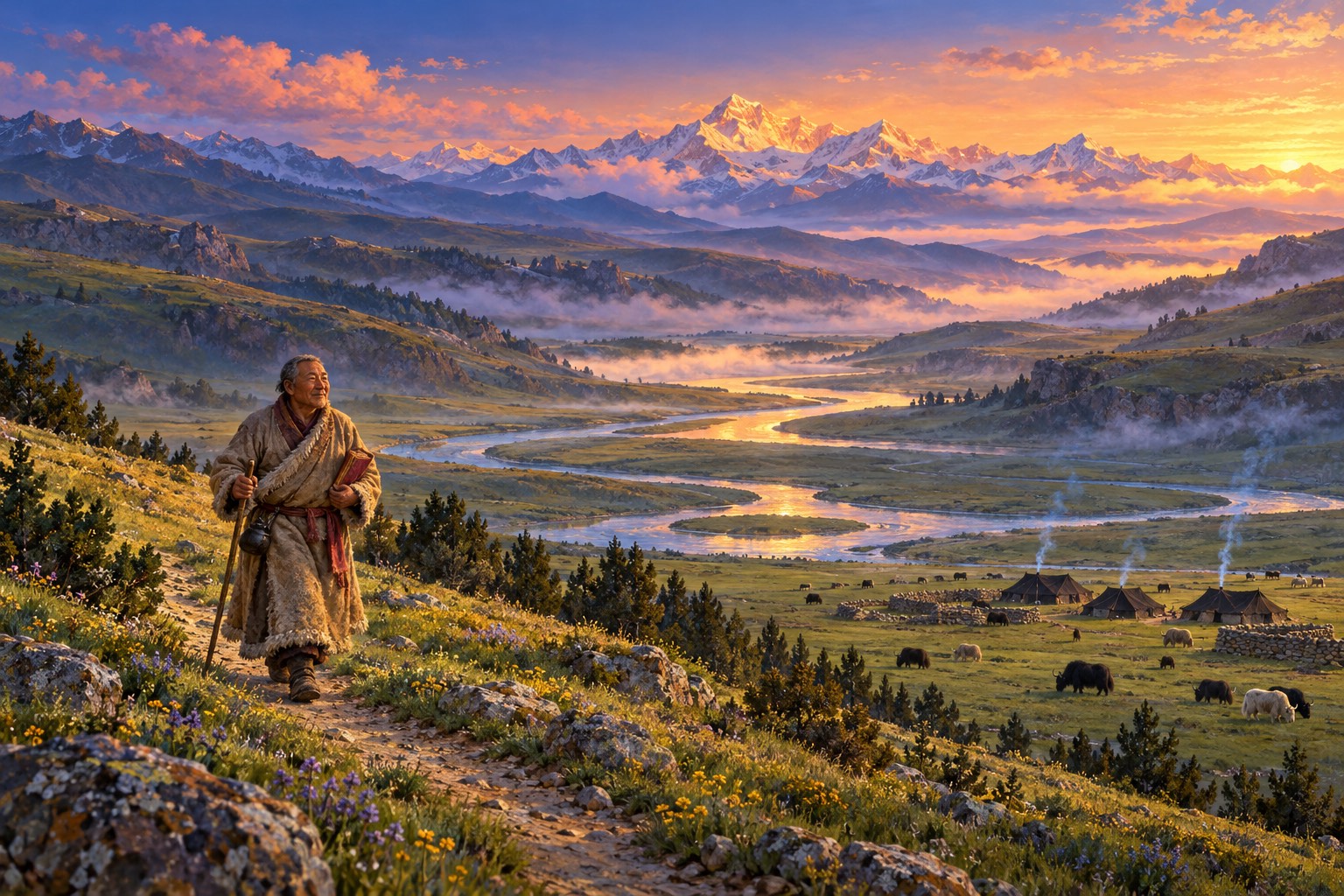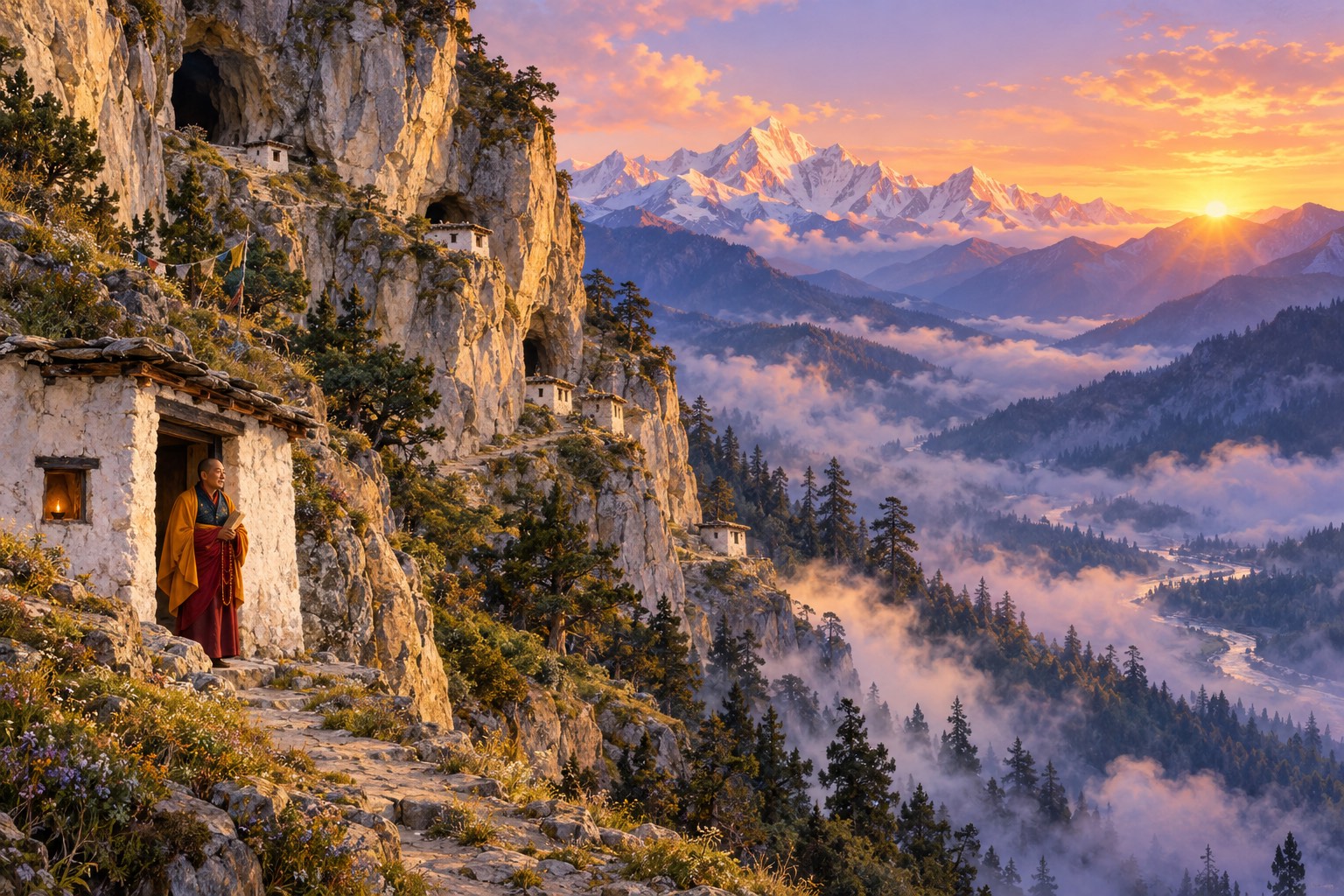
High in Kham, in the far east of Tibet, a long valley runs up toward a wall of glaciers. It is called Rudam. In it stands Dzogchen Monastery, one of the six great "mother monasteries" of the Nyingma, the oldest school of Tibetan Buddhism and the school of the Seven-Line Prayer to Guru Rinpoche.
Dzogchen means "Great Perfection." It is the Nyingma name for the heart of its teaching: recognizing the true nature of one's own mind. That teaching passes from a teacher to a student, and this story only tells where it took root.
The monastery began as a small hermitage built by a lama named Pema Rigdzin. He is remembered as the First Dzogchen Rinpoche. This is his story, and the story of his valley.
A craftsman's son
Pema Rigdzin was born in 1625 near Riwoche, in Kham. The Treasury of Lives, an online encyclopedia of Tibetan lives, says his father was an artisan from Nepal and his mother was Tibetan.
His father found work at Chamdo Jampa Ling, one of the largest monasteries of the Geluk school in Kham. So the boy was able to learn to read and write there.
 Illustration in preparation
When he was about ten he met Karma Chakmé, a great master of the Karma Kagyu school who also held Nyingma teachings. Karma Chakmé became one of his main teachers, and the same account says the boy spent as long as seven years practising what he was given. Karma Chakmé also appears in Story 47, "Kunzang Sherab and the Founding of Palyul."
Illustration in preparationThe man of the Great Perfection
As a young man he travelled to central Tibet. There he met treasure revealers, teachers who are said to find teachings hidden long ago by Guru Rinpoche. One of them was Rigdzin Düddul Dorje (1615–1672), who gave him more of the Dzogchen teachings. People began to call him "the Dzogchenpa from Kham."
Rigpa Wiki tells how the name stuck. One of his teachers, Bakha Tulku Rigdzin Chökyi Gyatso, is said to have told him that he had heard of the Great Perfection as a teaching, but had "never seen Dzogpachenpo as a person except in you." From then on, Rigpa Wiki says, he was known as Dzogchen Pema Rigdzin.
Illustration in preparationTeacher of the Great Fifth
In 1663 he went to central Tibet again and gave teachings to the Fifth Dalai Lama, Ngawang Lobzang Gyatso (1617–1682), who was then at the height of his power. The Fifth led the Geluk school and ruled Tibet, yet he was a great friend of the Nyingma.
Rigpa Wiki adds that Pema Rigdzin took his monastic vows from the Fifth Dalai Lama, and that this bound the Dzogchen Rinpoches and the Dalai Lamas closely together. The sources I read do not say when it happened.
Illustration in preparationOn that journey he visited the great centres of learning and practice and exchanged teachings with other masters, among them Terdak Lingpa, the founder of Mindrolling (Story 40).
Not everything was easy. A gifted young disciple, the treasure revealer Nyima Drakpa, travelled with him. The Treasury of Lives says the young man grew proud on the offerings he gathered. Pema Rigdzin went on supporting him, but had to correct him many times.
After three years of retreat at Tsari, a sacred mountain in south-eastern Tibet, Pema Rigdzin parted from Nyima Drakpa and went home to Kham. There a young man named Namkha Ösel became his disciple. He would be remembered as the First Dzogchen Pönlop, and he would hold the seat after his teacher.
In the 1670s Pema Rigdzin went back to central Tibet once more. By now even the great Geluk monasteries of Drepung and Sera asked for his teaching. While he was in retreat at Yerpa, a place of cliff caves near Lhasa, he met a young scholar named Tenpai Gyaltsen (1650–1704), who became his disciple. Tenpai Gyaltsen is remembered as the First Shechen Rabjam, the first of a line of lamas linked with Shechen, another of the mother monasteries.
Illustration in preparationA prophecy and a valley
Then came the meeting that gave Rudam its monastery. The Treasury of Lives tells that the Fifth Dalai Lama gave Pema Rigdzin a prophecy from one of his own revelations. It foretold a great centre of study and practice in a valley called Rudam. Karma Chakmé, his first teacher, also urged him to settle in the Derge region of Kham.
Illustration in preparationSo he went east. The Treasury of Lives dates his hermitage, Orgyen Samten Ling, in the Rudam Kyitram valley, to 1684. Its page on the monastery says 1685, and Rigpa Wiki says 1684–85. Rigpa Wiki also notes that a great Tibetan dictionary gives 1675, while the nineteenth-century master Jamyang Khyentse Wangpo gave 1684. The years differ, but the valley is the same.
The Fifth Dalai Lama had died in 1682, so his charge came some years before the first walls went up. The Treasury of Lives still names him among the patrons, with the ruling house of Derge and the local clan leaders. Its pages name the Derge patron in different ways: as the king Sanggye Tenpa, as Sanggye Tenpa the abbot of Derge's royal monastery, or as the king Ngawang Tashi.
Illustration in preparationHis disciples helped him build: Namkha Ösel, Tenpai Gyaltsen, and Nyima Drakpa too. Pema Rigdzin had to scold Nyima Drakpa again, this time for revealing treasures of the Bön religion in the valley. Even so, he offered him the leadership of the new monastery. Nyima Drakpa declined.
Lotsawa House keeps a short prayer by Pema Rigdzin, translated by Adam Pearcey. It calls on the masters of the Great Perfection one by one, with Guru Rinpoche among them. Its closing note says it was written "in the snowy wastes of Rudam."
Illustration in preparationPema Rigdzin passed away in 1697. Rigpa Wiki gives his age as seventy-three. Namkha Ösel took his seat. A line of rebirths followed Pema Rigdzin, the Dzogchen Rinpoches, and the Treasury of Lives says each of them added temples, hermitages and colleges, with branch monasteries spreading across Kham.
A great centre
About a century later, Jigme Lingpa, the master of the Longchen Nyingtik (Story 10), wrote a prayer to the Dzogchen Rinpoches and their earlier lives. Pema Rigdzin is named in it.
In 1842 an earthquake almost destroyed the monastery. Soon after, in 1848, the scholar Gyalse Shenpen Thaye founded a college there. It bears the name of Shri Singha, an early Indian master of the Great Perfection. Rigpa Wiki says it produced many of the finest scholars in Tibet.
The Treasury of Lives lists Patrul Rinpoche as its fifth khenpo, or head teacher. Patrul taught The Way of the Bodhisattva near Shri Singha year after year. In the Yamantaka cave, one of the hermitages above the monastery, he wrote down The Words of My Perfect Teacher. That is told in Story 11, "Patrul Rinpoche, the Wandering Teacher."
Illustration in preparationRigpa Wiki names Jamgön Mipham among those who studied or taught at Shri Singha. In 1901 Mipham finished his commentary on the Seven-Line Prayer, the White Lotus, in a small room there. He died in 1912 at his hermitage at Ju, north of the monastery. His story is Story 12, "Mipham and the White Lotus."
Illustration in preparationUnder the Fifth Dzogchen Rinpoche (1872–1935), Rigpa Wiki says, the monastery reached its height, with up to five hundred monks, thirteen retreat centres and some two hundred and eighty branches. It was famous, too, for its sacred dances.
Fire, and lamps lit again
The main temple burned in 1936 and was rebuilt. In the late 1950s the whole monastery was destroyed. It has since been rebuilt in the Rudam valley. A new Dzogchen Monastery was also begun in South India in 1985, three hundred years after the first, and opened in 1992. Rigpa Wiki says it is the seat of the Seventh Dzogchen Rinpoche.
Illustration in preparationThe glaciers still shine above the valley. The hermitages on its slopes still look down on the place where a craftsman's son once built a few small houses at the edge of the forest.
Illustration in preparationAbout the art
Pema Rigdzin is drawn after the painted portrait on his Lotsawa House page, since no older painting of him could be found on Himalayan Art Resources. He wears a tall orange-red pointed hat with gold trim and a saffron-orange shawl over a red robe. In his portrait form his right hand makes the teaching gesture, thumb and forefinger touching, and holds the stem of a white lotus, and his left hand holds a small golden vase. In his youth he is drawn bareheaded in plain robes, because no portrait shows him young.
The Fifth Dalai Lama appears in the yellow hat and golden-orange robes of his seventeenth-century portraits. Karma Chakmé wears his red pointed cap, as in Story 47. Patrul Rinpoche wears the worn sheepskin coat of a wandering teacher, and Mipham his blue-green vest and saffron shawl, as in Stories 11 and 12. The white silk scarf in scene 7 is a khata, offered in greeting and respect.
Guru Rinpoche appears once, as a devotional image and not as an event in the story, in his main form: the lotus hat with the half-vajra and one vulture feather, the five-pronged vajra at his heart, the skull cup holding a long-life vase, and the khatvanga staff in the crook of his arm, inside a sphere of rainbow light. The 1680s buildings are a modest reconstruction, since no description of them survives in the sources used. Books are shown blank. No twentieth-century or living teacher is pictured.
Why this matters for practice
Pema Rigdzin spent his life following his teachers and then made a place in a remote valley where others could follow too, which is what the sixth line of the prayer asks: to follow in Guru Rinpoche's footsteps. His own short prayer from Rudam calls on Guru Rinpoche, and for three centuries the monastery he began has been a home of the Great Perfection. Its deeper teachings belong with a teacher, but the seven lines are open to anyone, and one recitation joins the same current.
If something in this story moved you, perhaps the boy who came to be called simply "the Great Perfection," or a prayer written in the snows, you might pause and recite the prayer once. Your voice would join the voices that have said it in the valley of Rudam for more than three hundred years.
Sources and further reading
- Treasury of Lives: Nyingma Founders Part 5, Dzogchen (Alexander Gardner), Tricycle: The Buddhist Review
- Dzogchen Monastery; Śrī Siṃha College; The First Dzogchen Drubwang, Pema Rigdzin, The Treasury of Lives (via web.archive.org)
- Dzogchen Pema Rigdzin; Dzogchen Monastery; Shri Singha Shedra; Dzogchen Rinpoche Incarnation Line; Patrul Rinpoche; Mipham Rinpoche; Six "Mother" Nyingma Monasteries, Rigpa Wiki (via web.archive.org)
- Dzogchen Pema Rigdzin (author page and portrait); A Dzogchen prayer by Pema Rigdzin, trans. Adam Pearcey; Prayer to the Garland of Rebirths of the Dzogchenpas of Eastern Tibet by Jigme Lingpa, trans. Adam Pearcey, Lotsawa House
- Tradition: Dzogchen (Nyingma), Himalayan Art Resources
This retelling is waiting to be read by a knowledgeable practitioner. Where the traditional accounts differ, the story says so; if you notice a mistake, please tell us through Share Your Story.