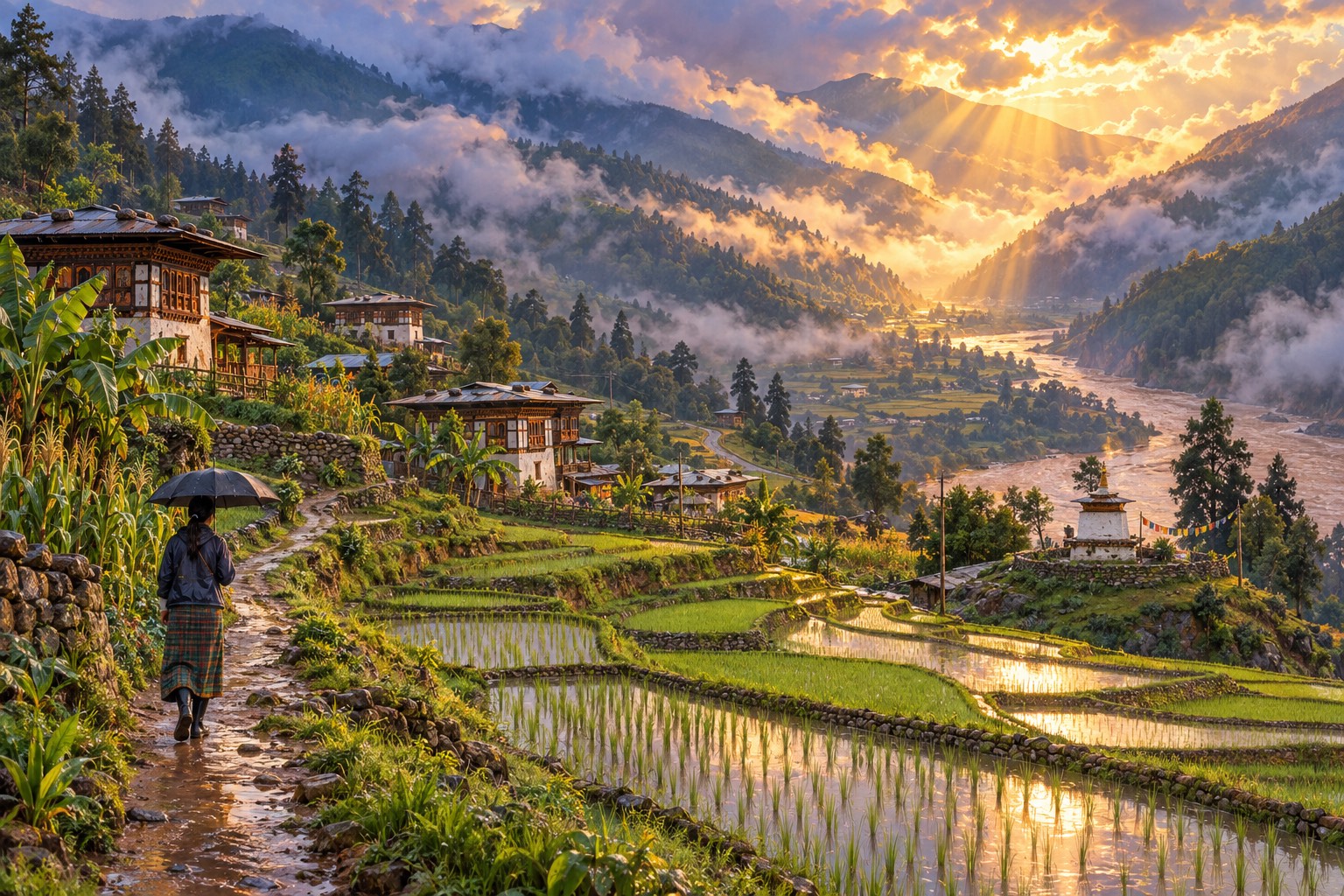
This is an original story, written for this site. It is fiction, not a teaching or a traditional account. Every person and house in it is invented.
The pond
Savitri Negi had lived in the same bungalow in Clement Town, at the southern edge of Dehradun in north India, for thirty-one years. Behind the house is a garden of mango and litchi trees, and at the far end, by the back wall, a small brick-lined pond that her husband dug the year he retired.
Harish had spent his working life making maps for the government. He planted one lotus root in the pond, a gift from a colleague, and for fifteen summers it was full of round leaves and pink flowers. He called them kamal, the Hindi word for lotus, and talked to them in the evenings. She pretended not to hear.
He was ill for his last two years, and the pond was the first thing to go. He died in November. By February it was a rectangle of black mud and dead stalks under a skin of rainwater the colour of tea.
Harish's black rubber boots still stood inside the kitchen door. On the windowsill was the last seed head from the pond, dry and brown, shaped like the rose of a watering can. She dusted round both.
 Illustration in preparation
Their daughter Neha, phoning from Pune on Sundays, said gently that the pond could be filled in. Savitri said she would think about it.
The man in the lane
Each morning Savitri took her tea on the back step, and each morning, a little after six, Tsewang-ji walked down the lane behind the wall. (-ji is the small Hindi word added to a name for respect.) He was a tall, thin Tibetan man of about seventy-five from the Tibetan colony two lanes over. He had come to India as a boy and sold woollen sweaters in the winter markets of the plains for forty years.
He walked with his hands behind his back, murmuring the same low run of words. She had heard it for years and never asked what it was. She had once taught his granddaughter biology, and that, and the weather, was most of what they had ever talked about.
Mud
In the first week of March the mornings began to warm. Savitri had taught biology at a girls' school for thirty-four years, and she knew what warmth meant. If anything was alive down in that mud, it would wake when the water warmed. The plant books put the line at about thirteen degrees.
So she put on Harish's boots, two sizes too big, stuffed the toes with newspaper, and started bailing. It took four mornings with a bucket. The mud smelt of old leaves and iron. Her back complained, and she let it.
On the fifth morning, working with her hands near the bottom, she found them. Pale segments of root, swollen in the middle and joined end to end like a string of small fat bananas, cold and firm. At the end of the longest was a pointed bud, faintly pink. Alive.
Illustration in preparationShe sat down on the brick rim in the mud and stayed there for some time.
Almost the first thing
That was when Tsewang-ji stopped at the wall. He looked at the bucket, at the boots, and at what she was holding.
"Kamal," she said, and held it up. "Harish's. Still alive."
He nodded slowly. "In Tibetan we say pema." He was quiet for a moment. "The prayer I say in the mornings. Almost the first thing in it is a lotus."
Illustration in preparationShe asked him what prayer. He said it was called the Seven-Line Prayer, and it was said to Guru Rinpoche, the teacher Tibetans remember for bringing Buddhism to their country in the eighth century. Its first line names the land he came from, far to the north-west. The second places him in the heart of a lotus.
The old stories, he said, tell of a child found sitting on a lotus in a lake, and so one of his names, Pema Jungne, means born from a lotus. "We say a lotus grows out of mud, and the mud does not stay on it." He looked at her boots and smiled. Then he said good morning and walked on, murmuring, and he did not bring it up again.
Clay, water, sun
She did it the way the gardening books said, and the way she remembered Harish doing it. She cut away the rotten pieces and kept the three best lengths, each with a growing bud. She laid them in wide tubs of heavy garden clay, buds angled up and left uncovered so they would not rot. Then she filled the pond only a hand's depth, so the sun could warm it.
For eleven days nothing happened.
On the twelfth there was a leaf on the water. It had come up rolled tight like a scroll and opened flat, no bigger than a coin. By the end of March there were nine. In April they grew wider, and then the first leaf rose clear of the water on its own stalk, a round, waxy shield tipped toward the sun.
Illustration in preparationEach morning she topped up the water and pulled off the yellow leaves. When aphids came she hosed them off, as she had shown a thousand girls in the school garden. She pressed a little fertiliser into the clay, well away from the roots. None of it was mysterious. It was mud, sun, water and waiting.
Evenings
The evenings were harder than the mornings. In the mornings there was the pond. In the evenings there was the chair on the verandah that nobody sat in, and the phone, and Neha's careful voice asking if she was eating.
Illustration in preparation"So you're keeping it, Papa's pond?" Neha asked one evening in April. Savitri said she did not know yet. She did not know whether she was keeping a pond or keeping some part of him, and she was not ready to find out which.
Water on the leaves
One morning she tipped the watering can over a dusty leaf and watched the water gather into silver beads and roll off, taking the dust with it. She had shown this to her classes every year. The leaf is covered in tiny bumps of wax, too small to see, she used to tell them, so water cannot hold on, and the leaf washes itself. Scientists call it the lotus effect.
Illustration in preparationWhen Tsewang-ji passed, she called him over to the wall and did it again. "It's the wax," she said. He watched the beads run off. "Maybe both," he said, and walked on.
The storm
In May the heat came, close to forty degrees in the afternoons. One night a storm blew up the valley ahead of the rains, all wind and dust and a few hard drops. Savitri stood at the back door with a torch and watched the tall leaves thrash. There was nothing she could do, so she did nothing.
Illustration in preparationIn the morning two leaves were torn and lay on the water like broken umbrellas. Among the others, standing a little above them on a stalk she had not noticed, was a bud.
Illustration in preparationIt was the shape of a closed paintbrush dipped in pink at the tip. She came out earlier with her tea. If Tsewang-ji noticed it, he did not say so, but he walked past more slowly.
Waiting
The late May afternoons were long and white with heat. She sat under the mango tree, where the fruit was ripening, and watched the bud. People had told her grief comes in waves. For her it came more like weather. Some days she talked to Harish out loud, the way he had talked to his kamal, and some days she did not.
Illustration in preparationThe first morning
It opened in the second week of June, a few days before the rains were due. At six it was a loose cup of pale pink, the petals parted just enough to show the flat yellow seed pod at its centre, ringed with stamens. She touched a petal and found it faintly warm. Botanists have measured it: the flower warms itself.
Illustration in preparationWhen Tsewang-ji came down the lane she was waiting at the wall. "Come and see," she said, and opened the back gate for him, which in thirty-one years she had never done.
They stood at the edge of the pond. He said nothing for a long time. Then, under his breath and at the same pace as every morning, he said his prayer, and she listened. She did not join in. She did not know the words, and he did not offer them.
When he had finished he put his palms together briefly, toward the flower or toward her or toward neither, she could not tell. Then he went back out through the gate.
Illustration in preparationThe flower would last about three days, the books said, opening each morning and closing at night. Then the petals would fall and leave a seed head like the one on the windowsill. She knew all that. She sat on the brick rim in her husband's boots and watched it anyway. When the sun was high she went in and phoned Neha, and told her the pond was staying.
About the art
This is an original story, written for this site; it is fiction, not a teaching or a traditional account, so its pictures show invented people in an invented house. Following the site's rule for present-day figures, Savitri and Tsewang-ji are painted as gentle storybook figures, never as likenesses: from behind, at a distance, as hands, or once each in soft profile. Harish and Neha are never shown. Guru Rinpoche does not appear anywhere on the page, and nothing shown is a vision; the lotus grows because of mud, sun and water, and the light on it is ordinary morning light.
The flower on every page is the sacred lotus, Nelumbo nucifera, not a water lily. You can tell it by its leaves: perfectly round with no notch, waxy and blue-green, and many of them held high above the water on their own stalks. The pictures follow it through its stages: the swollen, segmented root with its pink growing bud, small floating first leaves, raised leaves that shed water in beads, a long pointed bud, and the cup-shaped flower with a flat seed pod at its centre. The dry seed head on the kitchen windowsill is what that pod becomes.
The house and its garden are invented, but drawn to fit Clement Town at the southern edge of Dehradun, in the Doon Valley: a whitewashed bungalow with a red-oxide verandah, mango and litchi trees, bougainvillea, and the hazy ridge of the Mussoorie hills to the north. Tsewang-ji wears the everyday clothes of an elderly man in the town rather than Tibetan dress. Nothing sacred is pictured on purpose: no shrine, statue, prayer flags or beads. Following the site's rule against text in images, no sign, label, calendar or phone screen appears in any picture.
Why this matters for practice
The second line of the Seven-Line Prayer places Guru Rinpoche in the heart of a lotus, and for many Buddhists the lotus is the flower that rises out of mud without being stained by it. This story is fiction, and nothing in it is a miracle: a woman clears a pond and waits, and a neighbour keeps saying his prayer on his morning walk. You do not need to be sure what you believe, or to have finished grieving, to say the prayer once.
If something in this story stayed with you, you might stand for a moment wherever your own mornings begin, and recite the prayer once.
Sources and further reading
- Seven-Line Prayer (topic page), Lotsawa House
- Seven Line Prayer, Rigpa Wiki (via web.archive.org)
- Nelumbo nucifera, Wikipedia
- Nelumbo nucifera (Sacred Lotus), NC State Extension Gardener Plant Toolbox
- Lotus effect, Wikipedia
- Clement Town, Wikipedia
- Dehradun, Wikipedia
This retelling is waiting to be read by a knowledgeable practitioner. Where the traditional accounts differ, the story says so; if you notice a mistake, please tell us through Share Your Story.