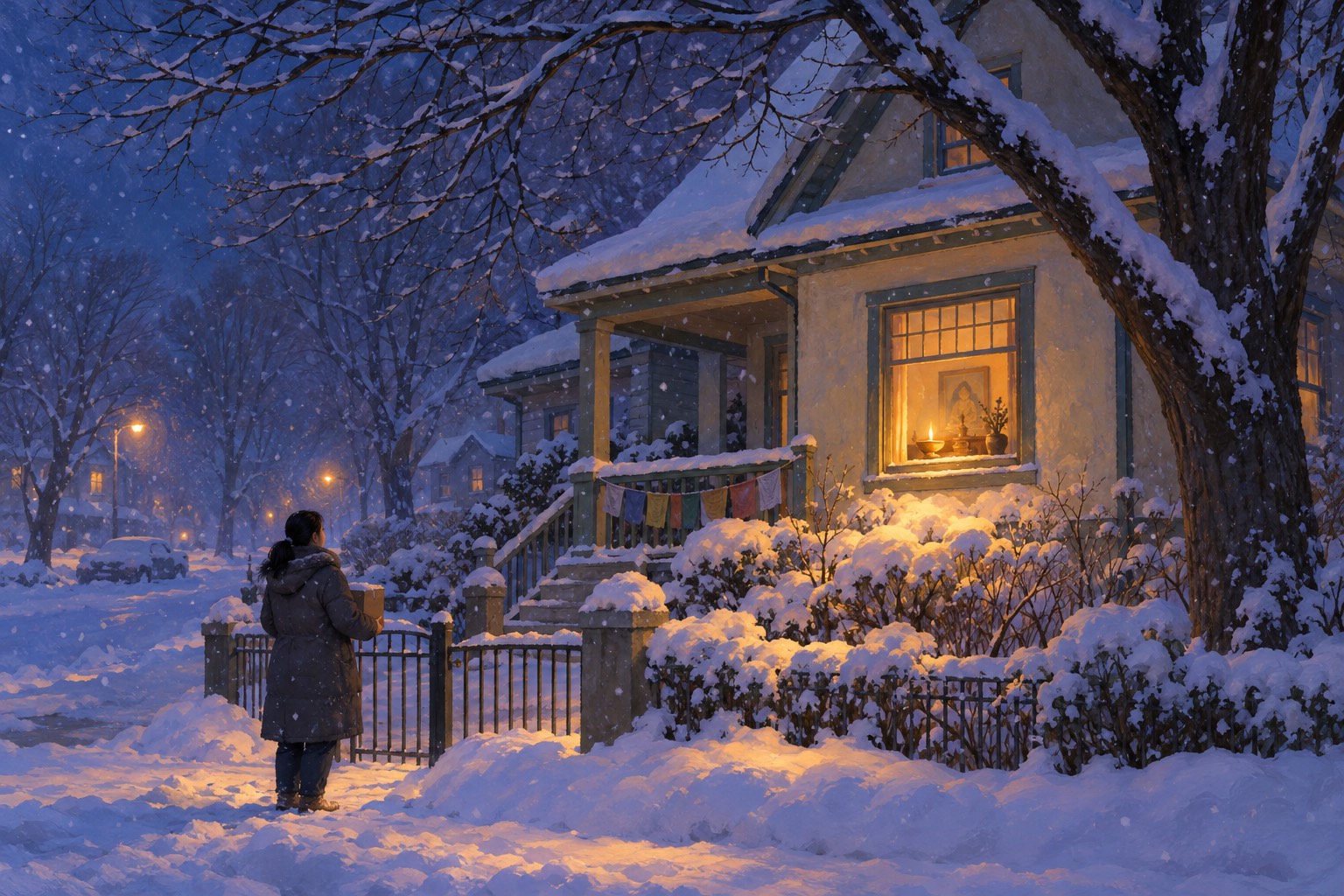
This is an original story, written for this site. It is fiction, not a teaching or a traditional account.
For thirty winters the house on the corner had a small light in its front window. It came on just after dark and was gone by the time most people on the block in south Minneapolis went to bed.
Dechen's grandmother lit it. Everyone called her Mola, the Tibetan word for grandmother, even the mail carrier.
Mola died in October, at eighty-seven, in the hospital a mile away. In December Dechen drove up from Chicago with an empty car and a list: sort the rooms, call the realtor, be back at work by spring.
The cold house
The furnace had been turned down low. The front room smelled of dust and cardamom and something older that she couldn't name until she saw the shelf by the window. Then she knew it: butter, and the burnt cotton of a great many wicks.
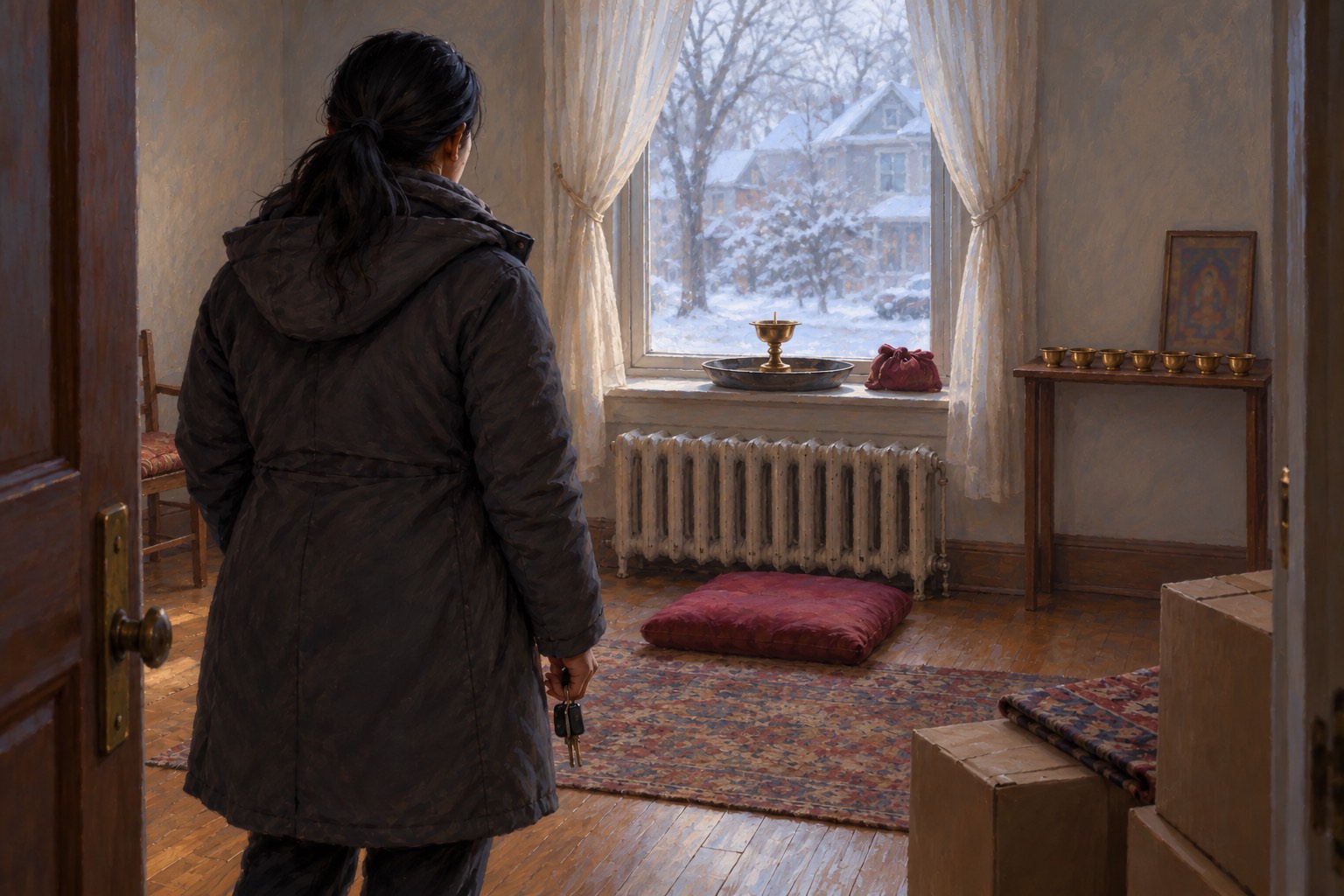
The shelf was just as she remembered it. A small framed painting of Guru Rinpoche, the eighth-century teacher whom Tibetans remember as the one who helped establish Buddhism in their country. Seven little water bowls, dry now. And on the sill, standing in a deep tin tray, a brass butter lamp: a wide, shallow cup on a slender stem.
Next to the tray lay a pouch of faded maroon cloth. Inside was Mola's mala.
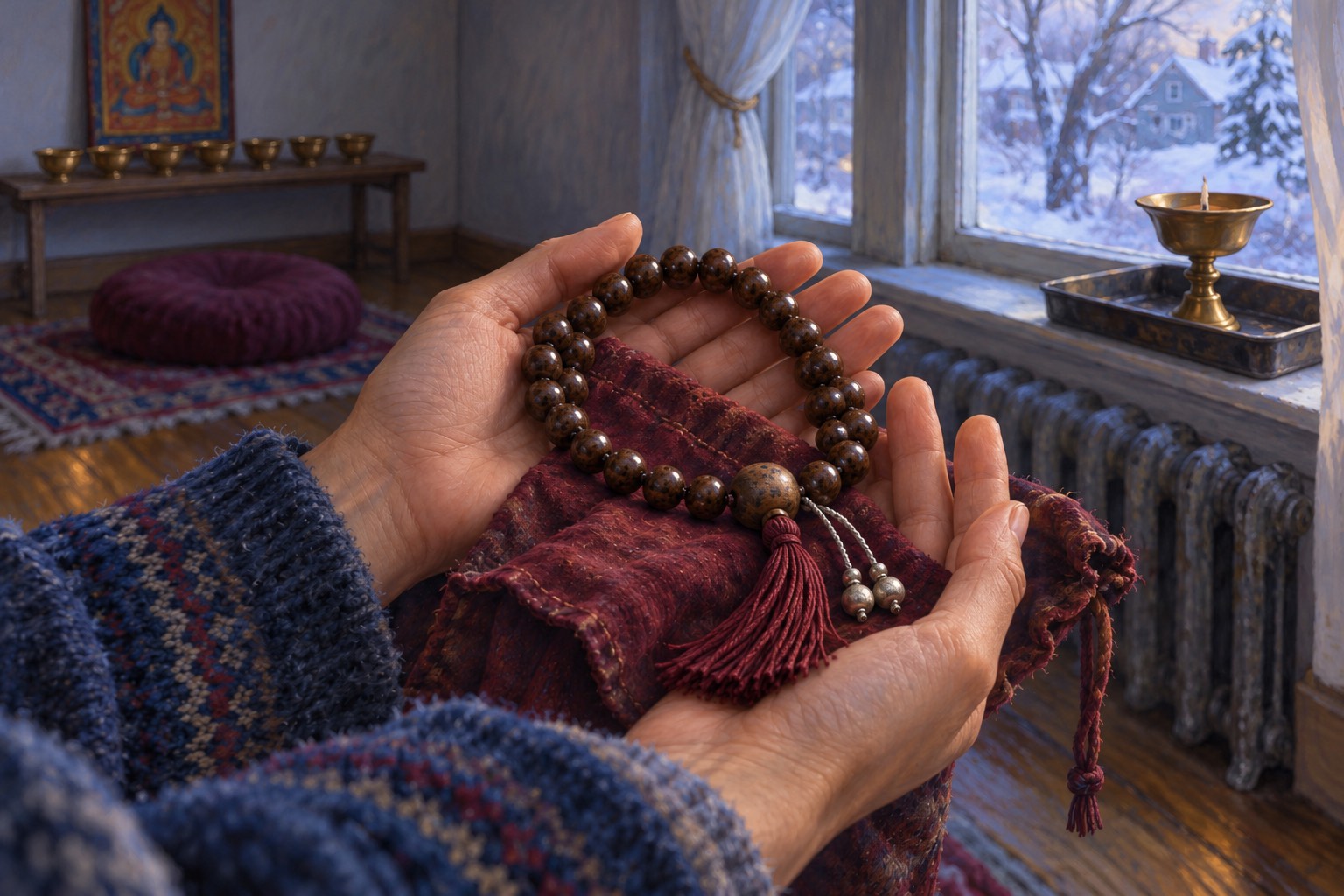
A mala is a string of prayer beads, usually 108 of them, with one larger bead where the two ends meet. Mola's were bodhi seeds, gone glossy and brown under decades of her thumb. The big bead at the top was worn almost flat on one side.
Dechen held it for a long time. Then she put it back in the pouch, put the pouch back on the sill, and went to start on the kitchen.
What Mola used to do
She had been eight or nine the last time she really paid attention. After school she would sit on the radiator under this window doing her homework, and at dusk Mola would come in from the kitchen, drying her hands.
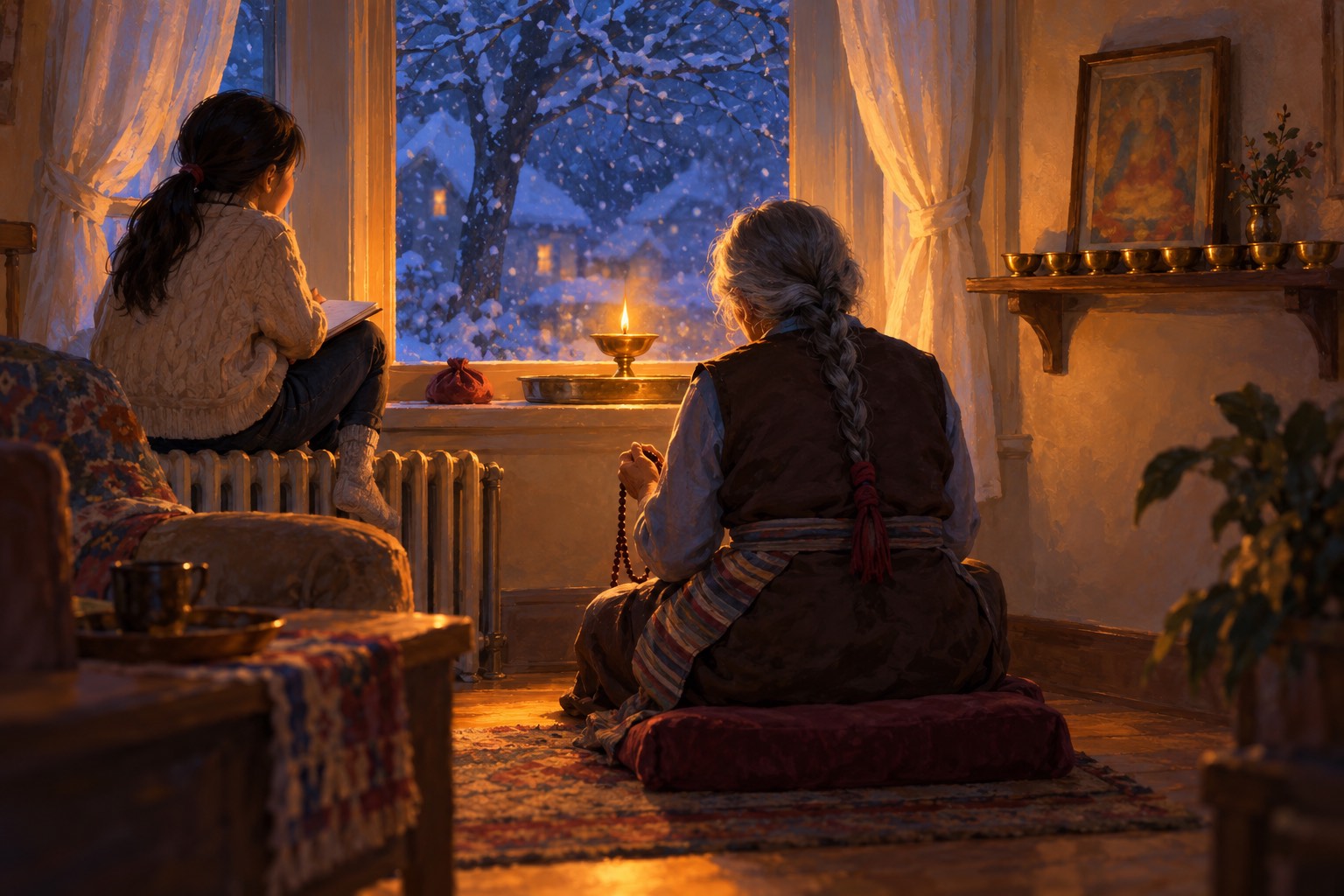
Mola spooned ghee into the lamp, pinched the wick straight and struck one match. Then she sat on her low cushion with her back to the room and said the Seven-Line Prayer, a short prayer that asks Guru Rinpoche to come and grant his blessing. She said it over and over, half aloud, the beads moving through her fingers.
Dechen had known the sounds by heart once, the way you know a song from the car radio without knowing what it means. One evening she asked why the lamp had to go in the window. Mola shrugged. "He can see in the dark," she said. "The lamp is for me. So I remember to sit down."
Then came high school, and college, and nursing shifts that ran straight through dusk. She stopped sitting by the window, and then she stopped coming home except at New Year. Nobody argued about it. It was distance, the ordinary kind.
Walt
The morning after the first big snow she woke to the scrape of a shovel. Walt Lindqvist from next door, seventy-nine, was clearing Mola's walk, as he had done, he said, every winter since his wife died.
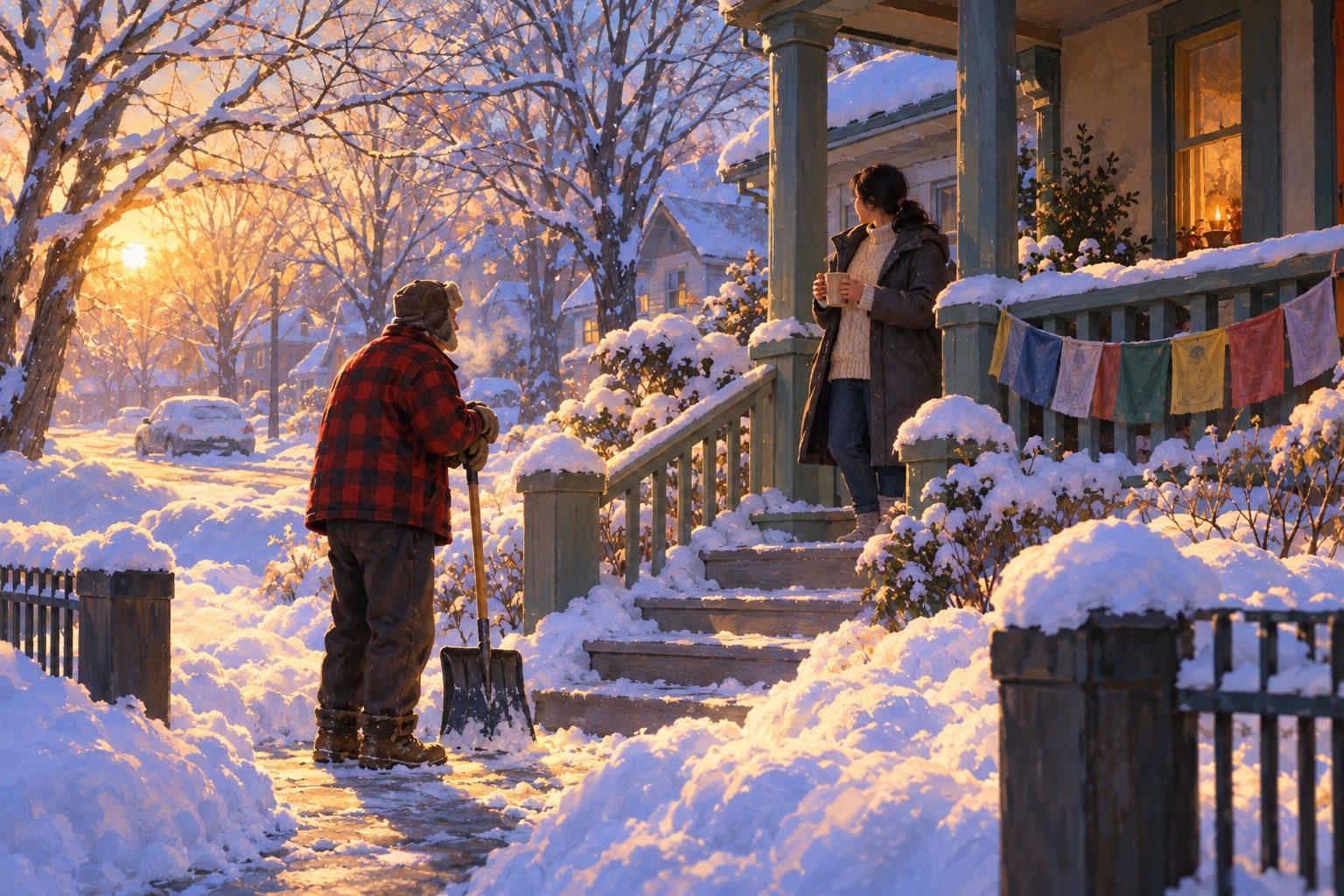
"I'll keep at it till you sell," he said. Then he leaned on the shovel. "Funny thing. I never set a clock. When her lamp came on, I knew it was time to start supper."
Dechen laughed. Then she went inside and sat on the stairs for a while. It was the first time since October that she had cried, and it surprised her how little it felt like falling apart. It felt more like setting something heavy down.
One match
Clearing the kitchen, she found Mola's dented thermos, the brick of black tea and the little jar of salt. She made tea the quick weekday way Mola had made it, butter and salt and a splash of milk whisked in a pot instead of churned, and drank it in the cold front room with her coat on.
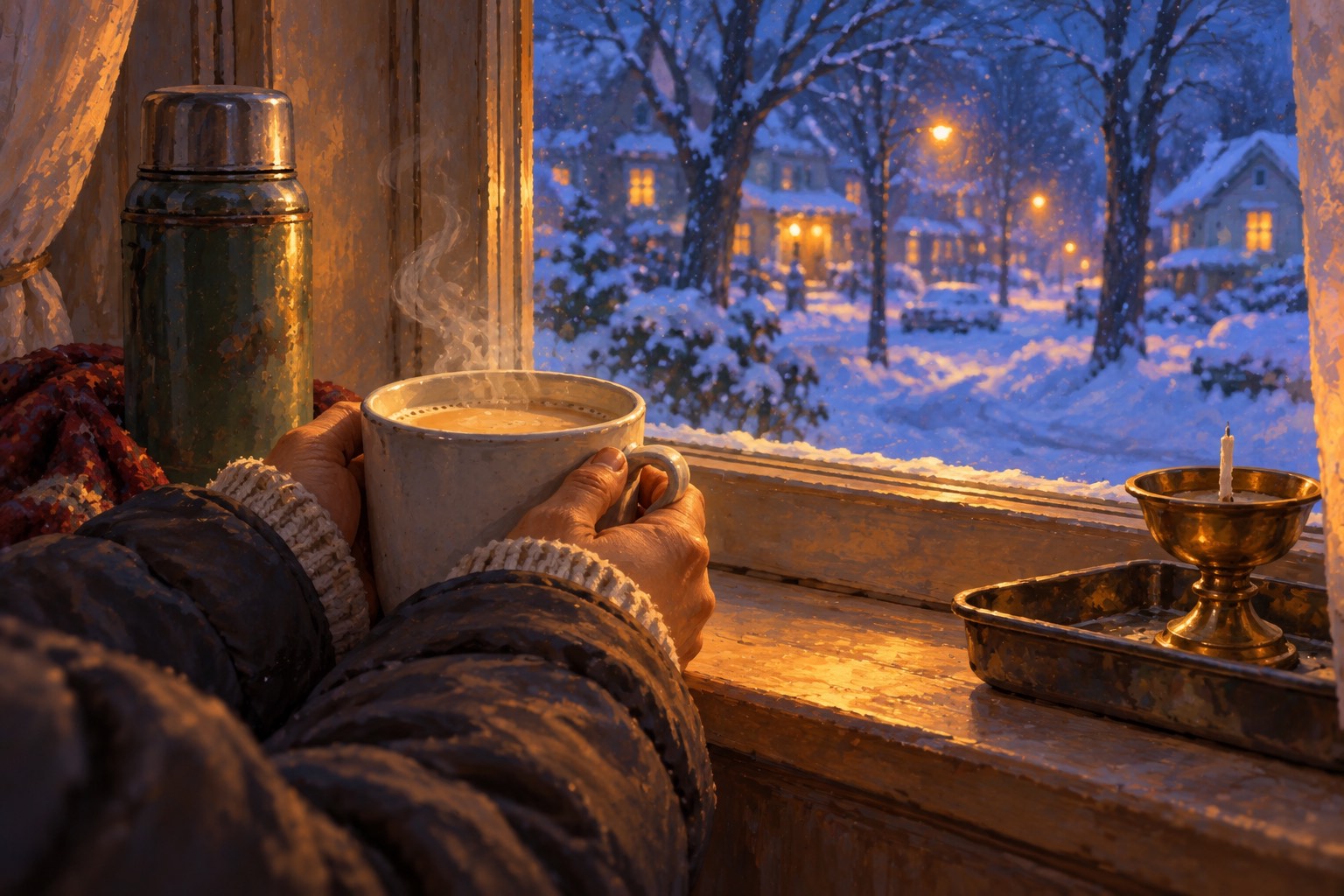
At a quarter to five the window turned blue. She looked at the lamp for a long time. Then she found the ghee in the fridge door, still good, and a box of wicks in the drawer under the shelf.
One match. The flame stood up small and straight in its tray, and the glass turned gold. She didn't sit on the cushion, because it still felt like Mola's. She sat on the radiator, the way she used to.
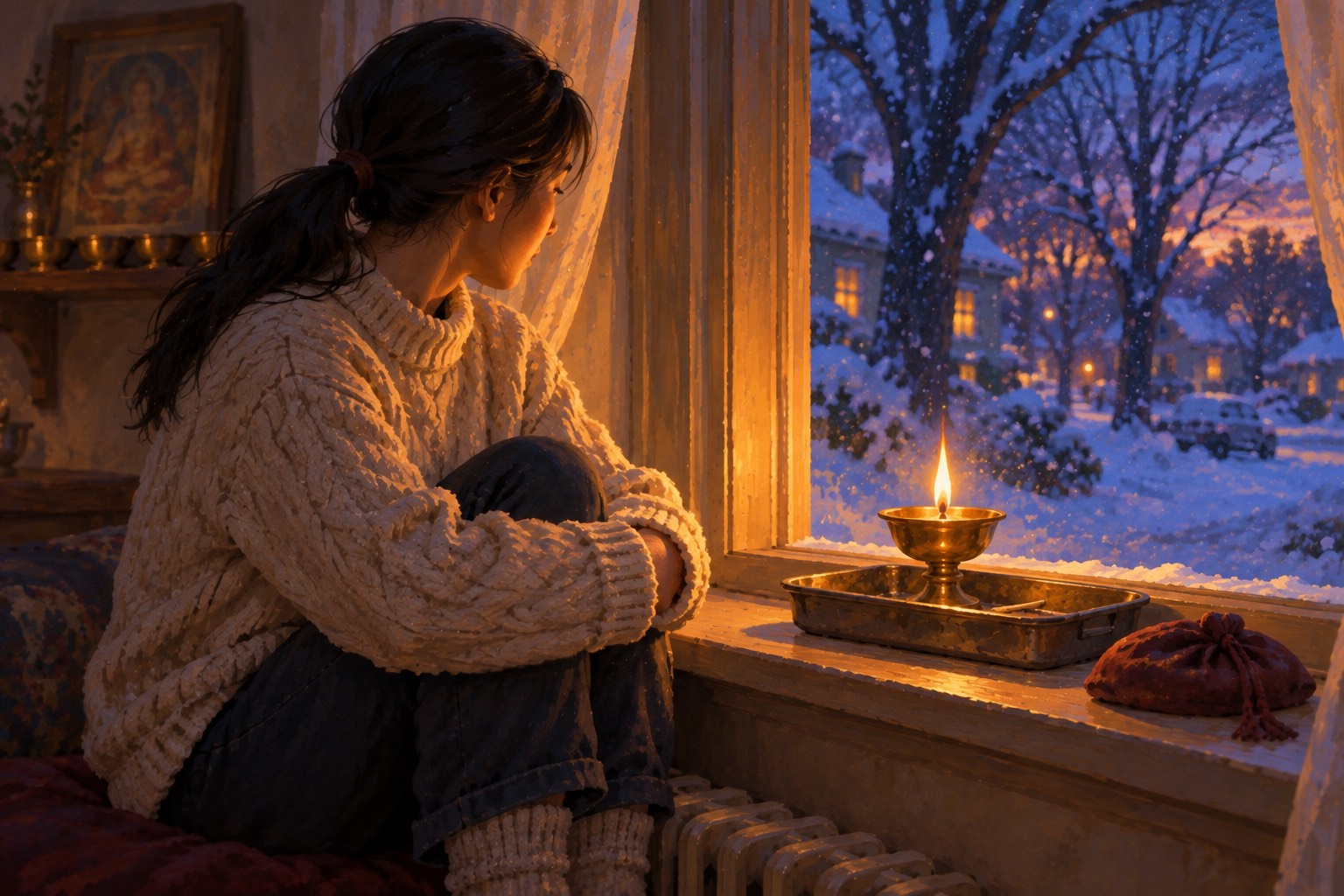
She tried the seven lines and got stuck after two. That night she looked the prayer up, the Tibetan and the sounds and an English translation, and read it slowly on her phone, like a letter from someone she used to know.
Losing count
The next evening she lit the lamp again, and the next. She never exactly decided to. It was simply what you did in this house when the window went blue.
The mala was harder. Her thumb skipped beads, and most nights she lost count somewhere after twenty. Now that she thought about it, Mola had never seemed to be counting either. Her lips moved and the beads moved, and that was all.
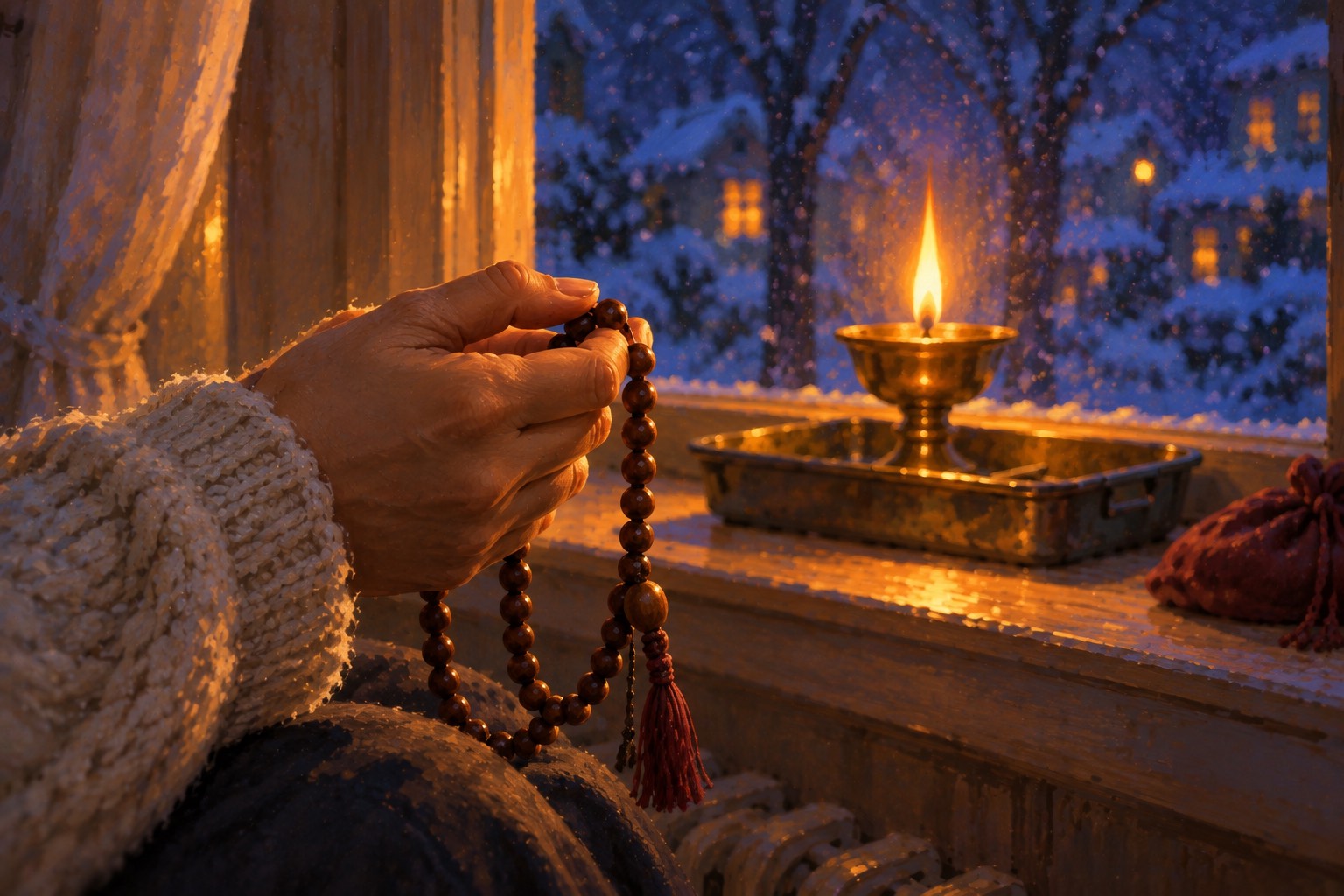
Some nights Dechen said the seven lines three times and blew the lamp out. Some nights she only sat and watched the flame and thought about nothing much, or about Mola's hands. She told herself that counted too. She wasn't sure it did, and decided not to mind.
In January the cold came down hard. In the late afternoons she walked to the frozen lake at the end of the street, where the little ice-fishing shacks sat scattered over the snow like dropped dice, and she got back just in time for the light to go.

After a while she noticed that she was getting back just in time on purpose. The cold made the evenings simple: walk, come home, light the lamp, sit.
The ice storm
In February an ice storm took the power out across the neighbourhood for most of a night. The streetlights went dark and the furnace went quiet. Dechen lit the lamp as usual and stayed beside it, wrapped in Mola's old blanket, saying the seven lines until she was tired and then a little longer.
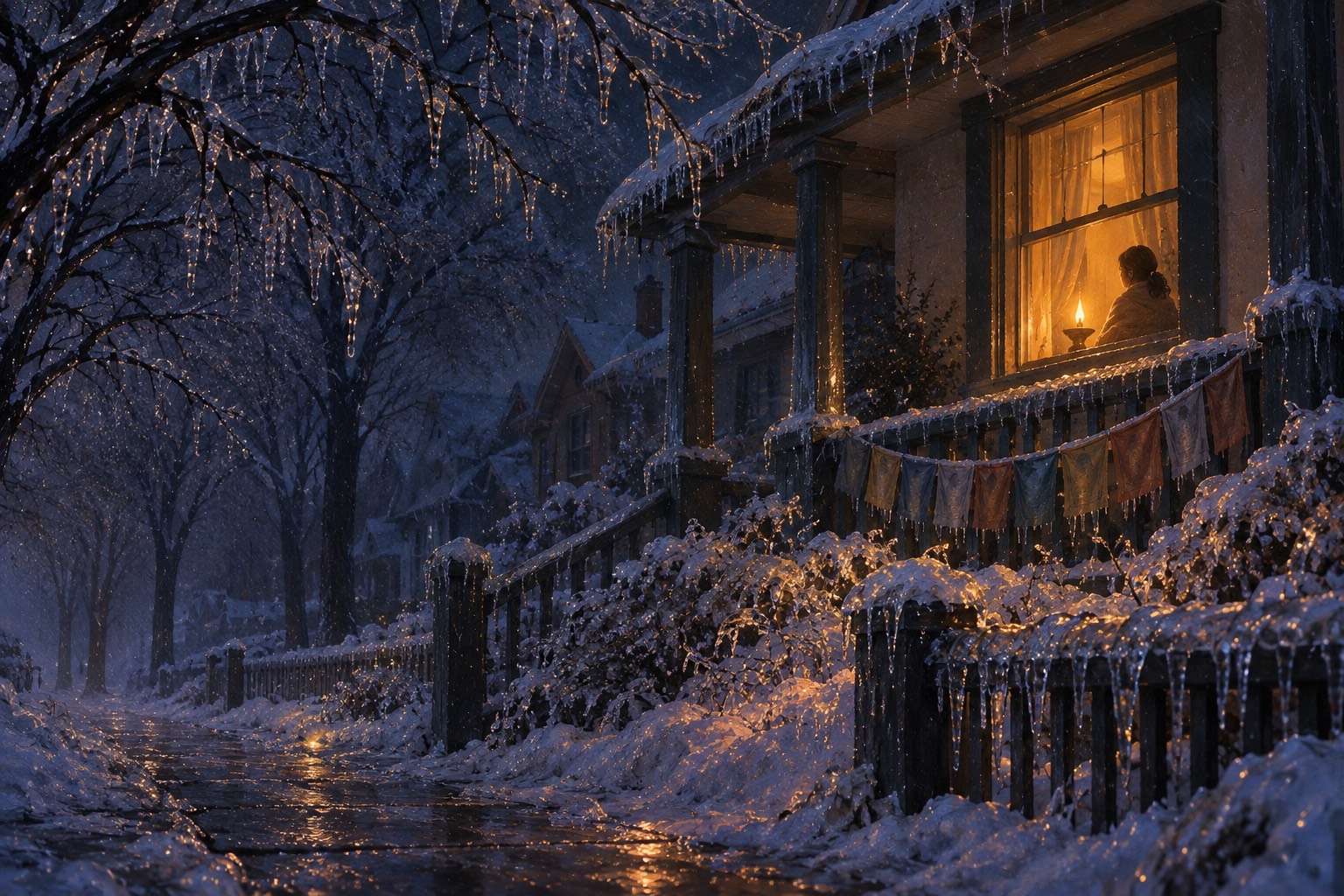
Nothing happened, in the way that stories usually mean it. Ice ticked against the glass. The flame burned the ghee down by a finger's width. She felt steady, which is not quite the same as feeling better, and was perhaps more use to her.
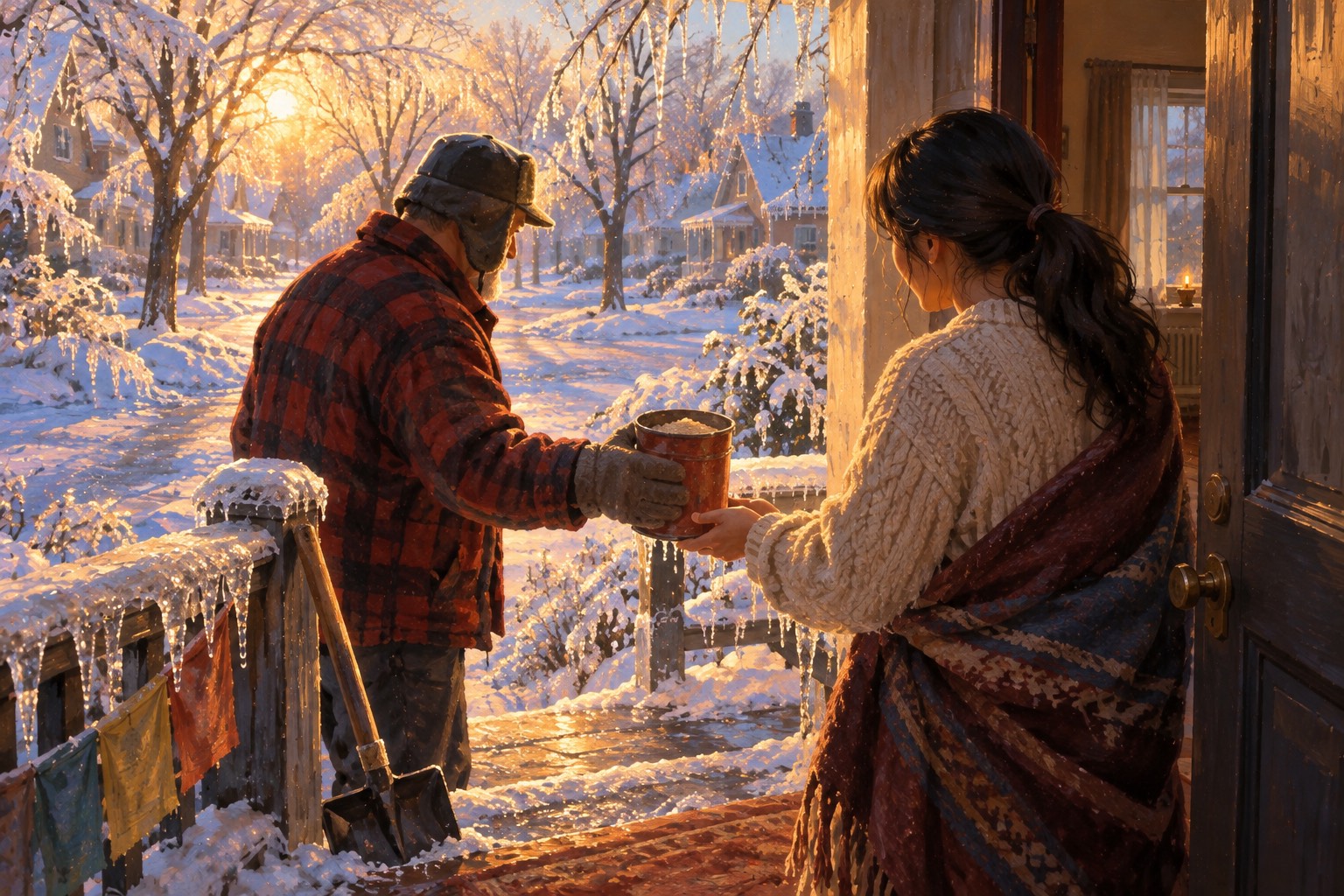
In the morning Walt knocked with a coffee can of sand for her icy steps. "Saw your light last night," he said. "Only one on the street." He didn't say anything else about it, and neither did she.
Spring, nearly
The realtor called in March. Dechen said she needed a little longer, and found that it was true.
She doesn't know yet whether she will keep the house. She does know what she will do at dusk: one match, the flame standing up straight, the seven lines, and the beads moving through her fingers whether she keeps count or not. Mola's lamp, lit for herself now, so she remembers to sit down.
About the art
This is an original story, so its pictures show invented people. Following the site's rule for modern figures, they are painted gently and mostly from behind, in profile or in silhouette, and much of the story is told through hands, a window, a lamp, snow and a mug of tea.
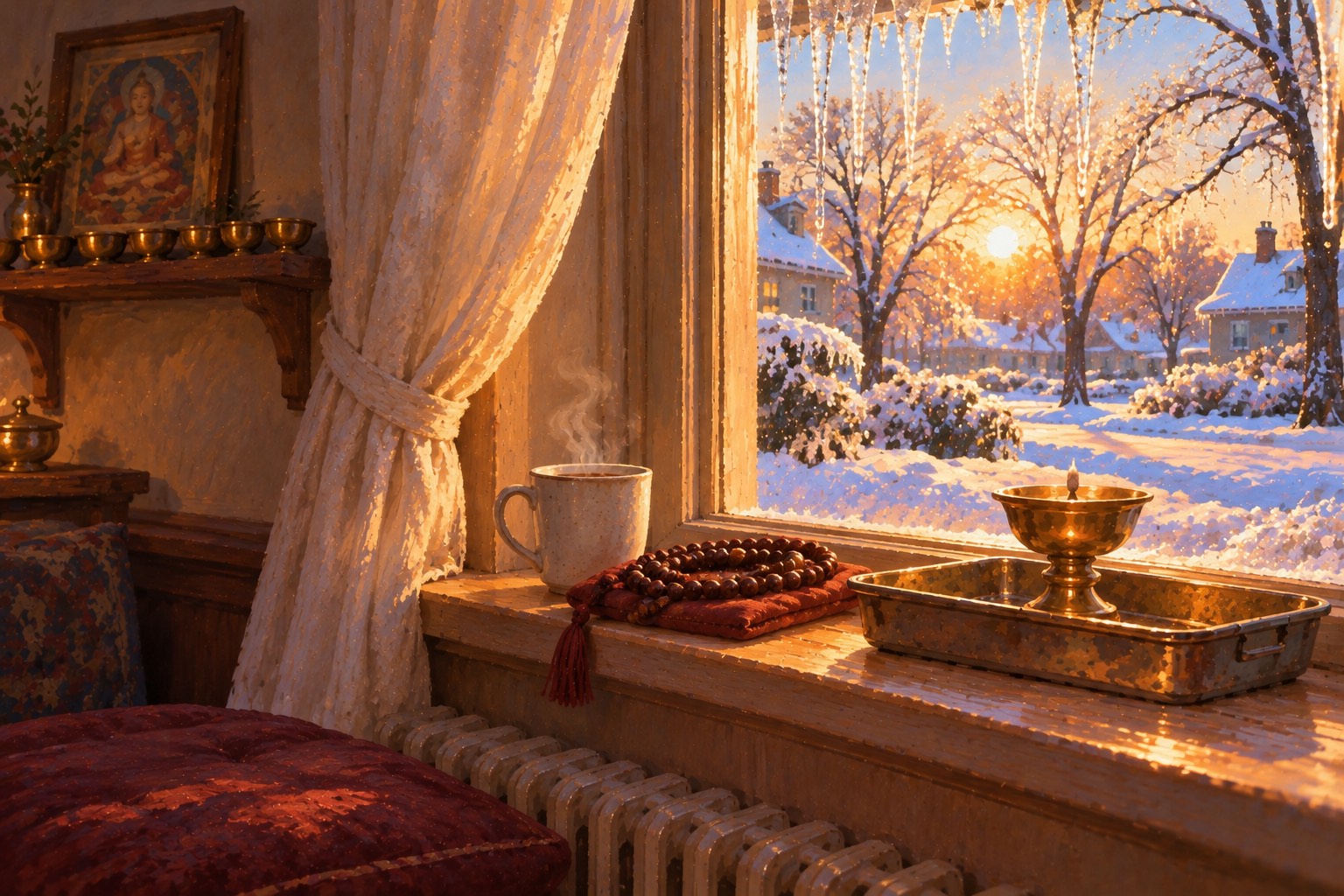
The lamp is a Tibetan butter lamp: a brass cup on a slender stem with a single upright wick, traditionally fuelled with clarified butter; today vegetable oil or ghee is common. Mola keeps hers in a deep tin tray on the sill, a sensible precaution with an open flame near a window.
The mala is a single loop of 108 bodhi-seed beads with one larger guru bead where the ends meet, plus two small counter strings of the kind many Tibetan malas carry. It is held in the left hand and moved one bead at a time with the thumb.
On the shelf are seven small water bowls and a framed painting of Guru Rinpoche. The painting is kept deliberately soft and small in the images, and, as everywhere on this site, no prayer words or script appear in any picture. The faded prayer flags on the porch are a common sight at Tibetan homes in exile.
Why this matters for practice
The Seven-Line Prayer ends by asking Guru Rinpoche to come and grant his blessing, and many people come back to it the way Dechen does: not with a decision, but with one small habit taken up again. This story is fiction, but the habit in it is ordinary and real, a lamp, a few minutes, seven lines said as well as you can. Losing count, or saying it imperfectly, is not a reason to stop.

If something in this story stayed with you, you might pause tonight, wherever your own window is, and recite the prayer once.
Sources and further reading
- Seven-Line Prayer (topic page), Lotsawa House
- Butter lamp, Wikipedia
- Japamala, Wikipedia
- Tibetan Americans, Wikipedia
This retelling is waiting to be read by a knowledgeable practitioner. Where the traditional accounts differ, the story says so; if you notice a mistake, please tell us through Share Your Story.