This is an original story, written for this site. It is fiction, not a teaching or a traditional account.
The year Lhamo turned ten, the grass on the spring pasture came up thin and early, and her grandfather said the yaks were telling them it was time to go.
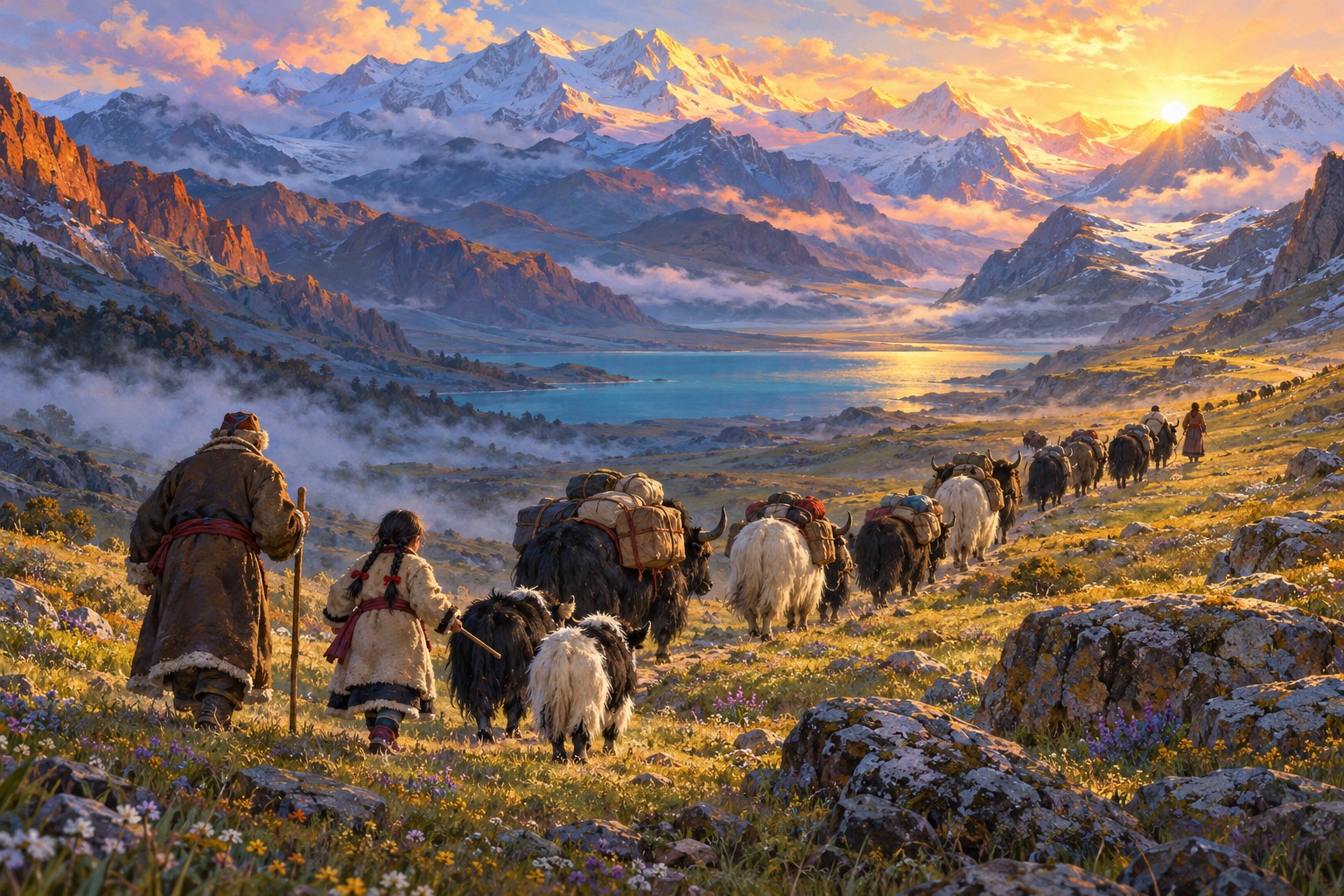
Every year the family moved the herd uphill as the snow drew back: first from the sheltered winter valley to the spring grazing, then, when the high grass was ready, over the pass to the summer pasture. From here it took seven days of walking. Lhamo had made the journey every summer of her life, though for the first few, she was told, she had mostly slept on a yak's back.
Packing up
On the first morning her mother, Yangchen, was up before light. The black tent came down in long, heavy strips of woven yak hair, and the poles, pegs and ropes were bundled. The pots went into sacks. The painted wooden chest that had come with Ama, as Lhamo called her mother, when she married was wrapped in felt and lashed onto the steadiest yak.
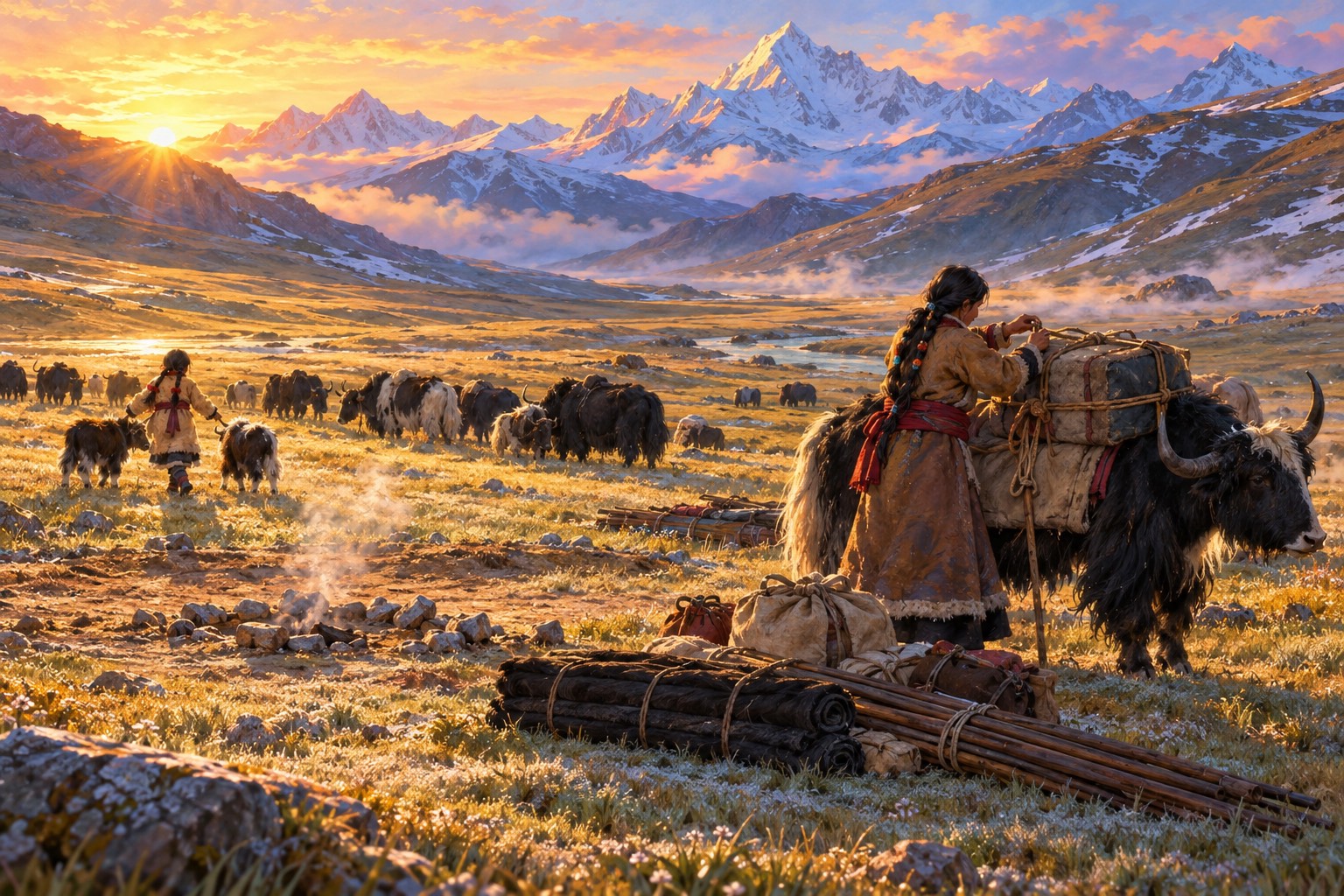
Lhamo's job was the calves, who did not want to go anywhere. Her grandfather's job, he said, was to walk at the back and keep an eye on everyone. Lhamo understood this to mean walking slowly.
The first line
So she walked at the back with him. On the first evening, while the herd grazed below a ridge, he asked whether she knew the prayer he said every morning by the fire, the one with seven lines.
She knew the sound of it. She had heard it all her life, under his breath, while the tea boiled. But she could not say it herself.
"Then we'll have one line a day," he said. "Seven days, seven lines. By the pass you'll have the whole thing."
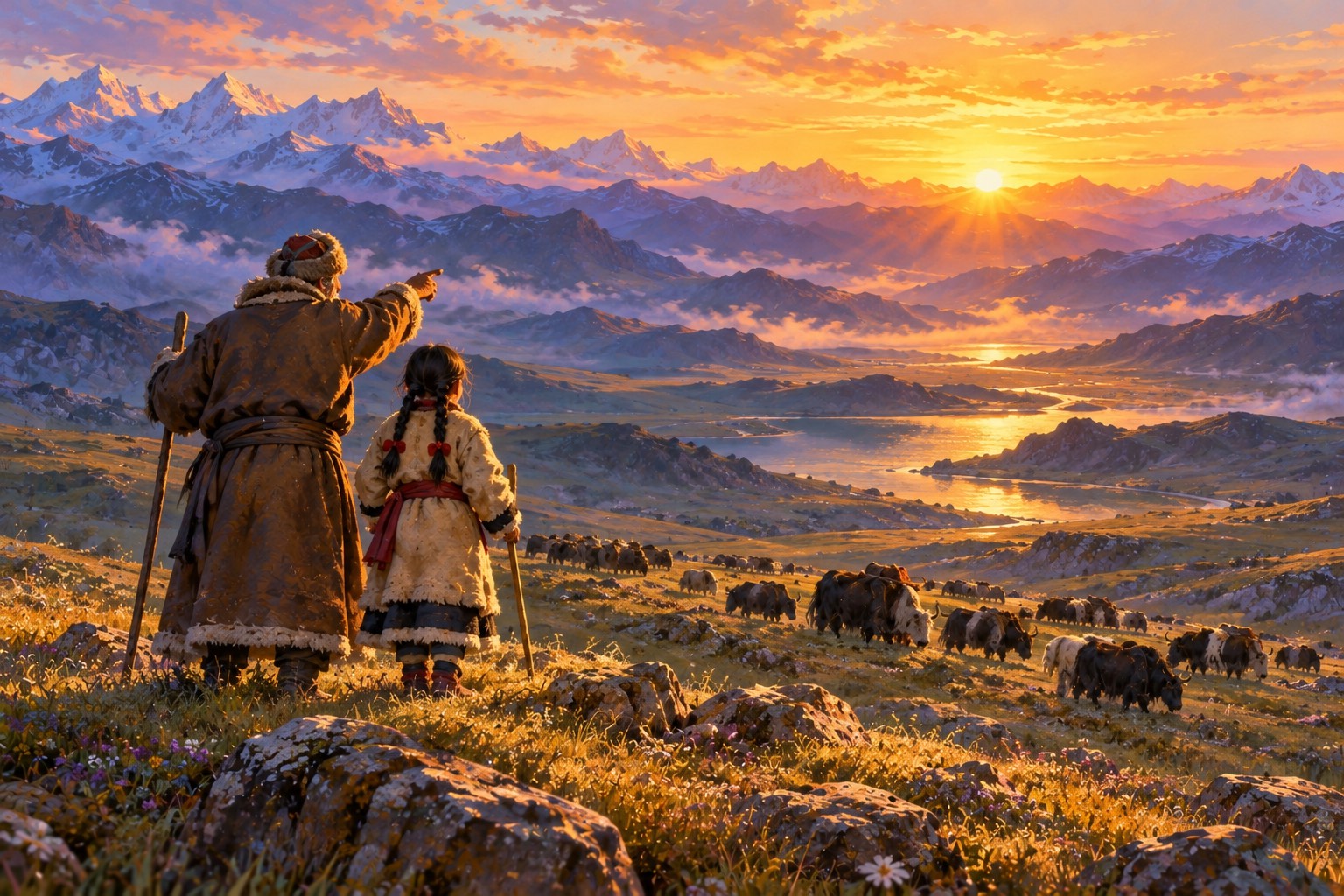
He pointed west and north, past the ridge, past the furthest blue mountains, to where the sun was going down. The first line, he told her, is only a place: the far country Guru Rinpoche came from. Guru Rinpoche was the great teacher of long ago whose small picture stood at the back of their tent.
"Before you ask anyone for anything," Grandfather said, "it's good manners to remember where they're from."
He said the line. She said it after him, wrong, then less wrong, then right. She said it to the calves all evening, until her mother asked her to say something else.
A lake, and a lotus
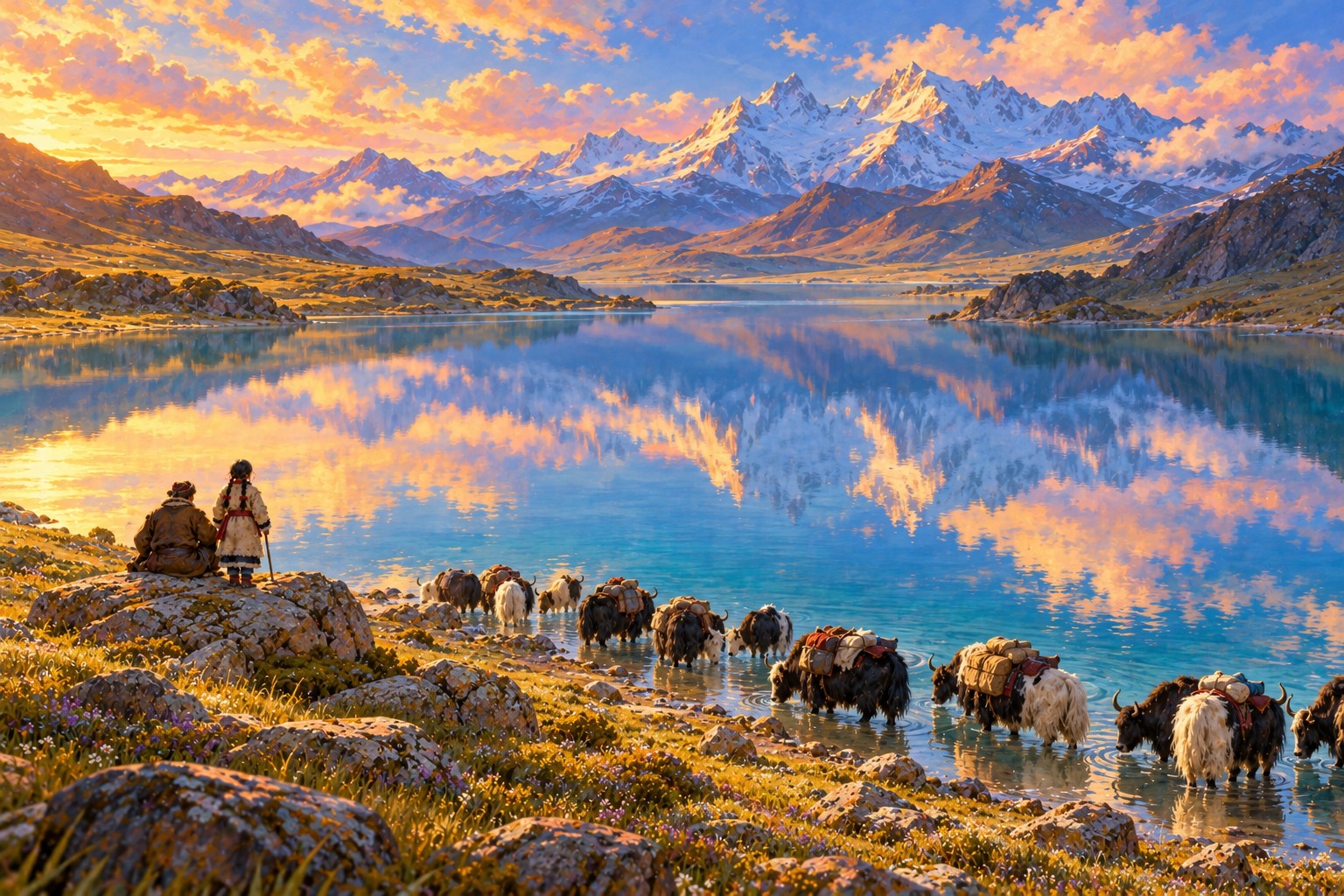
On the second day the trail ran beside a long lake, so still that the clouds lay in it. The herd stopped to drink, and Grandfather sat on a rock and gave her the second line: a lotus, and someone born in the very middle of it.
"What's a lotus?" Lhamo asked. Nothing like that grew up here. There was grass, and edelweiss, and a little blue gentian.
"A flower that grows out of lakes," he said. "In hot countries. I've never seen one either." He thought for a moment. "You have, though."
That night, by the fire, he showed her. On the front of Ama's chest, under years of smoke, someone long ago had painted a pink lotus, wide open, its petals curling round a golden centre. Lhamo had looked at it every day of her life without once seeing it.
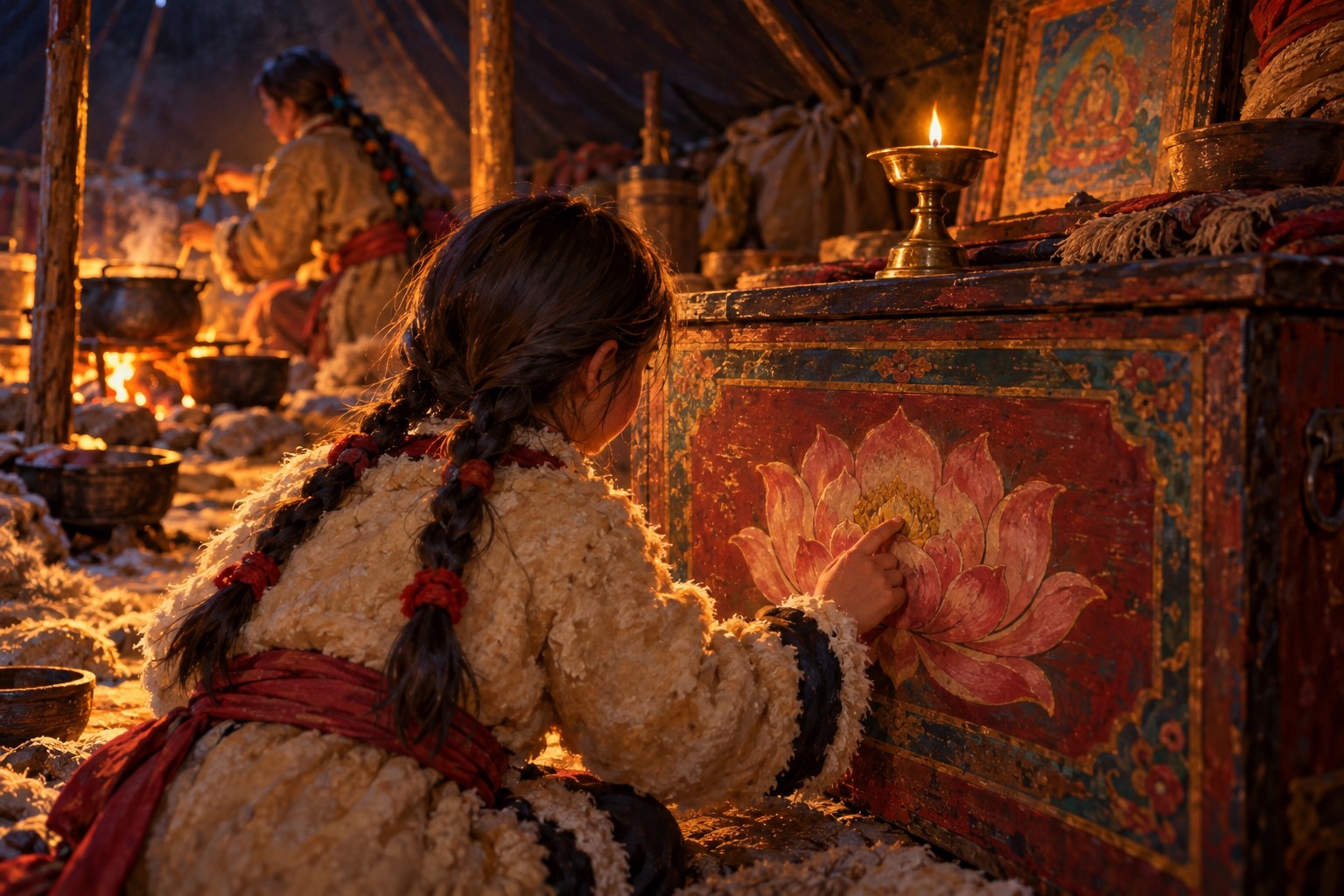
She put her finger on its centre and said the first two lines together. Ama, stirring the pot, said them along with her very quietly, and then laughed. "He taught me on this road too," she said. "At that same lake."
The cave in the cliff
On the third day they passed beneath a long red cliff. High up, far above any path, was a small dark opening, like an eye half closed.
"Someone lived up there once," Grandfather said. "Years and years, sitting in retreat. Nobody now." He did not know who. Nobody did any more.
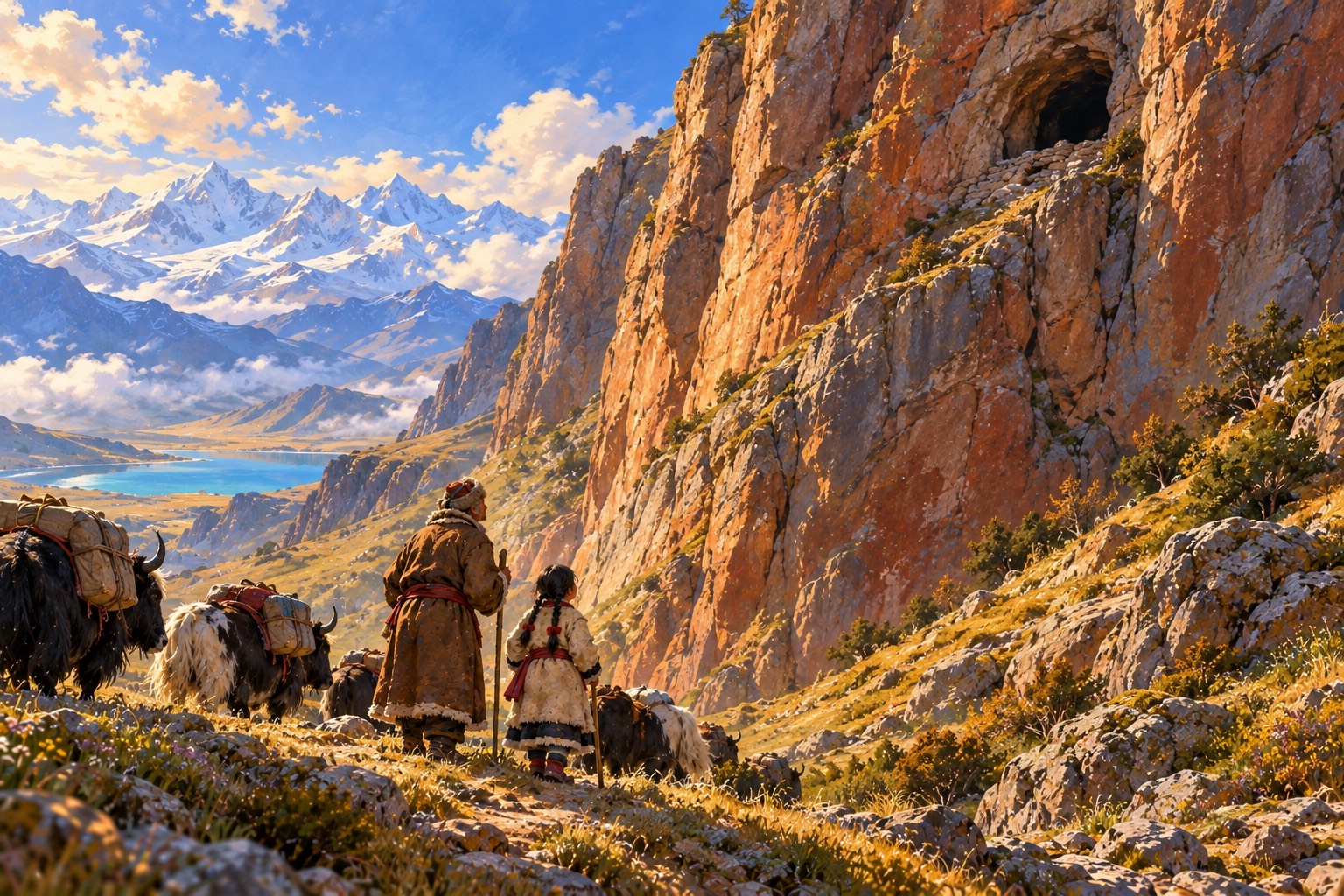
The third line, he said, was about finishing. The child from the lotus grew up and did the hardest thing there is to do, and did it all the way. "He woke up," Grandfather said. "Completely. That's what I think it means, anyway. I'm a yak herder. Ask a lama and you'll hear a great deal more."
Lhamo watched the cave until the trail turned and the cliff hid it. She tried to imagine being that patient. She said three lines to herself, and found that she could.
Calling by name
On the fourth day it rained, and the yaks spread out over a wet slope and would not come back. Grandfather cupped his hands and called them, one by one: White Forehead, Little Black, Old Crooked Horn. Each lifted its head at its own name and came plodding down.
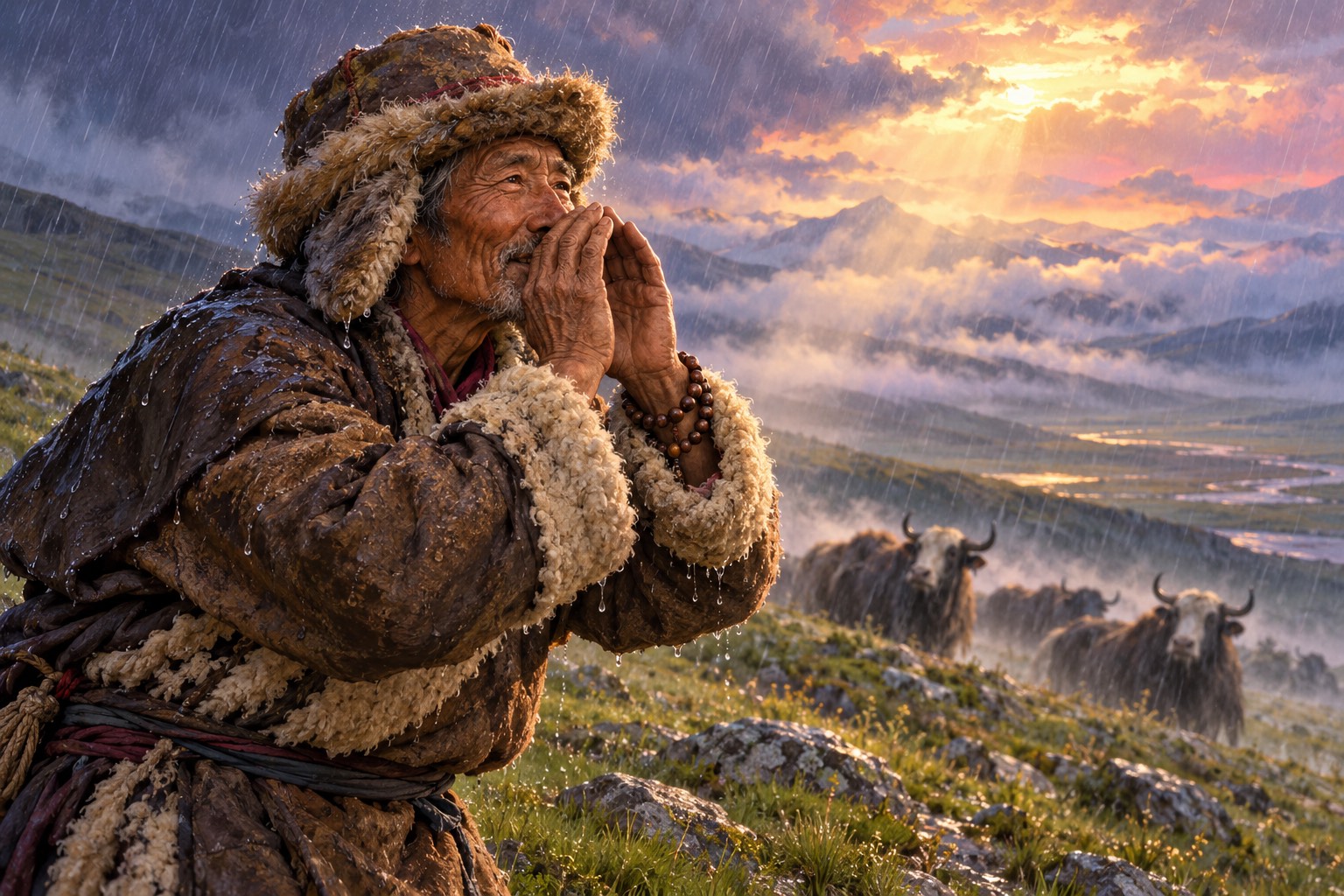
"That's the fourth line," he said, wiping the rain from his face. "His name. The Lotus-Born." Listen, he told her: the word for lotus comes back from the second line. Lhamo listened, and it did, and it pleased her more than she could explain, like spotting a friend on the far side of a river.
In a circle
On the fifth evening, as the light turned blue, the herd drifted in from the slopes and settled in a loose ring around the tent, the way it always did, with the calves in the middle.
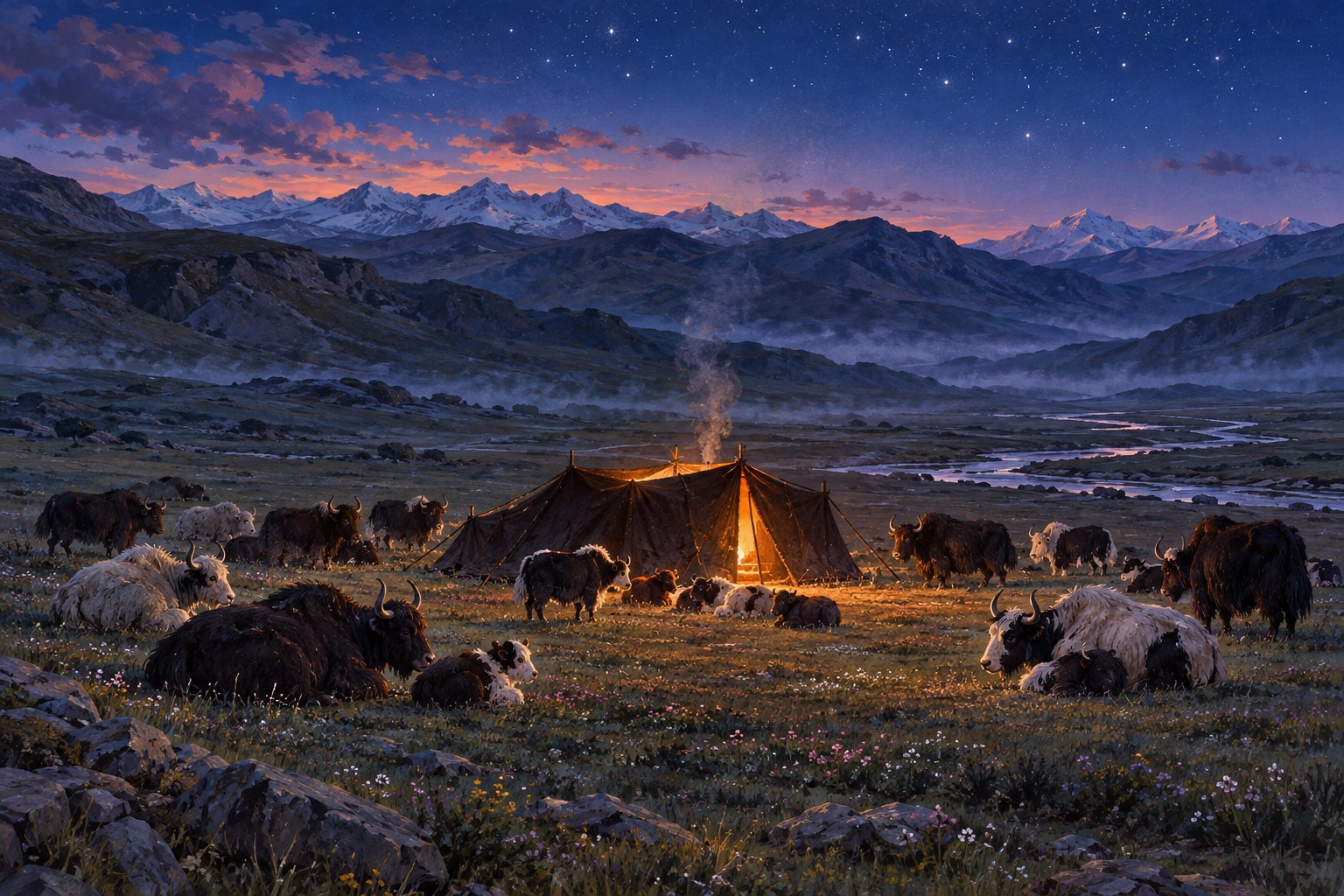
The fifth line, Grandfather said, is about the many who gather around Guru Rinpoche: dakinis. The Tibetan word, khandro, means sky-goer. "Hear how the line starts and ends on nearly the same sound?" he said. "It goes round, like they do." He nodded at the yaks, then laughed at himself. "Not that these are dakinis."
Lhamo said five lines into the dark and fell asleep before she could start to worry that only two days were left.
Footprints
On the sixth morning there was new snow on the upper slopes. Grandfather went ahead to find the trail, and Lhamo, at the back without him for once, stepped into his footprints. His steps were long. She had to stretch.
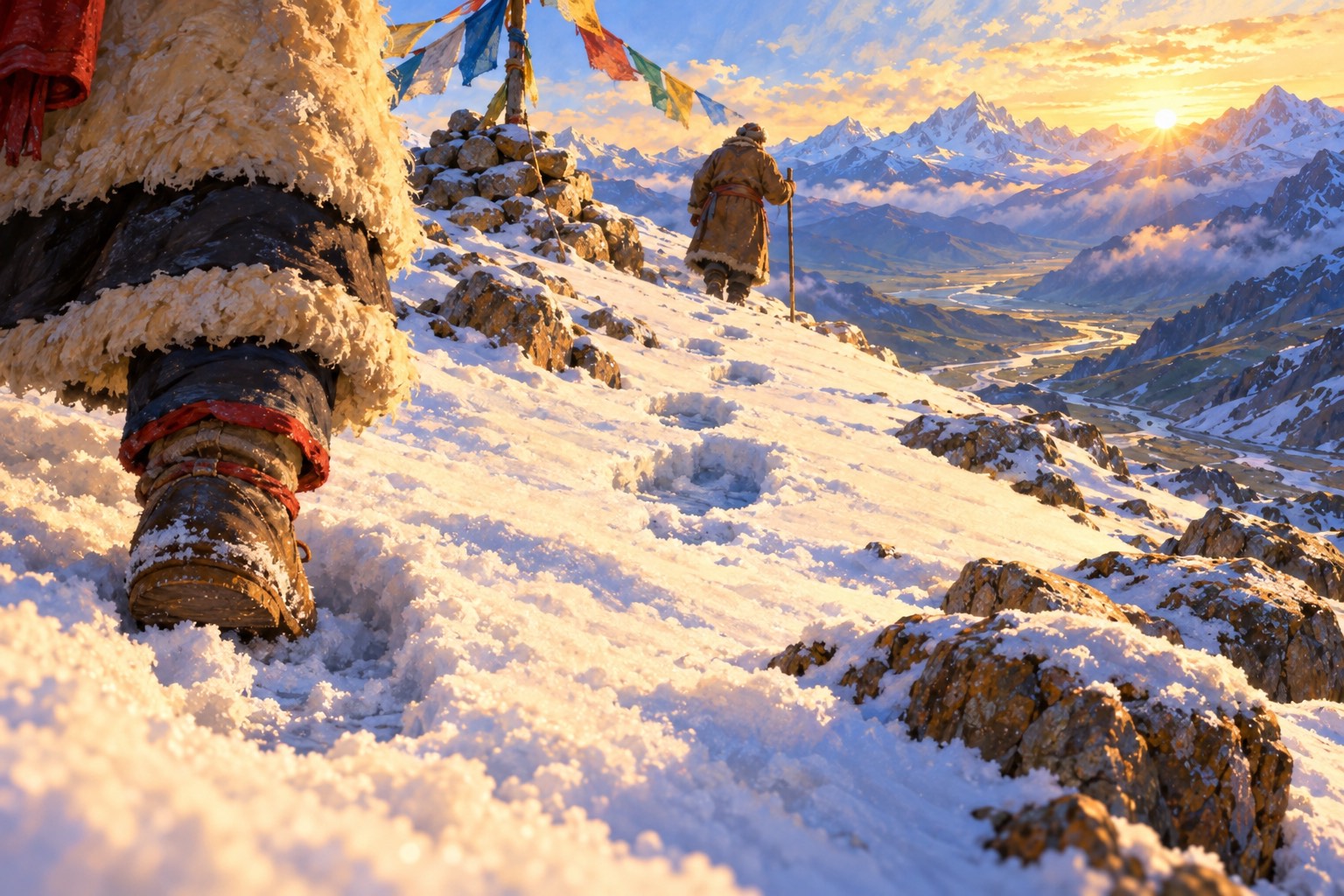
When she caught up, he gave her the sixth line, and she noticed it was different. Until now the prayer had been all about Guru Rinpoche: where he came from, how he was born, what he did, his name, who was with him. The sixth line turns round to the one who is saying it.
"It's a promise," Grandfather said. "You'll follow. You'll do your part." He looked down at her boots, still stretching for his tracks. "Like that."
The pass
The seventh day was the pass. They set out in the dark and climbed through a cold that hung the yaks' breath in clouds. At the top stood a cairn of stones, faded prayer flags snapping above it, and beyond it, for the first time, the summer pasture: a wide green valley far below, a river shining through it.
Grandfather stopped a little short of the top with the tired yaks. He gave her the last line there. "It only asks," he said. "For him to come, and to bless. You've said everything else. This is where you ask." Then he waved her on. "Go up. Say it all. I'll wait with these."
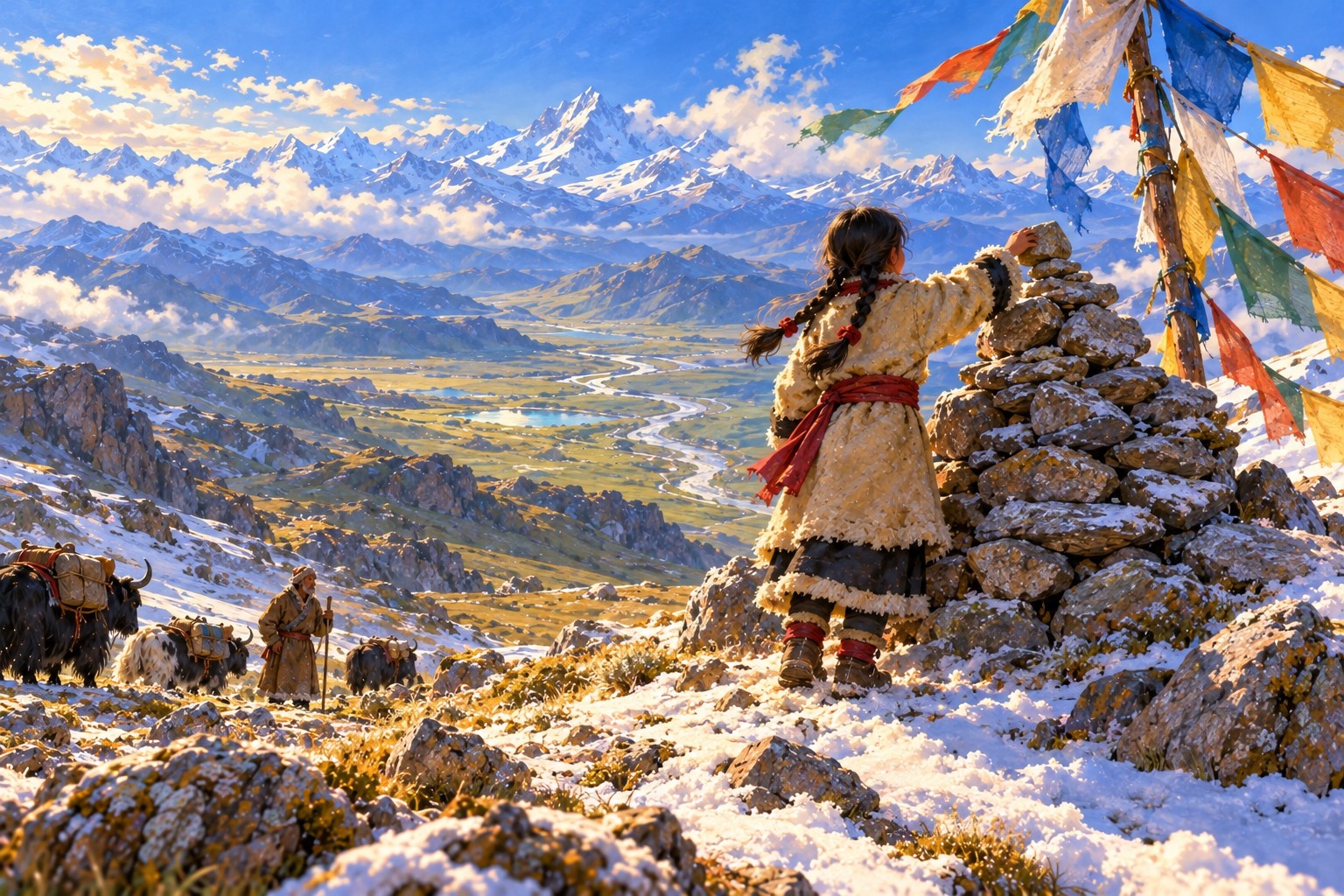
Lhamo climbed the last steps alone. The wind pushed at her. She set a stone on the cairn, the way everyone did, and stood with her face to the green valley, and began.
The far country. The lotus on the lake, and the one on Ama's chest. The cave in the cliff. The yaks lifting their heads at their names. The ring around the tent at dusk. Her boots in Grandfather's footprints. And then the asking.
Nothing happened, in the way stories usually mean it. The flags went on snapping, and a crow went over. But her voice did not shake, and she did not have to stop and hunt for a single line. Each one was waiting where she had left it, tied to something she had seen. She felt steady, and warm in the middle, the way you do after hot tea.
When she turned round, Grandfather was looking up the slope as though he had heard every word, though the wind must have carried most of them off. He said nothing about it. He only lifted his chin toward the valley: time to go down.
Summer pasture
They pitched the black tent that evening on new grass beside the river. Ama unwrapped the painted chest and set it in its place, lotus facing the fire. Lhamo brought the calves in.
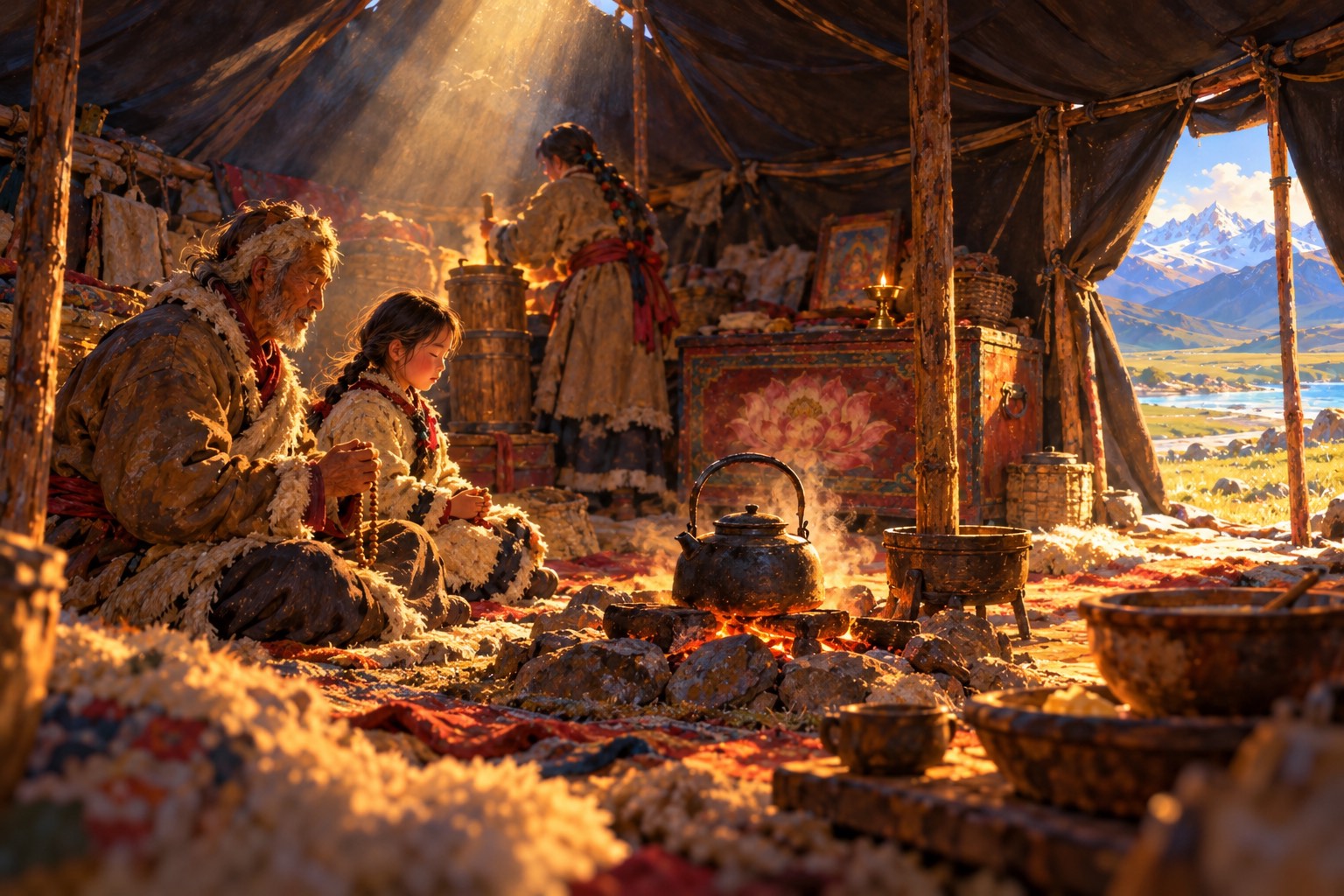
The next morning Grandfather said the prayer by the fire, as he always did, under his breath while the tea boiled. This time there were two voices.
Lhamo would walk that road for many summers after, and she always said the seven lines on the way, one for each thing she passed. She did not need the reminders any more. She kept them anyway.
About the art
This is an original story, so its pictures show invented people. The girl is painted modestly and at a respectful distance, mostly from behind, in soft profile or as a hand or a boot. Her grandfather and mother are gentle, slightly stylised figures, not portraits of anyone.
The family lives in a black tent woven from yak hair, the traditional nomad dwelling of the Tibetan grasslands: dark sloping sides held out by ropes, a hearth at the centre, and a long opening along the ridge for the smoke. The family's shrine and valuables sit at the back, opposite the door. Yaks carry everything on the move, and their dried dung is the fuel.
The painted wooden chest is the kind of household chest found across Tibet, painted with flowers and auspicious designs. Its lotus is the only lotus in the story: the sacred lotus grows in warm lowland waters, not on the high plateau, so the lake in scene 4 has none.
The cairn at the pass, with faded prayer flags above it, is a common sight on Tibetan passes, where travellers add a stone as they cross. As everywhere on this site, the flags in the picture carry no writing, and no prayer words or script appear in any image. Guru Rinpoche appears only as a small, softly blurred picture at the back of the tent: nothing on this page is a vision.
Why this matters for practice
The Seven-Line Prayer is often learned exactly this way: one line at a time, each one joined to the last, with a picture to hold for each. Its sixth line is where the prayer turns to the one reciting it, as a promise to follow, and this story is about following in someone's footsteps until the words are your own. Lhamo is invented, but the method is real, and the prayer page's line-by-line learning aid works the same way.

If something in this story stayed with you, you might learn the prayer the way Lhamo did, one line at a time, or simply pause tonight and recite the prayer once.
Sources and further reading
- Seven-Line Prayer (topic page), Lotsawa House
- In Search of the Black Tents, Emergence Magazine (Diane Barker, 2018)
- Flight of the Khyung, March 2010, Tibet Archaeology (John Vincent Bellezza)
- Domestic yak, Wikipedia
This retelling is waiting to be read by a knowledgeable practitioner. Where the traditional accounts differ, the story says so; if you notice a mistake, please tell us through Share Your Story.