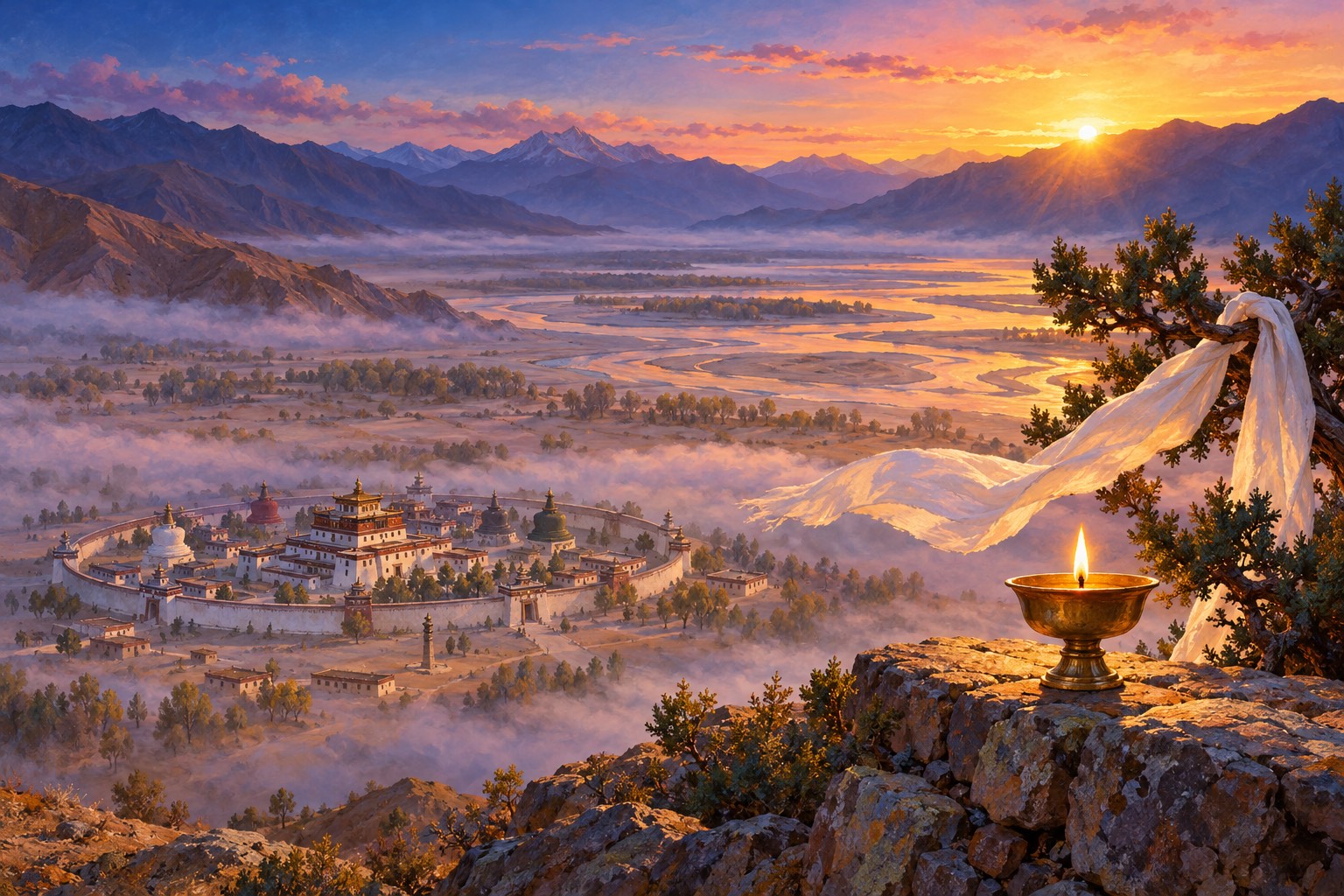
On the north-eastern edge of Kathmandu stands a white dome so vast that the people walking around its base look as small as grains of rice. Nepalis call it Boudha. Tibetans call it Jarung Khashor.
Its story, the tradition says, begins not with a king or a saint but with a poor woman who kept chickens.
A story told at Samye
The fullest telling is a treasure text, a terma: a teaching Guru Rinpoche is said to have given, which was hidden away to be found in a later age. It is called Liberation Upon Hearing: The History of the Great Jarung Kashor Stupa.
Its closing lines say that Yeshe Tsogyal wrote down the Guru's words and hid them behind a statue at Samye, Tibet's first monastery. A treasure revealer named Lhatsün Ngönmo later found the text, copied it and hid it again. In the early sixteenth century the master Ngakchang Shakya Zangpo, guided by a dream, drew it out once more.
The text opens at Samye, during an empowerment, a ceremony in which a teacher opens a practice to students. King Trisong Detsen bows a hundred times and asks the Guru a question. How did this golden age come about? Tell us who we were long ago, he says, and what we wished for, so that our faith may grow.
 Illustration in preparation
The Guru agrees, and he begins very far back.
The poultry-woman
In the time of an earlier buddha named Kashyapa, the text says, a girl was born into a family of poultry-keepers in the Kathmandu valley. The text names her Samvari. Tibetans usually call her Jadzima, which simply means "the poultry-woman."
She had four sons by four different fathers, men of humble trades: a horse-keeper, a swineherd, a dog-keeper and another poultry farmer. She had no husband and no wealth. She raised her chickens, saved what they earned, and set each son up as a respectable householder.
Illustration in preparationEven then, something was left over. So she made a wish: to build a great stupa, a domed monument holding relics of the buddhas, where anyone at all could gather merit, the good that comes of virtuous acts.
Let it be done
She went to the king of the valley, bowed, and asked for a grant of land. Great kings do not decide in haste, the text remarks, so he sat and thought. A poor woman alone, who had raised four sons on chicken money, now wanted to build for the Buddha. He found it astonishing, and he said, "Jarung": let it be done.
Illustration in preparationYou may hear this told with a clever twist: that she asked only for as much ground as a buffalo hide would cover, then cut the hide into one long, thin strip and laid it out around a vast circle. It is a much-loved detail, but it is not in the translation of the treasure text this page follows, where she simply asks for land, and this page could not trace it to a written source.
So the work began. Jadzima, her four sons and one servant loaded bricks onto an elephant and a donkey and carried them to the site.
Illustration in preparationWhen the walls stood three tiers high, the nobles of the valley grew uneasy. If a poultry-woman could build this, what would people expect of them? They went to the king and asked him to stop her.
His answer gave the stupa its name. The words "let it be done" had slipped from his tongue, he said, and, in Samye Translations' rendering, "Kings speak but once!" Jarung khashor: let it be done, slipped from the tongue.
A mother's last wish
Summer and winter the building went on. After four years it had risen as far as the dome, and Jadzima knew she was dying. She asked her sons to finish the stupa, to place relics inside it and to consecrate it well, for the sake of countless beings.
Illustration in preparationAs she died, the text says, music sounded and flowers fell from the sky, and through the merit of her stupa she attained buddhahood.
Her sons wanted to repay her kindness. With the same elephant, the same donkey and the same faithful servant, they worked for three more years. After seven years in all, the great stupa was finished.
Four wishes
Inside its central pole, the life-pillar, they placed relics of the Buddha Kashyapa. When they scattered flowers to consecrate it, the account says, the buddhas and bodhisattvas of every direction filled the sky, the earth trembled three times, and for three days so much light shone that day and night could not be told apart.
Illustration in preparationThen, the text says, the buddhas told the brothers that whatever they wished for now would come to pass. The brothers agreed that, since this was their mother's work, they should wish for something large.
The eldest thought of a frozen land to the north, all snow and ice, and wished to be born there as a king who would plant the Buddha's teaching. The second wished to be a monk who would ordain its first community. The third wished to be born not from a womb but upon a lotus, as a master of mantra who would tame every force that opposed the teaching. The youngest wished to be a royal minister who would carry messages, so that his scattered brothers could find each other again.
Illustration in preparationThe buddhas rejoiced, the account goes on, and gathered into a single sphere of light that dissolved into the stupa. That is why it is also called the stupa where all the buddhas gather.
Not every wish was so kind. A mosquito bit the eldest brother; brushing it away, he found he had killed it, and in pity he wished it to be born as his child. The donkey and the elephant, who had carried every brick, felt forgotten, and in anger they wished to harm the teaching in that northern land. The servant, and a raven who happened to be passing, wished to stand against them.
Illustration in preparationWho they became
Then the Guru told the king who they all were. The eldest was Trisong Detsen himself. The second was the abbot Shantarakshita. The third, who had wished for a lotus birth, was Guru Rinpoche. The youngest was the minister Bami Trizher, better known as Nanam Dorje Dudjom. The mosquito was the king's daughter, Princess Pemasal, who died young.
The angry donkey, the text says, became a minister who opposed the Dharma, and the elephant would be born three generations later as a king named Lang, remembered as Langdarma, who would try to destroy it. The servant became a minister of religion, and the raven would be reborn as Lhalung Palgyi Dorje, who would bring that king's reign to an end.
Illustration in preparationThe tellings do not all agree, especially about the youngest brother. Rigpa Wiki's page on the minister Ba Salnang, following the fourteenth-century Pema Kathang, the Chronicle of Padma, names him as Ba Salnang, and so does Keith Dowman's guide to the valley. In the Pema Kathang it is the abbot, not the Guru, who tells the story to the king.
One modern teacher's retelling, published by the FPMT, changes the order of the wishes: the second brother becomes the minister Pema Gungtsen, the third the abbot and the youngest Guru Rinpoche, while the eldest becomes King Songtsen Gampo, who reigned a century earlier. The heart of the story is the same in all of them: four brothers, one stupa, and wishes that ripened across lifetimes.
The restorer
The treasure text does not end with the past. The Guru foretells that in a dark age the stupa will crack and decay, and that a rebirth of the faithful servant, born in Tsang and named Pal or Zangpo, will restore it.
Tibetan guides have long seen that prophecy fulfilled in Shakya Zangpo himself. Wikipedia, following Tibetan accounts, says he came to Nepal and found only an abandoned mound, and that his restoration probably gave the stupa the size it has today.
Illustration in preparationHistorians tell a longer story. Newar chronicles connect the site with Licchavi kings of the fifth to seventh centuries, and the present structure most likely dates from the fourteenth century. Here the tradition and the records walk side by side without quite meeting.
Circling the stupa today
After 1959 many Tibetans settled around the stupa, and more than fifty monasteries now stand near it. At sunrise and at sunset the round path at its foot fills with people walking clockwise, the direction of respect: grandmothers with prayer beads, monks, schoolchildren, travellers. They turn the prayer wheels set in its low wall and light butter lamps.
Illustration in preparationThe dome is whitewashed again and again and splashed with saffron water in the shape of lotus petals. The 2015 earthquake cracked its spire; it was repaired with donations and reopened in November 2016.
The treasure text's third chapter lists, at great length, the blessings it says come from seeing the stupa, circling it, offering a lamp, even sweeping away its dust. Many pilgrims still come here to make wishes, as the brothers did. Teachers often encourage them to make those wishes large, and for the good of others.
Illustration in preparationAbout the art
The stupa of the legend is drawn as a plain white dome on three stepped square terraces, crowned by a simple block and a short gilt spire, without the painted eyes it has today. Those eyes and the gilded tower belong to the present structure, which historians date to about the fourteenth century, and the legend is set long before. A stupa is a monument for relics; its dome and terraces are often explained as a mandala, a sacred plan of the awakened mind, laid out in brick.
Jadzima and her four sons have no traditional portraits, so they are drawn as plain people of the valley in undyed and indigo cotton, with no halos and none of the hats or robes of the figures they would become. At the consecration the gathered buddhas are shown only as countless points of light, as no image could hold them all.
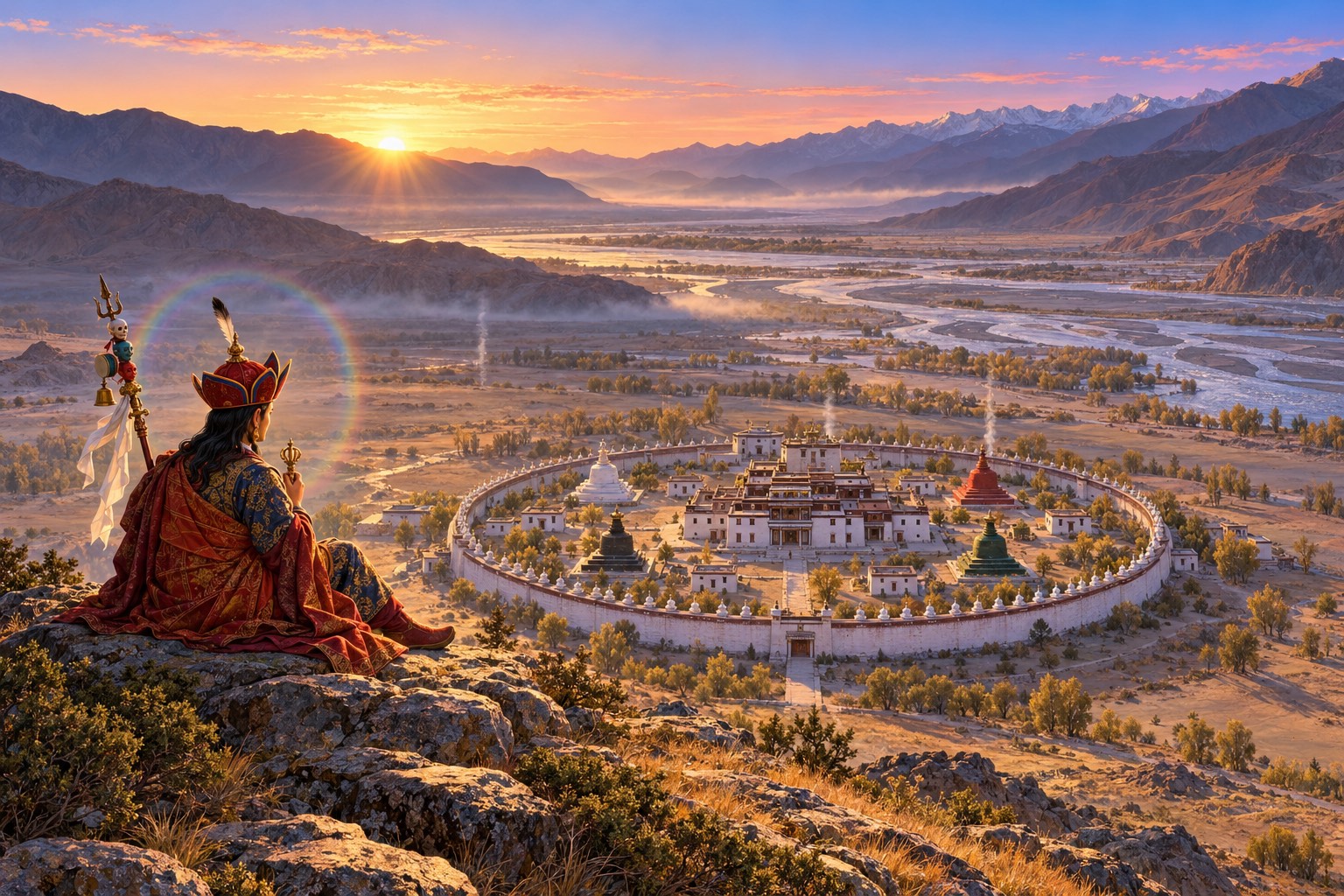
Guru Rinpoche appears in his main form: the lotus hat with a half-vajra, sun and moon and a single vulture feather; a five-pronged vajra at his heart; a skull cup holding a small vase of long-life nectar; and the khatvanga, a slender trident-topped staff, in the crook of his left arm. Beside him stand the abbot Shantarakshita in the pointed red hat of a great scholar, and King Trisong Detsen in eighth-century imperial dress based on the Dunhuang murals. Ngakchang Shakya Zangpo wears the pointed orange-red cap and red shawl of his traditional portrait. In the present-day scenes the people are tiny and unnamed, the painted eyes on the tower are kept small, and nothing in any image carries writing.
Why this matters for practice
The second line of the Seven-Line Prayer remembers Guru Rinpoche born on a lotus, and this legend imagines where that lotus birth was first wished for: by a poor woman's son, in front of a stupa he helped build for his mother. It is a story about how large and generous wishes can be, and about the long patience of kindness across lifetimes. Reciting the prayer, even once, can be a small wish of that kind, made for the good of others.
If something in this story stayed with you, a poor woman's stubborn kindness or a wish carried across lifetimes, you might make one wish of your own for the good of others, and then recite the prayer once. Its second line remembers the lotus that, in this story, a young man once asked for in front of a great white dome.
Sources and further reading
- Liberation Upon Hearing: The History of the Great Jarung Kashor Stūpa (spoken by Padmasambhava, recorded by Yeshe Tsogyal, discovered by Lhatsün Ngönmo, rediscovered by Ngakchang Shakya Zangpo; trans. Samye Translations, 2017), Lotsawa House
- Ngakchang Shakya Zangpo (author page), Lotsawa House
- Boudhanath, Rigpa Wiki (archived snapshot)
- Ba Salnang, Rigpa Wiki (archived snapshot)
- Ngakchang Shakya Zangpo, Rigpa Wiki (archived snapshot)
- Boudha (Kathmandu Valley): The Great Jarung Kashor Stupa, Nekhor (Samye Translations)
- Boudha Stupa, Wikipedia
- A Buddhist Guide to the Power Places of the Kathmandu Valley (Keith Dowman), section 32, "The Boudhnath Stupa", KeithDowman.net
- The Legend of the Great Stupa of Boudhanath (Keith Dowman, book page), KeithDowman.net
- Story of the Bouddhanath Stupa (Lama Zopa Rinpoche), FPMT / Mandala Publications
- The Legend of the Great Stupa and The Life Story of the Lotus Born Guru (trans. Keith Dowman), Dharma Publishing, 1973 (book)
This retelling is waiting to be read by a knowledgeable practitioner. Where the traditional accounts differ, the story says so; if you notice a mistake, please tell us through Share Your Story.