In many Tibetan shrine rooms, three figures sit side by side: an Indian abbot in a pointed red hat, Guru Rinpoche in his lotus hat, and a king in a tall pale turban. Tibetans call them the Abbot, the Master and the Dharma King. This is the story of the third, the man who brought the other two together.
His name was Trisong Detsen, and he ruled Tibet in the eighth century. The tradition counts him as the second of three Dharma Kings, rulers who helped the Buddha's teaching, the Dharma, take root in Tibet.
His life is told in two voices: the old chronicles and inscriptions that historians read, and the life stories that devotion has kept. Where they differ, this page will say so gently.
A boy on the throne
He was born, most historians say, in 742, in the Drakmar valley, the Valley of Red Rock where Samye would one day stand. The pilgrimage guide Nekhor records the tradition that he was born in the royal residence of Drinzang, and that light filled the valley at his birth. Only ruins remain there now.
 Illustration in preparation
His childhood ended early. In 755 his father, the emperor Me Agtsom, was killed in a palace revolt, as a stone pillar at Lhasa records. The boy was made tsenpo, emperor, at about thirteen.
For some years real power lay with his ministers. Later histories remember one of them, the regent Mazhang Drompakye, as an enemy of the new religion, and say Buddha images were buried or sent away while he ruled. Buddhism had reached Tibet a century before, but at court it was still fragile.
Turning toward the Dharma
Even so, the young king sent envoys to China to seek Buddhist teachings, around 761 and again around 763. The Testament of Ba, an early chronicle of these years kept by the Ba family, remembers these journeys, and the second was led by the minister Ba Salnang.
At about twenty, the histories say, the king quietly turned to the Dharma himself. Years later, in an edict of about 779, he described it in his own words. In Sam van Schaik's translation, he listened to teachers of virtue, and “the texts were brought before my eyes.” Then he considered how the teaching could be practised and spread.
Illustration in preparationThe same edict sums up what he learned in plain terms: that things are impermanent, that actions bring their results, and that the ten virtuous actions lead to a good rebirth. It is a modest summary, and it was the ground for everything that followed.
The life stories add a deeper layer. They see the king as an emanation, a deliberate appearance in the world, of Manjushri, the bodhisattva of wisdom. That is why paintings give him a sword and a book resting on lotus flowers at his shoulders, Manjushri's emblems.
An old promise
To build a temple and teach the Dharma, the king needed a teacher. He invited Shantarakshita, a great Indian scholar-monk. How the abbot was received, and how the walls of Samye would not stand, is told on its own page.
The Pema Kathang, the fourteenth-century Chronicle of Padma, says the abbot kept reminding the king of prayers they had made together lifetimes ago. Rigpa Wiki, following the same chronicle, tells of a poultry-keeper and her four sons in the Kathmandu valley, who long ago built the great stupa of Boudhanath, a domed monument for relics. When it was finished, each son made a wish.
Illustration in preparationThe eldest wished to be a king who would bring the Dharma to Tibet. The second wished to be a monk who would found its monastic community. The third wished to be a tantric master who would guard what his brothers built. The youngest wished to be a minister who would help them all.
The tradition names them as Trisong Detsen, Shantarakshita, Guru Rinpoche and a royal minister, though the accounts disagree about which minister. So when the abbot advised the king to invite Padmasambhava of Oddiyana, the life stories hear one brother sending for another.
Illustration in preparationWho should bow?
The king's envoys met Guru Rinpoche at Mangyul, near the border with Nepal, and he travelled slowly toward central Tibet, taming the spirits of each place as he came. The king rode out with his queens and ministers to meet him near the Tsangpo river.
The accounts place the meeting a little differently. Chokgyur Lingpa's treasure biography, The Wish-Fulfilling Tree, sets it in the tamarisk grove of Drakmar. The Pema Kathang, as Jamyang Khyentse Wangpo summarizes it, sets it on the riverbank at Zurkhar. The two lie close together, at the foot of the same valley.
Illustration in preparationThen came the awkward moment the tradition loves to tell. The abbot had bowed to the emperor. The king, lord of a vast empire, waited for this newcomer to do the same. Guru Rinpoche stood before him and did not bow.
In The Wish-Fulfilling Tree, the Guru himself recalls that the king was proud and could not yet see who stood before him, so he sang of his own realization and showed his powers. A well-known retelling, which Nekhor follows, adds that at a small gesture of his hand, flame leapt from his fingertips and scorched the king's fine robes.
Then the king bowed low, and his whole court with him. The Pema Kathang says that to confess his pride he built five stupas at Zurkhar. Five white stupas stand by the river there today, and pilgrims still connect them with that meeting.
Illustration in preparationTeachers often say this scene is about the student, not about the master's honour. A cup held upside down cannot be filled. Before the king could receive anything, his pride had to turn over.
Historians read the older sources more quietly. The Testament of Ba, as scholars summarize it, remembers Padmasambhava mainly as the master who tamed the forces troubling the work at Samye, and says he left when some at court grew suspicious of his power.
Illustration in preparationA king who asked
With the Guru's help, the traditional accounts say, Samye was built. Then, in The Wish-Fulfilling Tree, the abbot and the master spoke of going home. When the king heard, he wept, offered them gold, and begged them to stay for the sake of his people. They stayed.
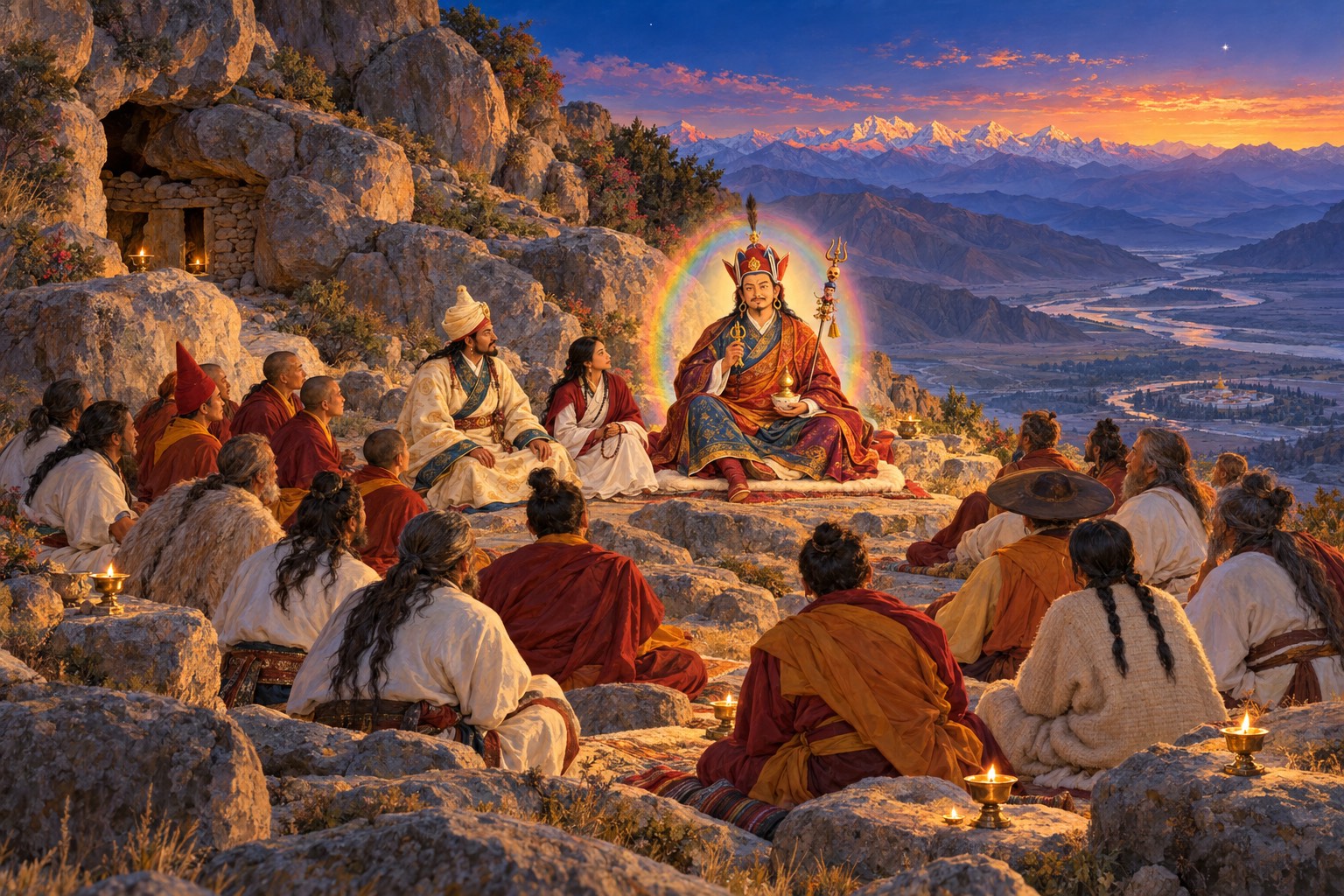
Illustration in preparationFrom then on the life stories show him less as an emperor than as a student. He climbed to the caves of Chimphu above Samye with gifts and request after request for teaching. Rigpa Wiki says the Guru opened the tantric teachings there to his twenty-five close disciples, headed by the king. Those teachings belong with a teacher, and this page leaves them there.
Illustration in preparationA king of translators
Teachings need words. The king gathered gifted young Tibetans to be trained as lotsawas, translators. Vairotsana, Kawa Paltsek and Chokro Lui Gyaltsen are among the names remembered. Some were sent to India, and Indian scholars were invited to Tibet.
In the Pema Kathang, as summarized, they translated not only scriptures but useful sciences too, such as medicine and astrology. Jamgön Mipham, in praises of the king written in 1906, honours him for commissioning the translations and having them carefully checked.
Illustration in preparationHe could be brave for his translators. When jealous ministers plotted against Vairotsana, the Pema Kathang says, the king staged a false drowning to hide him. Even so, the queen and ministers later forced Vairotsana into exile. A king could not always protect his friends.
Late in his reign, historians add, he hosted a long debate at Samye between Indian and Chinese Buddhist teachers, from about 792 to 794. Sources still differ about how it ended.
The later years
Here, too, the two voices part. In the Pema Kathang the king dies at fifty-nine, and Guru Rinpoche stays on to enthrone his sons, first Muné Tsenpo and then Mutik Tsenpo, and to comfort a grieving prince before leaving Tibet. The Wish-Fulfilling Tree tells of the king practising for seven years with his sons and disciples at Namkha Dzong in Kham.
Illustration in preparationHistorians give 797 as the end of his reign. Some say he retired that year to a palace at Zungkar and passed the throne to Muné Tsenpo; others carry his life on to 804. The Testament of Ba says his son insisted on Buddhist funeral rites instead of the old customs. He was buried among the royal tombs of the Yarlung kings.
The tradition does not let him go so easily. Later treasure revealers, among them Nyangral Nyima Özer and Jamyang Khyentse Wangpo, were counted as his emanations. Mipham's praises say such emanations will keep appearing for as long as the Buddha's teaching remains.
The disciple who bowed
The sixth line of the Seven-Line Prayer asks to follow in Guru Rinpoche's footsteps. Trisong Detsen is one of the first people the tradition shows taking that step. For him, the first step was simply setting down his pride. In the twentieth century Dudjom Rinpoche wrote a short prayer to the Abbot, the Master and the King at Samye, and it is still recited.
Illustration in preparationAbout the art
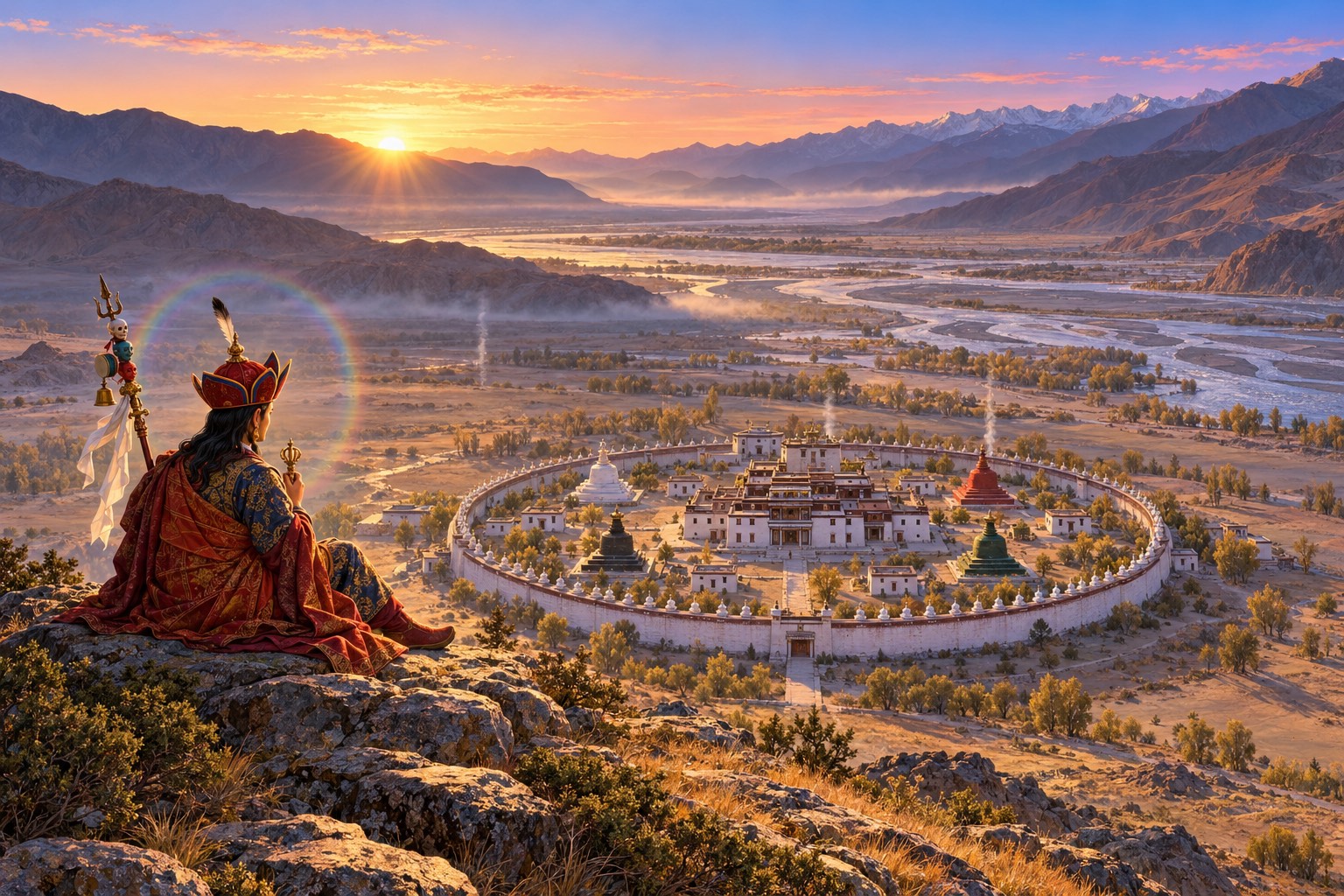
Guru Rinpoche appears in his main form, Padmasambhava: the lotus hat crowned with a half-vajra, a sun and moon and a single vulture feather; a five-pronged vajra at his heart; a skull cup holding a small vase of long-life nectar; and the khatvanga, a slender trident-topped staff resting against his left shoulder. At the river and at Chimphu he stands or sits on rock, because the story finds him travelling. Only in the final image does he sit on his lotus with sun and moon discs inside a sphere of rainbow light.
King Trisong Detsen wears dress based on surviving images of the Tibetan emperors at Dunhuang: a tall wrapped turban with a small crown panel, a long pale robe with large woven roundels and wide triangular lapels, and a patterned belt. He is drawn at three ages from the same features. In the last image he has the sword and book on lotus flowers that devotional paintings give him, the emblems of Manjushri, the bodhisattva of wisdom. Shantarakshita wears the pointed red pandita hat of a great scholar-monk, and Vairotsana the translator wears a similar hat in red.
The five white stupas at Zurkhar are drawn in a simple early form, and the great stupa of the Boudhanath legend is shown plain, without the painted eyes it has today, because the legend is set long ago. The tamarisk of the meeting grove is a feathery riverside shrub with pink flower plumes. The flame of the meeting is not shown; a faintly singed cuff stands for it. No image contains lettering.
Why this matters for practice
The sixth line of the Seven-Line Prayer expresses the wish to follow in Guru Rinpoche's footsteps, and Trisong Detsen is the tradition's first great picture of what that looks like: an emperor who lowered his head, asked for teaching, and spent his wealth so others could hear the Dharma in their own language. His first step was not a feat of meditation but the setting down of pride. Reciting the prayer, even once, can be a small version of that same bow.
If something in this story touched you, you might lower your head for a moment, as the king did by the river, and recite the prayer once. Anything beyond recitation is best explored with a teacher.
Sources and further reading
- King Trisong Detsen, Rigpa Wiki (archived snapshot)
- Padmasambhava, Rigpa Wiki (archived snapshot)
- Ba Salnang, Rigpa Wiki (archived snapshot)
- Nyang Ral Nyima Özer, Rigpa Wiki (archived snapshot)
- Jamyang Khyentse Wangpo, Rigpa Wiki (archived snapshot)
- The Wish-Fulfilling Tree: The Life Story of the Master of Uḍḍiyāna (Chokgyur Lingpa, trans. Samye Translations), Lotsawa House
- A Beautiful and Wondrous Udumbara Garland: A Supplication and Summary of the Chronicles of Padma (Jamyang Khyentse Wangpo, trans. Samye Translations), Lotsawa House
- Snowy Lands: Praises to the Great Dharma Emperor Tri Songdetsen (Mipham Rinpoche, trans. Samye Translations), Lotsawa House
- A Short Prayer to the Abbot, the Master and the King (Dudjom Rinpoche), Lotsawa House
- Guru Padmasambhava texts, Lotsawa House
- Zurkhar Do, Nekhor
- Drakmar Drinzang, Nekhor
- Hepori, Nekhor
- Buddhism and Empire IV: Converting Tibet (Sam van Schaik), early Tibet
- The Abbot, or Ironing out History's Wrinkles (Sam van Schaik), early Tibet
- Padmasambhava I: the early sources (Sam van Schaik), early Tibet
- Trisong Detsen, Wikipedia
- Tridé Tsuktsen (Me Agtsom), Wikipedia
- Mashang Drompakye, Wikipedia
- Testament of Ba, Wikipedia
- Padmasambhava, Wikipedia
- Boudha Stupa, Wikipedia
- Trisong Detsen, Encyclopedia of Buddhism
- King: Trisong Detsen (Tibet), Himalayan Art Resources (archived snapshot)
- The Three Dharma Kings (Rubin Museum painting), Himalayan Art Resources (archived snapshot)
- The Life and Liberation of Padmasambhava (Pema Kathang, revealed by Orgyen Lingpa), Dharma Publishing, 1978 (book)
- dBa' bzhed: The Royal Narrative concerning the bringing of the Buddha's Doctrine to Tibet (trans. Pasang Wangdu and Hildegard Diemberger), Austrian Academy of Sciences, 2000 (book)
This retelling is waiting to be read by a knowledgeable practitioner. Where the traditional accounts differ, the story says so; if you notice a mistake, please tell us through Share Your Story.