Some stories about Guru Rinpoche are full of wonders: a birth on a lotus, spirits tamed on mountaintops, footprints pressed into rock. This one is quieter. It is about what he is remembered as saying when people simply asked him how to live.
Guru Rinpoche, "Precious Teacher," is the name Tibetans most often use for Padmasambhava, the master from Oddiyana who, the tradition says, helped the Buddha's teaching take root in Tibet in the eighth century.
A mountain full of caves
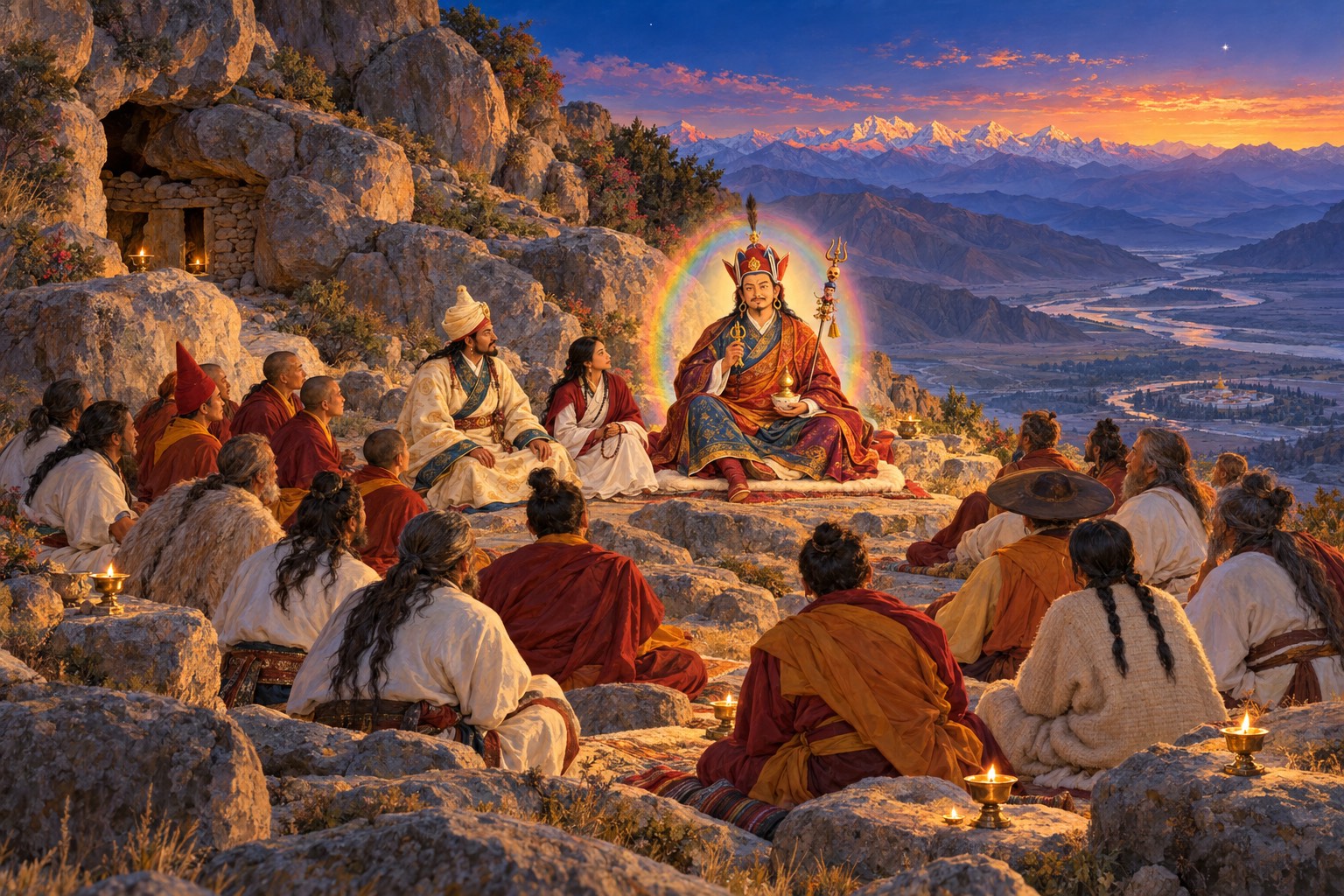
High above Samye, Tibet's first monastery, a side valley climbs to a steep slope of granite boulders and small caves. This is Chimphu. Rigpa Wiki notes that practitioners still stay there in long retreat today.
In his short guide to the place, the eighteenth-century master Jigme Lingpa writes that Guru Rinpoche stayed at Chimphu for two and a half years, teaching the disciples gathered around him. He names the caves on its slopes. One belonged to King Trisong Detsen, who had invited the Guru to Tibet. In another, he says, Yeshe Tsogyal practised for twelve years.
 Illustration in preparation
Yeshe Tsogyal was a young noblewoman of the Kharchen family who became Guru Rinpoche's closest disciple. In the tradition's memory she was also the one who asked the most questions, and who made sure the answers were not lost.
The questions of the Lady
Two books translated by Erik Pema Kunsang gather this kind of advice in English: Dakini Teachings, from 1989, and its companion, Advice from the Lotus-Born, from 1994. The foreword to the second says the teachings were spoken by Padmasambhava to his close disciples in Tibet, mostly in answer to questions from Lady Tsogyal.
Sometimes it was the king who asked. One chapter is called "Advice to Trisong Deutsen." Others carry plain titles, such as "Oral Advice on Practice," "A Spur Towards Spiritual Practice" and "Pointing the Staff at the Old Man."
Illustration in preparationAccording to the translator's prefaces, Tsogyal wrote his answers down in "dakini script," a secret coded writing. A dakini is a female embodiment of awakened wisdom, and Tsogyal herself is often called one. She then hid the writings as terma, treasure teachings, to be found centuries later by revealers called tertöns.
Illustration in preparationThe preface to Dakini Teachings says this advice was revealed by Nyang Ral Nyima Özer in the twelfth century and again by Sangye Lingpa in the fourteenth. In places their versions are almost word for word the same.
The tradition's explanation is a tender one. In earlier lives, it says, both men had been present when Guru Rinpoche spoke. Nyang Ral had been King Trisong Detsen, and Sangye Lingpa had been one of the king's sons.
Almost every chapter, Kunsang notes, says the words were given for people of the future. In a sense, Tsogyal was writing for us.
Illustration in preparationOne gentle note on dates. That same preface places Guru Rinpoche's stay in Tibet in the ninth century, while most accounts on this site speak of the eighth. The sources count the years differently, and nothing in the advice depends on it.
Not just words
The books' publisher, Rangjung Yeshe, sums up the heart of this advice: what we learn about the spiritual life has to become our own, and not stay a theory. On its page for Advice from the Lotus-Born it prints a single line of his: "Don't mistake mere words to be the meaning of the teachings."
The pieces of advice retold below come from other treasure texts of the same plain kind, which can be read freely in English on Lotsawa House. They are retold here in simple words. The books themselves are worth seeking out.
Like the sun in winter
A Garland of Vajra Gems is a short life of Guru Rinpoche that, the tradition says, Yeshe Tsogyal recorded and the nineteenth-century master Jamgön Kongtrul later revealed. Near the end of his years in Tibet, it tells, laymen and laywomen crowded around him, touching his feet to their heads and offering whatever they had.
Illustration in preparationHe told them, in the Garland's telling, that a human life with the freedom and the chance to practise is as rare as the udumbara, a flower said to bloom only once in a very long while. And it does not last. It is like the sun on a winter day, which never stays long in the sky.
What we do now, good or bad, will ripen later, he said. So do good, and keep every thought close to the Dharma, the Buddha's teaching, without drifting. Then he named practices that are learned from a qualified teacher, and this page leaves them in a teacher's care.
Illustration in preparationIt is plain advice, and it fits a short winter afternoon as well as a sleepless night. There is time, but not endless time.
Finer than flour
Lotsawa House keeps two lines attributed to Padmasambhava that Tibetan teachers often quote. His view, he says, is higher than the sky, yet his care for karma is "finer than grains of flour" (trans. Adam Pearcey).
Karma means action, and the way actions bring their results: kindness tends toward happiness, and harm toward suffering. The site's note on the lines says they are about respecting karma even while holding the highest view.
Illustration in preparationThink of roasted barley flour, tsampa, the everyday food of Tibet, running through the fingers in grains too small to count. One way to hear the lines is this: a great understanding is never a reason to be careless with small things, like a sharp word, a kept promise or a bowl of food shared.
People change the times
Another treasure, A Concise History of Orgyen Padma's Enlightened Deeds, was revealed at Chimphu itself by Orgyen Lingpa in the fourteenth century. Near its close a king of Tibet, whom the Guru addresses as Mutri Tsenpo, weeps and bows. He asks what will become of his family line and of the Tibetan people.
Illustration in preparationThe answer is not comforting at first. In the text, the Guru foretells hard centuries of good and bad kings, armies and broken kingdoms. Then he says something that could have been said yesterday: "The times don't change themselves — it is people who change them" (Samye Translations). It is bad conduct, he says, that brings on dark times.
So his advice for dark times is simple. Turn to him in prayer by day and remember him at night. Keep the good of others in your heart. And be kind to all six kinds of living beings, the gods, demigods, humans, animals, hungry spirits and hell-beings of the old Buddhist picture of the world, because every one of them, he says, has been our mother or father.
At the door
Both treasures end with Guru Rinpoche leaving Tibet for the south-west, a parting told on this site in "The Rakshasa Land." But first each of them makes the same homely promise. In the Garland he says that for any man or woman with faith in him, he has never gone away: "I sleep at their threshold" (Samye Translations). The Concise History says almost the same, that he sleeps at the door of all who have faith.
Illustration in preparationThe Garland adds a practical word for those who would never meet him face to face. Honour the images and places that stand for awakened body, speech and mind, he says, and respect the sangha, the community of practitioners. Doing so, he says, is the same as making offerings to him.
It is striking how ordinary all of this is. Remember that life is short. Take care over small actions. Be kind to every creature. Do not wait for the times to mend themselves. Remember your teacher. None of it needs a cave on a mountain.
How to hear it
These are words the tradition places in Guru Rinpoche's mouth, gathered in treasure texts revealed between the twelfth and nineteenth centuries. Jacob Dalton, writing for the Treasury of Lives, notes how little is known of Padmasambhava as a historical person, and how his legend grew richly from about the twelfth century onward.
Believers hear the Guru himself, speaking through Tsogyal's pen. Either way, the advice stands on its own feet. This page passes it on as the tradition keeps it, with no promise of any particular result.
Illustration in preparationAbout the art
Guru Rinpoche appears in his main form, as in most stories on this site: the tall red lotus hat with a half-vajra and a single vulture feather on top, layered robes of blue, red-orange and maroon, a five-pronged vajra held at his heart, a white skull cup with a small long-life vase in his lap, and the slender staff called a khatvanga resting against his left shoulder. Each is a symbol, not a weapon: the vajra stands for what cannot be broken, and the skull cup for turning ordinary experience into wisdom.
Yeshe Tsogyal is shown as a young yogini in simple white cotton robes and a dark red woollen shawl, with her hair in a single braid, the way she is drawn on this site when she is practising rather than at court. When she writes, the paper is left blank, because this site never places script inside its pictures, including the secret dakini script the tradition speaks of.
Chimphu is painted as a dry granite mountainside with small caves, some closed by low stone walls, far above the circular wall of Samye. The people who gather at Samye wear plain eighth-century wool robes, and the king who weeps is seen only from behind. The barley flour, the winter sun and the lamp on a doorstep are pictures of the advice itself, not of events in the texts.
Why this matters for practice
The sixth line of the Seven-Line Prayer is a wish to follow in Guru Rinpoche's footsteps, and this advice is what those footsteps look like on an ordinary day: remembering that life is short, taking care over small actions, being kind to every creature. Reciting the prayer can be a way of bringing that advice back to mind. And the promise the tradition keeps, that he sleeps at the door of anyone with faith, makes the prayer feel less like calling into the distance and more like speaking to someone near.
If something in this story stayed with you, you might carry one small piece of the advice into tomorrow, and tonight recite the prayer once, as a way of remembering the teacher who, in the tradition's words, keeps watch at the door of anyone with faith.
Sources and further reading
- Advice from the Lotus-Born (front matter: contents, foreword by Erik Pema Kunsang, and sources list), Rangjung Yeshe Wiki (Internet Archive snapshot)
- Dakini Teachings (front matter: publication data and translator's preface by Erik Pema Kunsang), Rangjung Yeshe Wiki (Internet Archive snapshot)
- Advice From the Lotus-born, Rangjung Yeshe Publishing
- Dakini Teachings, Rangjung Yeshe Publishing
- A Garland of Vajra Gems: The Life and Liberation of the Guru, revealed by Jamgön Kongtrul Lodrö Tayé (trans. Kaleb Yaniger and Stefan Mang, Samye Translations, 2018), Lotsawa House
- A Concise History of Orgyen Padma's Enlightened Deeds, revealed by Orgyen Lingpa (trans. Kaleb Yaniger and Stefan Mang, Samye Translations, 2016), Lotsawa House
- My view is higher than the sky..., attributed to Padmasambhava (trans. Adam Pearcey, 2004, revised 2025), Lotsawa House
- The Kalaviṅka's Call: A Guide to Glorious Samyé Chimpu, by Jigme Lingpa, Lotsawa House
- Samye Chimphu, Rigpa Wiki (Internet Archive snapshot)
- Padmasambhava, Rigpa Wiki (Internet Archive snapshot)
- Padmasambhava, by Jacob Dalton (Internet Archive snapshot, 2014), Treasury of Lives
This retelling is waiting to be read by a knowledgeable practitioner. Where the traditional accounts differ, the story says so; if you notice a mistake, please tell us through Share Your Story.