Children who hear the stories of Guru Rinpoche often ask a simple question at the end. Where did he go?
The traditional accounts give an answer that sounds like a fairy tale: south-west, across the sea, to the land of the rakshasas. Yet the old texts linger less on where he went than on something he is remembered as saying before he went. He would not really be gone.
The land in the south-west
Guru Rinpoche, the "Precious Teacher" Padmasambhava, is the eighth-century master Tibetans remember for helping to bring the Buddha's teaching to their country. The tradition says that after many years there, he told them his work among them in that body was done.
In The Wish-Fulfilling Tree, a treasure text revealed by Chokgyur Lingpa in the nineteenth century, he recalls a prophecy of the Buddha: one day the rakshasas would pour out of the south-west. A treasure text, or terma, is a teaching the tradition says he hid, to be found by a later master. So, the account says, he had to go and tame them.
 Illustration in preparation
Rakshasas are fierce beings of old Indian and Tibetan tales, rather like the ogres of other people's stories. Rigpa Wiki places their land, Ngayab Ling, called Chamara in Sanskrit, on one of the small continents that the old Buddhist picture of the world sets beside our own, to its south-west.
In that picture they are a danger to the human world, like a storm gathering far away. The retellings say little more about them. They tell instead that he calmed them and made his home there, on the Copper-Coloured Mountain. That mountain has its own story on this site, "The Copper-Coloured Mountain."
Illustration in preparationA prayer for afterwards
Long before the day he left, the tradition says, his disciples were already thinking about afterwards. The Prayer in Seven Chapters, or Le'u Dünma, a treasure revealed in the fourteenth century by Tulku Zangpo Drakpa, opens at Samye, Tibet's first monastery, in the year 766.
Five disciples gathered around him there, it says, among them King Trisong Detsen, his son the prince Mutri Tsenpo, and the lady Yeshe Tsogyal. They asked for a prayer short enough for ordinary people to say morning and evening, for themselves and for all who would come later.
Illustration in preparationThe king asked for a prayer for himself and for people of the future who had devotion. Yeshe Tsogyal, his closest disciple, asked for something more tender still.
Let it be a prayer so strong, she said, that even after he had gone back to the realm of the dakinis, the sky-dancers who embody awakened wisdom, he would come to any Tibetan who said it with devotion, wherever they might be.
Illustration in preparationThe first chapter answered them all, and each of the five was given a chapter of their own. The seventh, as we will see, came at the very end.
At the pass
Then came the leaving. The accounts say a great crowd walked with him to the Gungthang pass in Mangyul, on Tibet's border with Nepal. The pilgrimage guide Nekhor adds that tents were pitched and he went on teaching for three more days. Rigpa Wiki says he gave final teachings to each of them.
Illustration in preparationThe last chapter of the Le'u Dünma keeps one of these farewells. King Trisong Detsen had died. His son the prince bowed to the ground, held the edge of the Guru's robe and wept. Who will we turn to, he asked, when hard times come? Then, the text says, grief overcame him and he fainted.
Guru Rinpoche revived him and gently laid the prince's head in his lap. When he spoke, his first words were about coming, not going. "Still I shall come for the benefit of Tibet," he says in the Rigpa Translations version, and to those with devotion he would appear in person.
Illustration in preparationVerse after verse, he asks the prince not to despair. They will meet again and again, he says, in this life and beyond it. He will keep the prince's family and people in his care.
What he left behind
The Wish-Fulfilling Tree tells the moment differently. There, the prince's sadness lifts when Guru Rinpoche explains what he will leave: likenesses to stand for his body, hidden treasures for his speech, and the realisation of his heart entrusted to disciples destined to carry it.
The Testament Prayer, drawn from that book, calls all this his "loving testament" to the Tibetan people (Rigpa Translations). The tradition keeps both tellings side by side.
Illustration in preparationA prayer for every hour
Before the Le'u Dünma closes, the prince turns to his own people. Say the first chapter whenever you remember him, he tells them, this one in the evening, this one before first light, this at dawn, this in the afternoon, this at midnight and this at midday. And say any of them whenever suffering comes near.
It is a quiet, practical gift. The whole day, from dark to dark, is given a prayer to hold.
Illustration in preparationThen he went. The Le'u Dünma has him ride away on a ray of sunlight. Rigpa Wiki recalls an older life story in which he turned his face back from the south-west and sent his disciples a ray of loving kindness. The farewell itself is told on this site in "The Hiding of the Treasures."
Illustration in preparationNo coming and no going
Other treasure texts carry the same promise in other words, and the day they name most often is the tenth of each lunar month. In Jigme Lingpa's prayer for the tenth day, Guru Rinpoche says he will come to Tibet on every tenth day. How that day is kept is told in "Why the Tenth Day Belongs to Guru Rinpoche."
The most striking words come from a short treasure revealed by Ratna Lingpa, The Invocation of Uddiyana on the Tenth Day. In it he says that after he has gone to the land of the rakshasas, he will return on the tenth day of every month. Then he says something gentler, and deeper.
In truth, he says, for him there is "no traveling and no remaining" (Samye Translations). People think of him as living in the rakshasa land, and in one sense he does. Yet because his compassion never breaks off, he is beside everyone who has faith in him.
Illustration in preparationHe even says what a meeting is. Kindness rising in the mind, compassion suddenly welling up, remembering him for a split second: that too, he says, is meeting him. Earlier in the same text he asks only to be remembered for an instant, even in the middle of eating, drinking and going about the day.
How to hear it
These are words the tradition places in his mouth, and many people treasure them as a promise of presence, of someone who answers when called. Himalayan Art Resources, describing paintings of the mountain, puts the belief plainly: he still lives there, and makes himself available to those devoted to him. This page passes all of it on as the tradition's words, not as a promise of any particular result.
Historians look from another side. Jacob Dalton, writing for the Treasury of Lives, notes how little is known of Padmasambhava as a person of history, and how richly his legend grew over the centuries. The tradition dates his leaving to 864, long after King Trisong Detsen's reign. Even the prince's name varies: Rigpa Wiki calls the young king at the pass Mutik Tsenpo.
None of this changes the simple thing the farewell stories share. They are about a teacher who, at the very moment of leaving, spoke mostly about coming back.
Illustration in preparationAbout the art
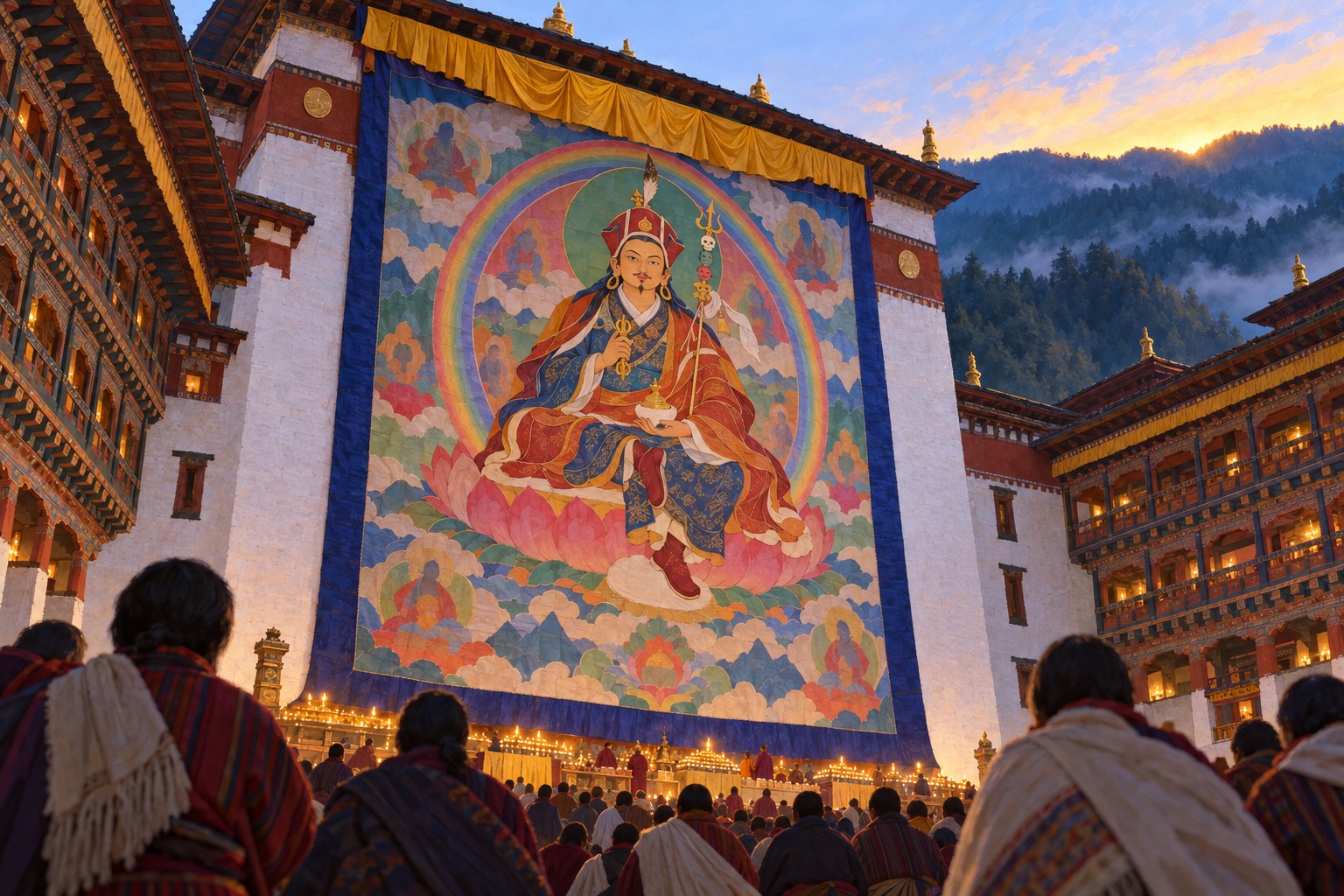
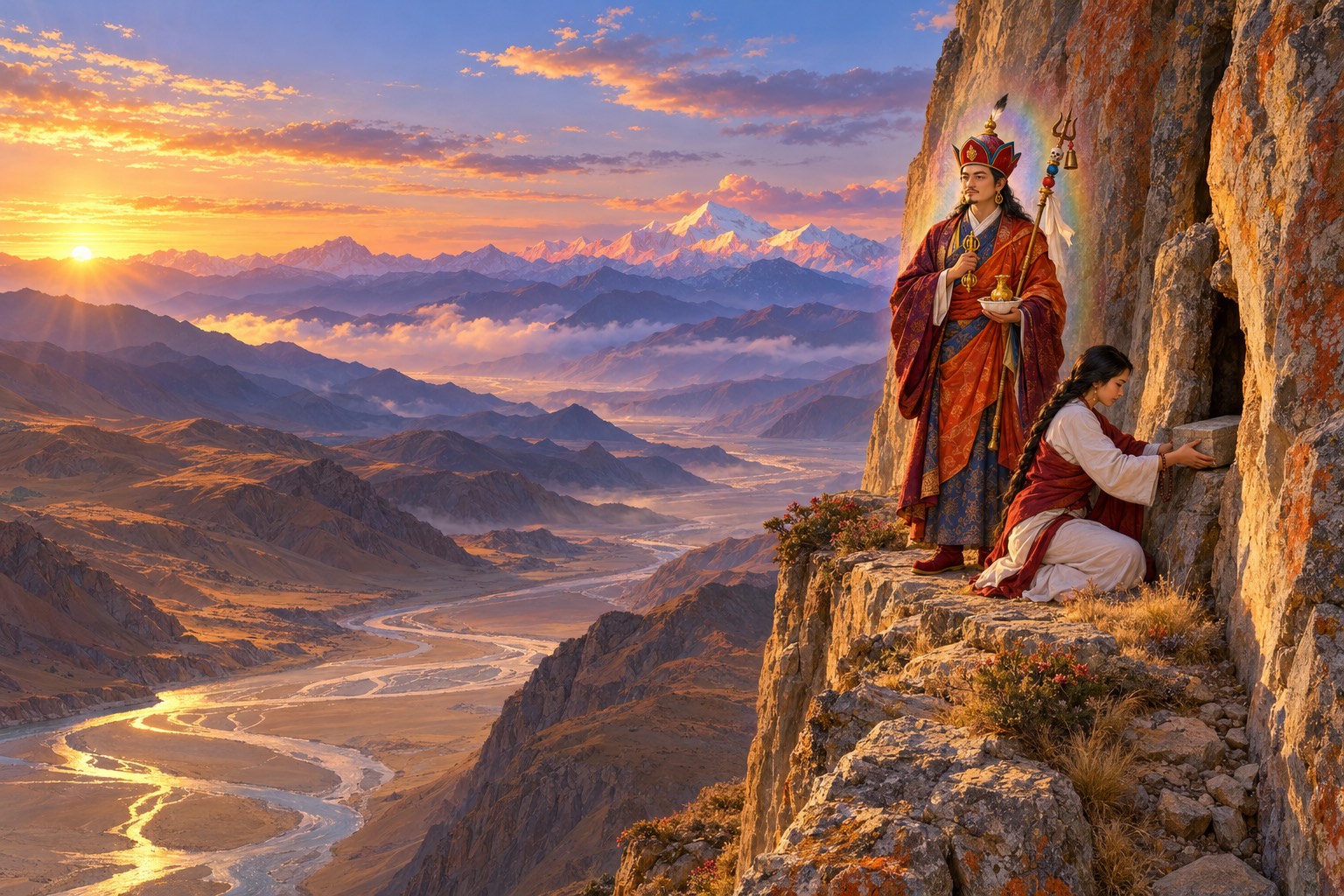
Guru Rinpoche appears on this page in his main form only: the five-petalled red lotus hat with a half-vajra and a single feather, a golden five-pronged vajra at his heart, a white skull cup holding a small long-life vase in his lap, and the slender staff called the khatvanga resting against his left shoulder. He keeps this form at Samye, on the pass and in the sky, so that the moment, not a change of costume, carries the story. The rainbow light around him is the traditional sign of an awakened presence.
King Trisong Detsen and his son the prince wear eighth-century Tibetan imperial dress as seen in the Dunhuang murals: a tall wrapped turban, and a long heavy robe closing left over right with wide triangular lapels. The king wears cream, the prince russet red, so father and son can be told apart. Yeshe Tsogyal appears as a young yogini in white robes and a dark red shawl. All are painted after the manner of traditional depictions, not as likenesses.
The rakshasas are never drawn. Paintings of the Copper-Coloured Mountain often fill the land below it with fierce figures; here their land is shown only as a storm seen from very far away, and later as that storm grown quiet. The three objects on the stone stand for what the accounts say he left: a likeness for his body, a sealed treasure for his speech, and a lamp for the realisation entrusted to his heirs. The arrangement is an illustration, not a ritual. No writing appears anywhere, including on the casket.
Why this matters for practice
The seventh line of the Seven-Line Prayer asks Guru Rinpoche to come and grant his blessings, and the farewell stories are the tradition's reason for asking: at the moment of leaving, he is remembered as promising to come to anyone who calls with devotion. The prince's advice turns that promise into something simple enough for anyone, a prayer for whatever hour it happens to be. Reciting the prayer can be a way of taking the old farewell at its word.
If something in this story touched you, you might do what the prince told his people to do, at whatever hour it is where you are, and recite the prayer once. In the tradition's own telling, even a moment of remembering him is a kind of meeting.
Sources and further reading
- Le'u Dünma, Chapter 7: The Prayer to Guru Rinpoche that Spontaneously Fulfils All Wishes (Sampa Lhundrupma), revealed by Tulku Zangpo Drakpa (trans. Rigpa Translations), Lotsawa House
- Le'u Dünma, Chapter 1: The Prayer to the Three Kaya Guru, revealed by Tulku Zangpo Drakpa and Rigdzin Gödem (trans. Rigpa Translations), Lotsawa House
- Le'u Dünma, Chapter 2: The Prayer Requested by King Tri Songdetsen (trans. Rigpa Translations), Lotsawa House
- Le'u Dünma, Chapter 3: The Prayer Requested by Khandro Yeshe Tsogyal (trans. Rigpa Translations), Lotsawa House
- Le'u Dünma, Chapter 6: The Prayer Requested by Prince Mutri Tsenpo (trans. Rigpa Translations), Lotsawa House
- The Invocation of Uddiyana on the Tenth Day, revealed by Ratna Lingpa (trans. Peter Woods and Stefan Mang, Samye Translations, 2019), Lotsawa House
- A Prayer Invoking the Benefits of the Festival of the Tenth Day, by Jigme Lingpa (trans. Rigpa Translations, 2013), Lotsawa House
- The Wish-Fulfilling Tree: The Life Story of the Master of Uddiyana, revealed by Chokgyur Dechen Lingpa (trans. Erik Pema Kunsang and Samye Translations, 2020), Lotsawa House
- The Testament Prayer to Orgyen Rinpoche, revealed by Chokgyur Dechen Lingpa (trans. Rigpa Translations, 2015), Lotsawa House
- Guru Rinpoche, Rigpa Wiki (Internet Archive snapshot)
- Ngayab Ling, Rigpa Wiki (Internet Archive snapshot)
- Le'u Dünma, Rigpa Wiki (Internet Archive snapshot)
- Mutik Tsenpo and Mutri Tsenpo, Rigpa Wiki (Internet Archive snapshots)
- Gungthang Pass, Nekhor
- Padmasambhava: Copper Coloured Mountain (set 491, Jeff Watt), Himalayan Art Resources
- Padmasambhava leaving Tibet from the Gungtang Pass, item 36517, Himalayan Art Resources
- Padmasambhava, by Jacob Dalton (Internet Archive snapshot, 2014), Treasury of Lives
This retelling is waiting to be read by a knowledgeable practitioner. Where the traditional accounts differ, the story says so; if you notice a mistake, please tell us through Share Your Story.