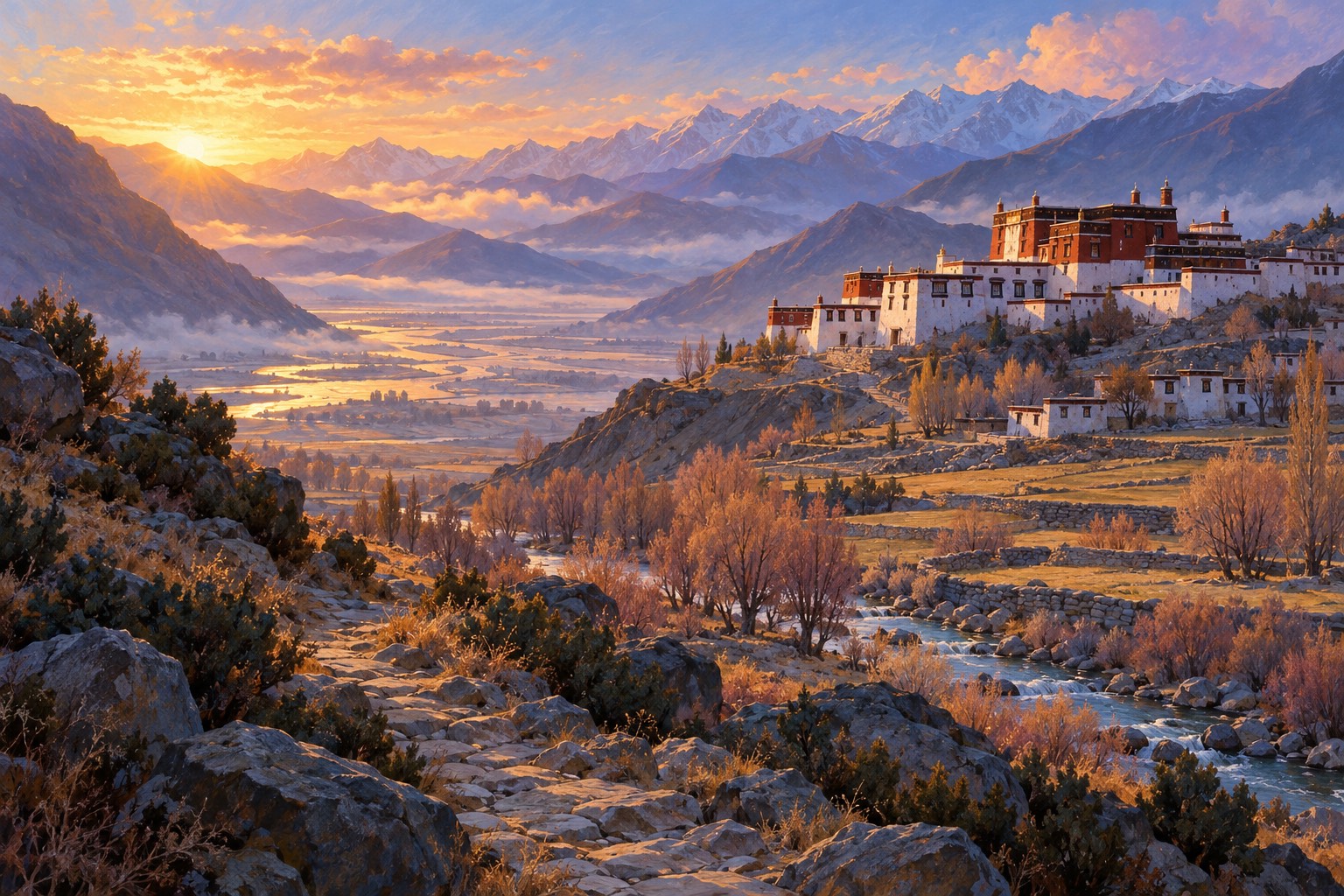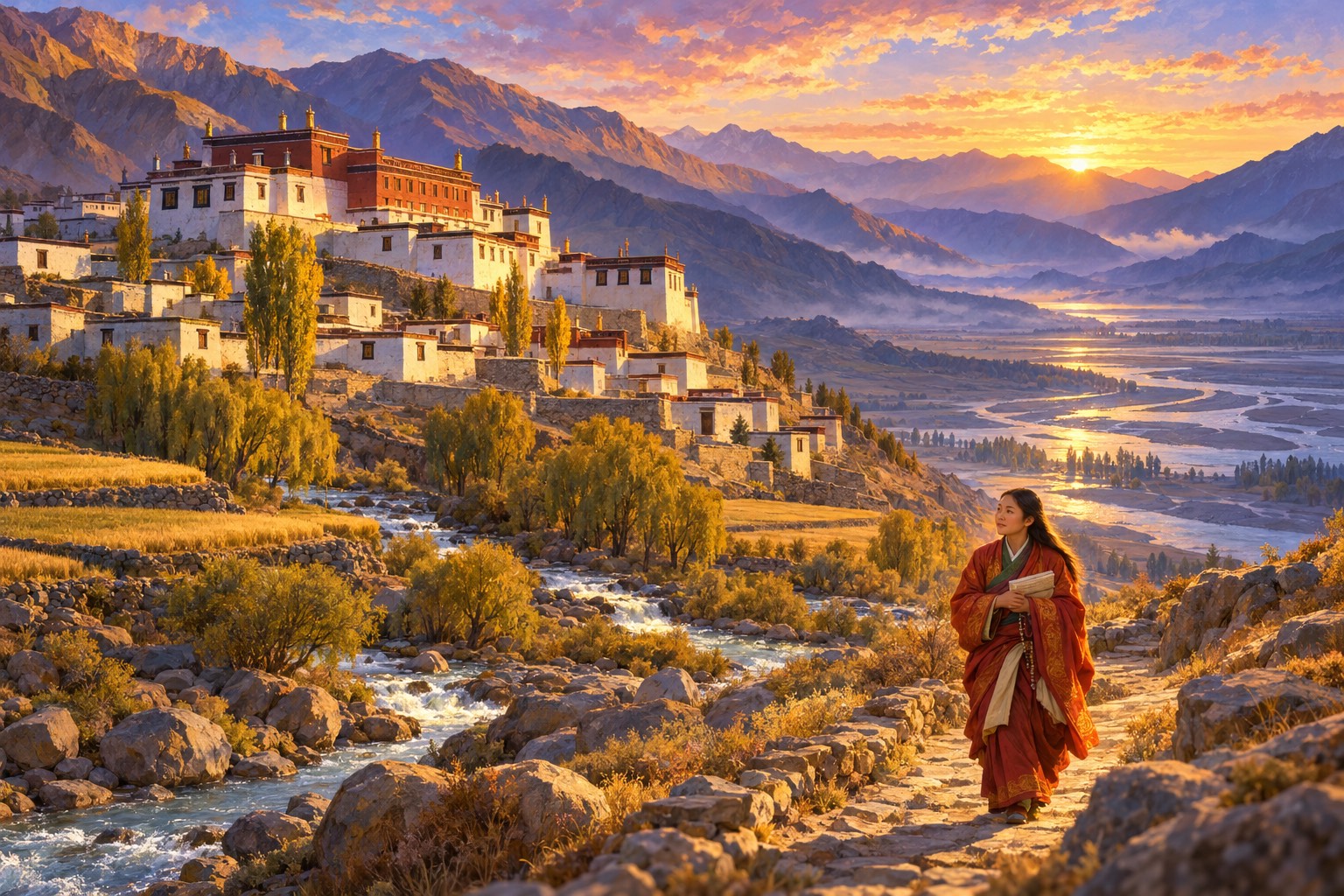
In the far east of Tibet, in the forested country of Kham, a monastery stands on a mountainside above a river. Its full name is Palyul Namgyal Jangchub Chöling. People simply call it Palyul, which means something like "glorious land."
It was founded in the 1660s, and over time it became one of the six great "mother monasteries" of the Nyingma, the oldest school of Tibetan Buddhism and the school of the Seven-Line Prayer to Guru Rinpoche. Its first throne-holder, the lama who first held its seat, was Rigdzin Kunzang Sherab. This is his story, and the story of the place he looked after.
A boy who would not sleep
Palyul's own history says Kunzang Sherab was born in 1636, the year of the Fire Rat, in a village called Ah Chog in the Bubor area of Kham. Most sources agree on that year. One Treasury of Lives entry gives 1638 instead.
The same history remembers him as a gentle child who would not hurt even the smallest creature, and who learned many prayers by heart. It says that as a boy he tied up his hair at night so that he would not drift off to sleep in the middle of his practice.
 Illustration in preparation
Two teachers, an old one and a young one
As a young man he studied with several great masters. Namdroling Monastery in India lists him among the chief disciples of Karma Chakmé, a famous yogi and scholar of the Karma Kagyu school who also held Nyingma lineages. Karma Chakmé spent most of his life in retreat. Namdroling's account says that from the age of thirty-seven he stayed sealed in his hut for thirteen years, teaching through a small opening in the wall.
Illustration in preparationKarma Chakmé's birth is given as 1613, 1610 or 1609, depending on the source. All agree that he died in 1678. His prayer for rebirth in Sukhavati, the pure land of the Buddha Amitabha, is still widely recited today.
In 1655, the Treasury of Lives says, Karma Chakmé met a boy of about eleven from a family that had fallen on hard times. He recognized the boy as the rebirth of a lama of Katok, an old Nyingma monastery nearby, and took him into his care. The boy was given the name Mingyur Dorje.
Illustration in preparationTreasures from the sky
Mingyur Dorje became a tertön, a revealer of hidden teachings. In the Nyingma tradition such teachings, called terma or treasures, are said to have been concealed by Guru Rinpoche and found centuries later by the right person at the right time. Some are found as objects. Others, called mind treasures, arise in the revealer's mind in visions.
Most of Mingyur Dorje's revelations were of this second kind. Lotsawa House dates one of his visions of Amitabha to 1657, when he was twelve. The boy spoke what he received, and his teacher wrote it down. In time the teachings filled thirteen volumes.
Illustration in preparationThey became known as the Namchö. Translations vary: "Sky Dharma," "Sky Treasures," or, as Namdroling puts it, "Space Treasures." The traditional accounts say that during these years the boy saw many buddhas and teachers in vision, among them Guru Rinpoche himself.
Illustration in preparationSo a strange and lovely thing happened. The old master became the student of the boy he was raising. The Treasury of Lives says Mingyur Dorje gave Karma Chakmé the empowerments of the very teachings the older man had written down for him.
In 1663, when Mingyur Dorje was nineteen, Karma Chakmé told him he was grown now and would go his own way. The young tertön travelled across Kham at the invitation of Kagyu, Nyingma, Sakya and Bon communities alike. At Katok, the Treasury of Lives says, he finally won over the monks who had once doubted that he was their lama reborn.
The third teacher
Around this time Karma Chakmé met another master of Kham, the treasure revealer Rigdzin Düddul Dorje. The Treasury of Lives says Düddul Dorje sent gifts ahead and received the young tertön with great honour, and that the two exchanged teachings.
Illustration in preparationKunzang Sherab studied with Düddul Dorje too. Katok's own history of its early masters names him among Düddul Dorje's disciples, as "Palyul's founder." Düddul Dorje carried the treasure lineage of an earlier master, Jatsön Nyingpo; Story 41, "Jatsön Nyingpo and the Union of the Precious Ones," tells how that lineage reached Katok and Palyul.
Palyul's own history calls Mingyur Dorje his guru, and Namdroling says Kunzang Sherab received the Namchö from him.
The sources do not quite agree about who taught whom. Himalayan Art Resources describes Kunzang Sherab as a student of Karma Chakmé and a teacher of Mingyur Dorje. Rigpa Wiki adds the Fifth Dalai Lama to his teachers. However the threads ran, all three masters stand behind him.
Illustration in preparationThe time has ripened
In the mid-1660s a new monastery was built in southern Derge, one of the kingdoms of Kham. Namdroling says it was built in 1664 by Lachen Jampa Phuntsok, the ruler of Derge, with his minister Trichen Sangye Tenpa. The Treasury of Lives calls the patron the abbot of Derge's great monastery, and dates the founding to 1665. Namdroling adds that a small retreat place had stood on that hillside since the ninth century.
The king invited Kunzang Sherab to lead it. Palyul's history says he asked Mingyur Dorje what to do, and was told that the time had ripened for him to work for the good of beings. In 1665, the year of the Wood Snake, at about thirty years old, he arrived to take his seat.
Rigpa Wiki mentions a founding date of 1632 as well, before Kunzang Sherab was born. It may remember the older temple on the site. Most sources give 1665.
Illustration in preparationA tradition of practice
Kunzang Sherab gave Palyul a shape it has kept ever since. Its teachings bring together kama, the long unbroken line of teachings passed from teacher to student since Guru Rinpoche's time, and terma, the revealed treasures.
Namdroling names some of the treasures at the heart of the tradition: the Namchö of Mingyur Dorje, the treasures of Ratna Lingpa, Karma Lingpa and Jatsön Nyingpo, and the great Kagyé cycles of Nyangral Nyima Özer and Guru Chöwang. Palyul's website calls the lineage "the tradition of accomplishment," meaning one centred on practice and retreat. These are practices received from a qualified teacher, so this page only names them; the Find a Teacher page can help.
Illustration in preparationMingyur Dorje did not live long. He died in 1667, at twenty-three. The Treasury of Lives says his relics were shared among many monasteries, Palyul among them, and that Kunzang Sherab built a temple with a reliquary stupa, a shrine holding a teacher's remains, and had a statue of him made.
Illustration in preparationUnder Kunzang Sherab, Palyul's website says, the monastery grew to some three thousand monks, and his disciples founded branch monasteries of their own. His nephew, Pema Lhundrup Gyatso, came to live with him at sixteen and later became the second throne-holder.
Illustration in preparationSpring in winter
Palyul's history says Kunzang Sherab passed away in 1699, the Earth Rabbit year, at sixty-four. It says the weather turned warm out of season, buds opened, and at the cremation rainbows filled the sky. Rigpa Wiki also gives 1699. The Treasury of Lives gives 1698, and one of its entries 1689.
Illustration in preparationThe lamp carried on
Palyul did not end with him. Rigpa Wiki counts it among the six mother monasteries with Katok, Dorje Drak, Mindrolling, Dzogchen and Shechen, and calls it the principal keeper of Ratna Lingpa's lineage and the Namchö.
A long line of throne-holders followed. Rigpa Wiki says that by the twentieth century Palyul had more than four hundred branch monasteries. The Treasury of Lives says that in the nineteenth century the reborn Kunzang Sherab was recognized in Gyarong and given the title Gyatrul.
In 1959, when many thousands of Tibetans fled their country, the eleventh throne-holder, Penor Rinpoche (1932–2009), went into exile too. In southern India, at Bylakuppe in Karnataka, he laid the foundation stone of a new monastery in 1963. He named it Namdroling.
Illustration in preparationIt grew into one of the largest Nyingma monasteries in the world. Rigpa Wiki says that each autumn, following the custom of Palyul, Penor Rinpoche gave a month of teachings from Mingyur Dorje's Namchö. In Tibet, Rigpa Wiki says, the mother monastery has a living head of its own, the fifth Karma Kuchen Rinpoche. The teachings of the boy and the old yogi, and the monastery a young lama took over at thirty, are still alive in Tibet and in exile.
Illustration in preparationAbout the art
Kunzang Sherab is drawn after an eighteenth-century painting now in the Rubin Museum, shown on Himalayan Art Resources (item 777), where he is named by an inscription. He wears a tall red-and-orange lotus hat with long red lappets falling over his shoulders, the hat Himalayan Art Resources says is typical of the Palyul tradition, with an orange shawl and a green scarf. His hands are raised at his heart in the teaching gesture. His hat has no half-vajra or sun-and-moon emblem, so it is not confused with Guru Rinpoche's. In the scenes of his youth he is drawn bareheaded, because no portrait shows him young.
Karma Chakmé and Mingyur Dorje both appear in the same painting, at either side of Kunzang Sherab. Karma Chakmé wears a red pointed cap and red robes and holds a small golden vase. Mingyur Dorje is a youth in white robes with his hair in a topknot, as in a seventeenth-century painting of his life. Düddul Dorje is suggested only by a distant rider in the white and red dress of a lay treasure revealer.
Guru Rinpoche appears once, in a vision, in his main form: lotus hat with one vulture feather, vajra at the heart, skull cup with a long-life vase, the khatvanga staff in the crook of his arm, and a sphere of rainbow light. The stupa is a reliquary, a shrine for a teacher's remains. Books are Tibetan loose-leaf volumes, shown blank. No twentieth-century or living teacher is pictured; the exile and Namdroling are shown only as a landscape with tiny distant figures.
Why this matters for practice
Kunzang Sherab spent his life following his teachers and making a place where their teachings could be practiced, which is what the sixth line of the prayer asks: to follow in Guru Rinpoche's footsteps. The tradition he shaped still holds treasures that come from Guru Rinpoche, and its full practices belong with a teacher. But the seven lines are open to anyone, and one recitation joins the same current that has run through Palyul for three and a half centuries.
If something in this story moved you, you might pause tonight and recite the prayer once, adding your voice to the long line that runs from Guru Rinpoche through Mingyur Dorje, Karma Chakmé and Kunzang Sherab to the lamps still burning at Palyul and Namdroling.
Sources and further reading
- Palyul Lineage: First Throneholder Kunzang Sherab, Palyul Ling International (palyul.org)
- Pelyul Monastery; Namcho Mingyur Dorje (Samten Chhosphel, 2011), The Treasury of Lives
- Palyul Monastery; Six "Mother" Nyingma Monasteries; Throneholders of Palyul Monastery; Namdroling Monastery; Penor Rinpoche; Karma Chakmé; Tertön Mingyur Dorjé, Rigpa Wiki (via web.archive.org)
- Karma Chakme; Tertön Mingyur Dorje, Lotsawa House
- Palyul Tradition; Terton Mingyur Dorje; Mahasiddha Karma Chagmed; home page, Namdroling Monastery (namdroling.net)
- Duddul Dorje, Kathok Dorjeden (kathok.org.sg)
- Teacher (Lama): Rigdzin Kunzang Sherab (item 777); Namcho Mingyur Dorje (item 44692); Tradition: Payul (Nyingma), Himalayan Art Resources
This retelling is waiting to be read by a knowledgeable practitioner. Where the traditional accounts differ, the story says so; if you notice a mistake, please tell us through Share Your Story.