In the first half of the twentieth century, lamas all over eastern Tibet spoke of one master as a teacher of teachers. His name was Jamyang Khyentse Chökyi Lodrö, and his home was Dzongsar, a monastery on a rocky spur in Kham, the wide eastern country of Tibet.
He held the teachings of every Tibetan school and was a living heart of what is called Rimé, the non-sectarian spirit that honours all traditions without ranking them. Beneath all that learning ran something simpler: a lifelong devotion to Guru Rinpoche, the Lotus-Born master of the Seven-Line Prayer. This story follows that devotion from the valleys of Kham to the lakes and caves of the Guru's deeds, and to a last home in Sikkim.
A boy for two monasteries
He was born in 1893 near Katok Monastery, south of Derge, the son of a tantric master, Gyurme Tsewang Gyatso, and of Tsultrim Tso. The great Jamyang Khyentse Wangpo of Dzongsar had died the year before.
When the boy was about seven, his own short autobiography says, Jamgön Kongtrul named him as Khyentse Wangpo's "activity" emanation, one of several children recognized as carrying on that master's work. He was brought up and schooled at Katok. In his mid-teens (the sources give fourteen or fifteen) he was called to Dzongsar to take his predecessor's seat.
Over the years he studied with more than eighty teachers of every school. Yet in that same autobiography he says, in the self-deprecating way of Tibetan masters, that he had not really taken any of it to heart.
His love for Guru Rinpoche shows early. A short prayer to the Guru, translated on Lotsawa House, is signed in 1919 by Dharmamati, the Sanskrit form of his name, who calls himself a "youthful servant" of the Guru's teachings. He was twenty-six.
 Illustration in preparation
Sacred ground at home
Kham is full of places the tradition links to Guru Rinpoche, and he cared for them. Probably in 1924 he wrote a short prayer to Pema Shelpuk, the Lotus Crystal Cave near Dzongsar, where his predecessor and Chokgyur Lingpa had opened a place of retreat, as told in The Treasure Friends of Kham.
Treasury of Lives tells of more. At Dzongsar he founded a college for study, the Khamjé shedra, and a retreat centre for it at Karmo Taktsang, a cliff hermitage above the monastery. At Katok he built a temple of Zangdok Palri, the Copper-Coloured Mountain where the tradition says Guru Rinpoche now dwells.
Illustration in preparationIn 1952, the same source says, he and his wife, Khandro Tsering Chödrön, opened a new sacred site on a mountainside above Dzongsar, called Khyungchen Paldzong, wrote a description of it and installed statues of Padmasambhava there. To "open" a site, in Tibet, means to recognize a place as blessed and make it known to pilgrims, usually with a written guide.
Illustration in preparationLeaving Kham
By 1955 the signs of coming upheaval in Kham were plain. Treasury of Lives says he saw that devastation was near, and he left Dzongsar that year. His autobiography gives the day he set out as the twenty-third of the sixth Tibetan month; a timeline on Rigpa Wiki speaks of a quiet departure in the ninth. He did not see Dzongsar again. The monastery was destroyed in 1958, and has since been rebuilt.
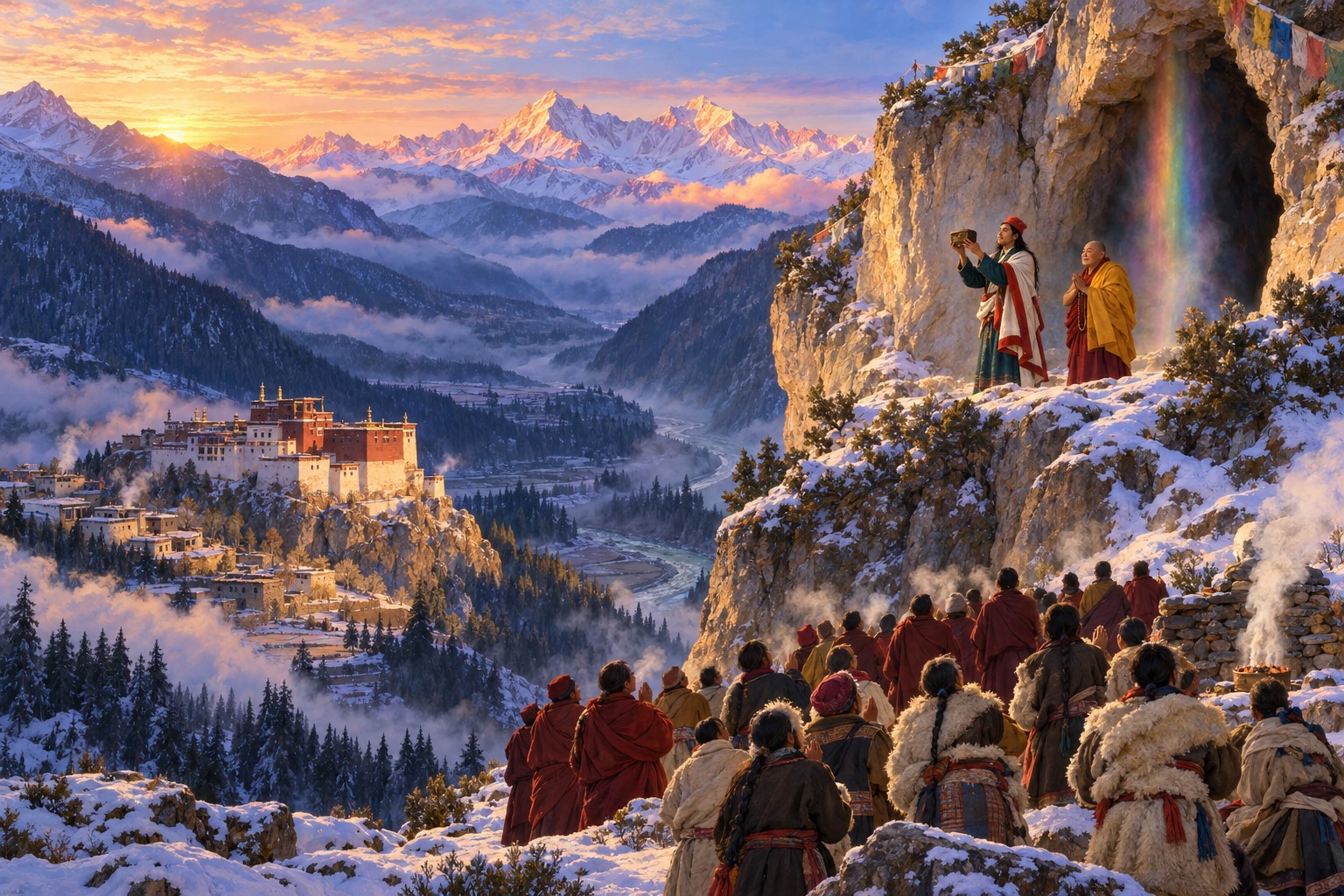
Even on the road he wrote for pilgrims. In the seventh month of that year, in the upper valley of Sengchen Namdrak, the Great Lion Sky Rock, one of the twenty-five great sacred sites of eastern Tibet, he wrote a short guide to the place. Beside the old words of blessing, it asks pilgrims plainly to give up hunting and the killing of wild animals there.
Illustration in preparationIn the footsteps of the Lotus-Born
More than a year of pilgrimage followed, through central Tibet, India and Nepal, and much of it traced Guru Rinpoche's own life. The Rigpa Wiki timeline follows him month by month: Lhasa and Tsurphu over the turn of the year, then Mindroling, then Samye and Chimphu in the spring of 1956, and Lhodrak in the summer.
Samye, the first monastery of Tibet, was built with Guru Rinpoche's help (told in The Building of Samye). It keeps a statue of the Guru called "Looks Like Me", which the tradition says he blessed as his true likeness.
On the twentieth day of the third month of 1956, during a tsok, a feast offering made with prayers and song, Chökyi Lodrö wrote a prayer in front of that statue at the request of an attendant of the Dzogchen Rinpoche. Rigpa Translations later rendered it in English as A Yearning Plea to the Precious Guru.
Illustration in preparationAbove Samye lie the caves of Chimphu, where the Guru and his disciples are remembered practising in retreat. Further south, in Lhodrak, he stopped at Kharchu, the caves of Namkhai Nyingpo, whose own story tells of the praise he wrote there. At Yerpa, near Lhasa, he wrote a praise of the place in its Moon Cave, remembering that Guru Rinpoche and the abbot Shantarakshita had blessed it; its closing note gives no year, so it may come from this journey or an earlier one.
Illustration in preparationAt each place he did what pilgrims have always done. His autobiography says he made offerings with his own hands, and that again and again he made aspiration prayers, heartfelt wishes, for the welfare of the whole world, and of Tibet and Kham in particular.
Those who met him remembered how much he carried. Tulku Urgyen Rinpoche recalled, as Rigpa Wiki reports, that you could ask him about any point in any treasure teaching of any lineage, and he always had an answer. Yet his autobiography ends by calling him simply an old monk, and insists he had little to tell of visions.
Illustration in preparationOver the mountains
In the tenth month of 1956, by the timeline, he reached Bodhgaya and the Ganges, and then Nepal. In front of the Great Stupa of Boudha he wrote a prayer to Nepal's three great stupas. A merry song for touring Nepal's holy places, probably from February 1957, rings with an old pilgrim's joy at simply arriving.
Yangleshö, the cave where the tradition says Guru Rinpoche reached supreme accomplishment, lay on his path too; that story is told in The Caves of Yangleshö.
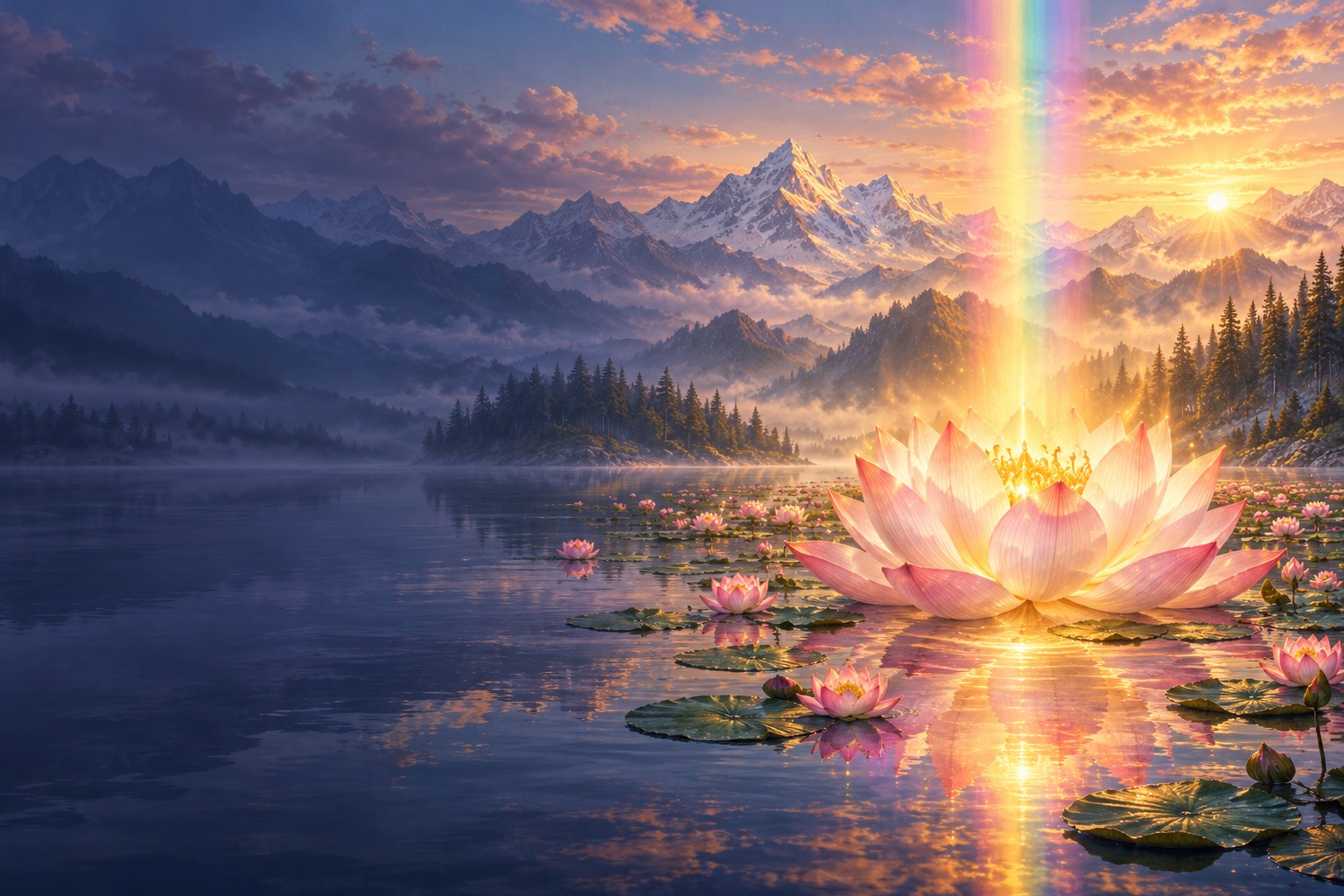
Illustration in preparationIn 1957 he made his home in Sikkim, but he was still a pilgrim. In the tenth month of that year he travelled to Tso Pema in northern India. The traditional accounts say that there a king tried to burn the Guru and Princess Mandarava, and the pyre became a lake of lotuses.
His praise of the lake pictures snow peaks strung like pearls and forests all around, and remembers that wonder. He signed it, in Adam Pearcey's translation, as "the lowliest of Padma's followers."
Illustration in preparationA last home in Sikkim
The King of Sikkim had invited him, and he lived in the royal chapel of the palace at Gangtok, the Tsuklakhang. Sikkim is itself counted a hidden land blessed by Guru Rinpoche (told in The Hidden Valleys). He wrote prayers for its welfare, asking that it be cleansed of every stain and that its people come to regard one another as dear parents.
Illustration in preparationIn his last years the palace temple became a gathering place. Lamas who had crossed the mountains from Tibet came to receive the teachings he held, from every school, and he kept on giving them.
There was grief there too. In June 1957 a young princess of the royal family, Sangay Deki, died suddenly. He performed rituals and wrote an aspiration for every being connected with him, even those who merely hear his name, that they be free of suffering.
Illustration in preparationOn the first of January 1959 he wrote three short verses asking to be reborn in Sukhavati, the pure land of the Buddha Amitabha, and asking the same for all connected with him. Early that year he fell gravely ill. Rigpa Wiki says that lamas of every lineage in Sikkim prayed for his long life, day and night.
Illustration in preparationHe passed away in Gangtok in 1959; the Rigpa Wiki timeline gives the twelfth of June. Rigpa Wiki reports that he remained in meditation for three days afterwards, and that his body was kept for six months while disciples came from across the Himalayas.
He was cremated at Tashiding, the hill the tradition counts as the heart of Sikkim's hidden land, and Nekhor says his disciples raised a stupa there for his relics. Rigpa Wiki adds that relics are also kept in the royal chapel; the sources tell this part a little differently. Tashiding ties him to an earlier pilgrim too, as told in Lhatsün Namkha Jigme and the Hidden Land of Sikkim.
Illustration in preparationA devotion that travels
His learning filled volumes. But the closing notes of his small prayers tell a plainer story: an elderly man arriving at one more place the Guru had touched, making an offering and writing a few lines of longing before moving on.
About the art
Jamyang Khyentse Chökyi Lodrö died in 1959, in the age of photography, so this page never gives him a lifelike face. In the story scenes he is small, seen from behind or far off, in the maroon shawl and golden-yellow upper garment of a Tibetan lama, with a heavy cloak for the road. The one portrait is painted in the manner of an old lineage painting, with a simplified face, not copied from any photograph. There he wears the tall red-gold pandita hat with long side flaps, a scholar's hat that later Khyentse masters often wear in paintings.
Guru Rinpoche appears only as statues, as a pilgrim would meet him: the small gilded figure on a Dzongsar shrine, and the great statue at Samye called "Looks Like Me". Both show his main form, with the lotus hat crowned by a half-vajra and a single vulture feather. He holds a five-pronged vajra, the scepter of the indestructible, at his heart, and a skull cup with a small vase of long life in his lap. The slender staff in the crook of his left arm is the khatvanga.
The places are painted from the sources: Dzongsar on its spur above a river in the forested valleys of Kham, the boulder caves of Chimphu above Samye's round wall, the Great Stupa of Boudha with its painted eyes, the small reed-fringed lake of Tso Pema, the royal chapel of Gangtok and the white chortens of Tashiding under Kangchenjunga. The Tashiding stupa is shown whitewashed, as it would have been at first; the gold leaf on it today was added in the 1990s.
Texts and statues are always wrapped, closed or blank, and prayer flags are plain, because the site never paints Tibetan script into its images. The animals under the cliff at Sengchen Namdrak are bharal, the wild blue sheep of the Tibetan highlands. They stand for his plea that pilgrims stop hunting there.
Why this matters for practice
Chökyi Lodrö's pilgrimage took him to the places where, the tradition says, Guru Rinpoche showed his wondrous accomplishment, Chimphu, Yangleshö and Tso Pema among them, the deeds the prayer's third line remembers. What he did there was simple: he made an offering, called on the Guru with longing and wrote a few lines of prayer. The Seven-Line Prayer lets any of us do the same from wherever we are, and for anything deeper a qualified teacher is the right guide (see find-a-teacher.html).
If something in this story stayed with you, you might pause wherever you are, as he did at each of those places, and recite the Seven-Line Prayer once.
Sources and further reading
- Jamyang Khyentse Chökyi Lodrö; Jamyang Khyentse Chökyi Lodrö Timeline, Rigpa Wiki (Internet Archive snapshots, 2024)
- Jamyang Khyentse Chokyi Lodro, by Alexander Gardner (2009), Treasury of Lives (Internet Archive snapshot, 2014)
- A Short Story of the Life and Liberation of Jamyang Khyentse Chökyi Lodrö, As Told by Himself (trans. Gyurme Avertin), Lotsawa House
- Prayer to Orgyen Rinpoche (1919); A Yearning Plea to the Precious Guru (Samye, 1956), Lotsawa House (trans. Adam Pearcey; Rigpa Translations)
- A Prayer to the Great Sacred Site of Pema Shelpuk; Guide to Sengchen Namdrak; Drumbeat of the Gods: In Praise of Yerpa, Lotsawa House (trans. Adam Pearcey)
- A Prayer to the Three Stūpas of Nepal; Auspicious Dance of Longevity: A Song for Touring the Sacred Sites of Nepal, Lotsawa House (Samye Translations; trans. Adam Pearcey)
- The White Lotus Garland of Immortality: In Praise of the Supreme Vajra Place, Tso Pema, Lotsawa House (trans. Adam Pearcey, 2018)
- Burgeoning Joy and Happiness (Sikkim); Aspiration on Princess Sangdé's Passing; Aspiration for Rebirth in Sukhāvatī, Lotsawa House (trans. Adam Pearcey; Abraham Ta-Quan)
- The Guru in West Sikkim, Nekhor
- Dzongsar Khyentse Chökyi Lodrö; Tsuklakhang Palace; Tashiding Monastery, Wikipedia
- Where It All Began: Dzongsar, Derge, Khyentse Foundation
- The Life and Times of Jamyang Khyentse Chökyi Lodrö, by Dilgo Khyentse Rinpoche and others (Shambhala, 2017), Book
This retelling is waiting to be read by a knowledgeable practitioner. Where the traditional accounts differ, the story says so; if you notice a mistake, please tell us through Share Your Story.