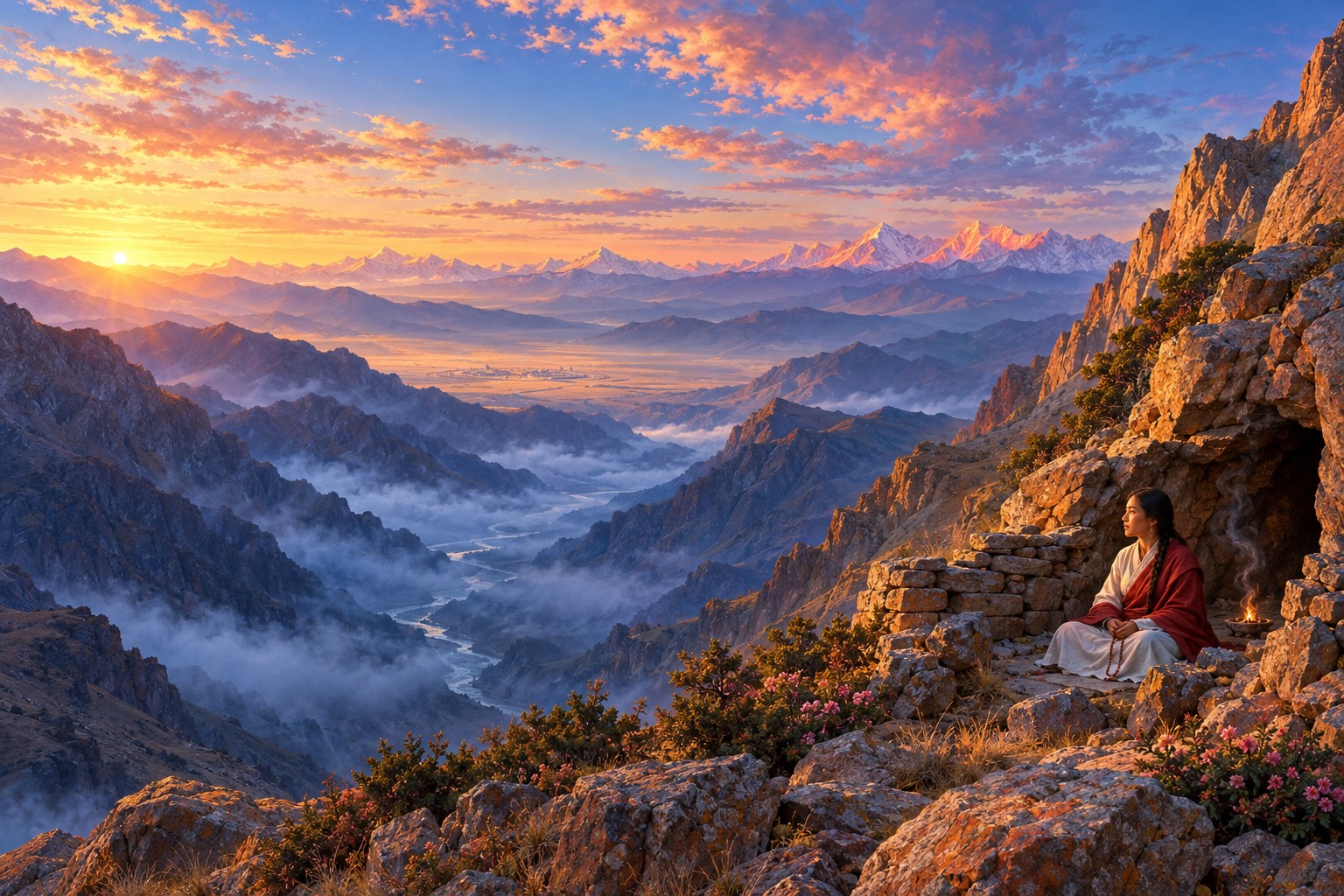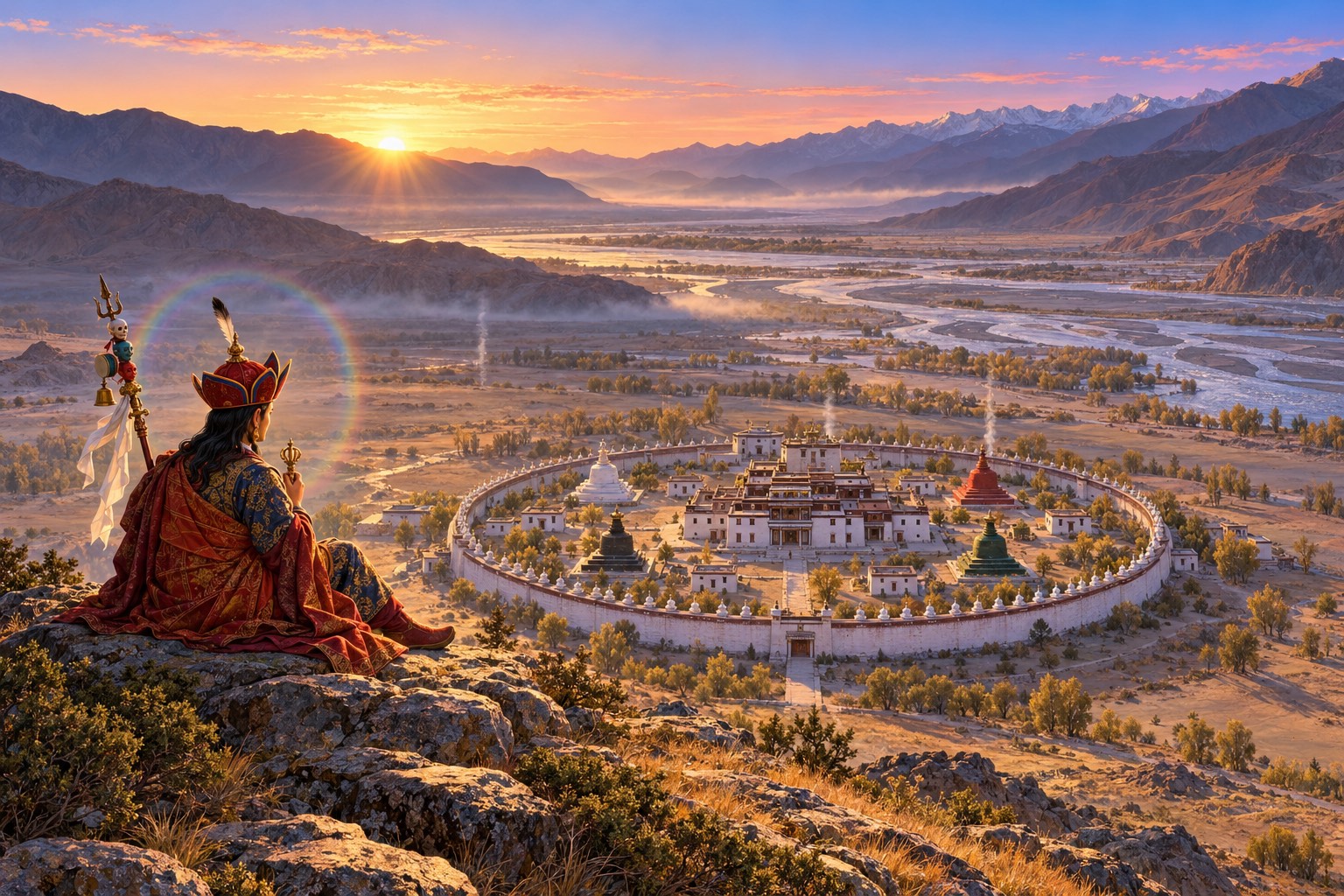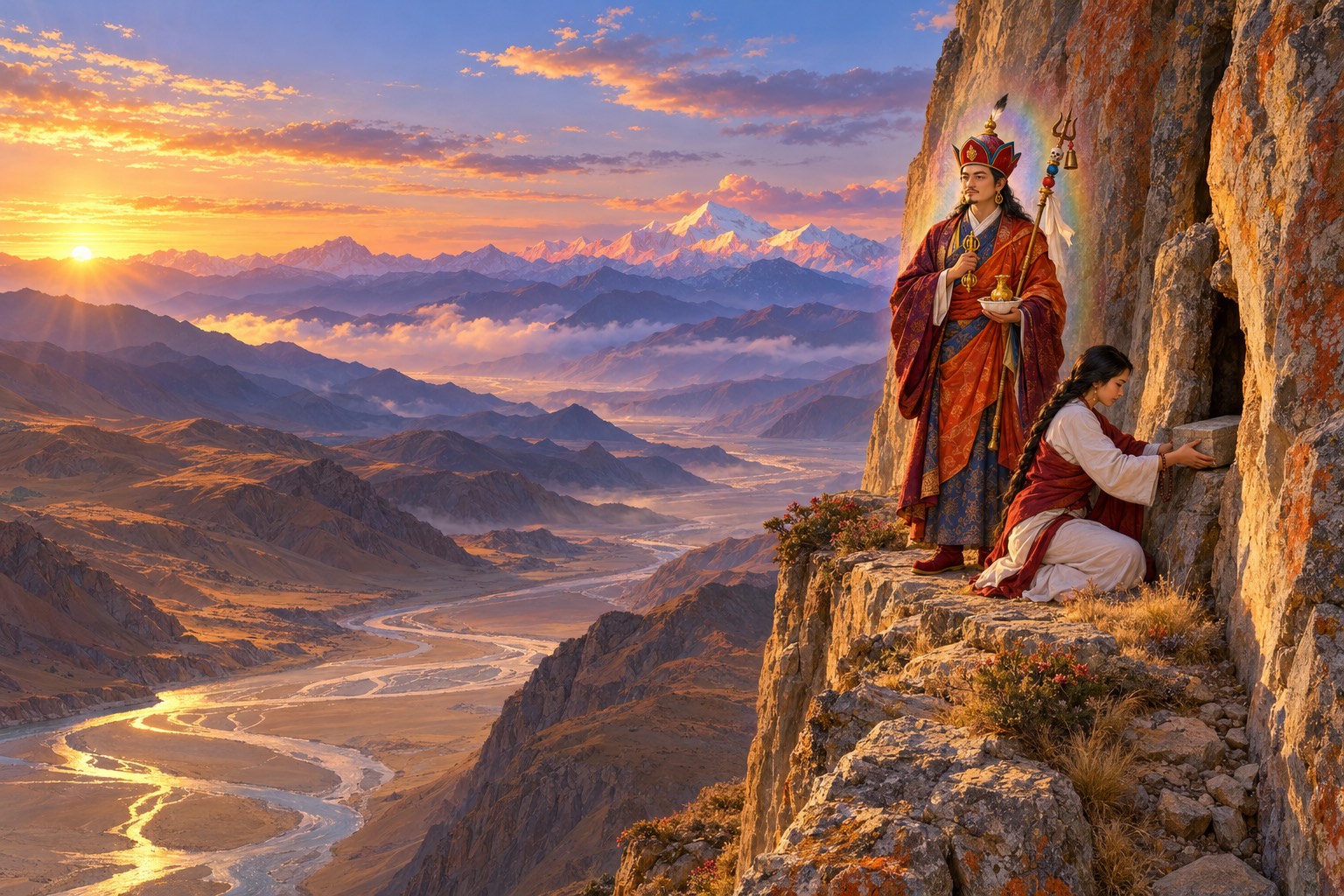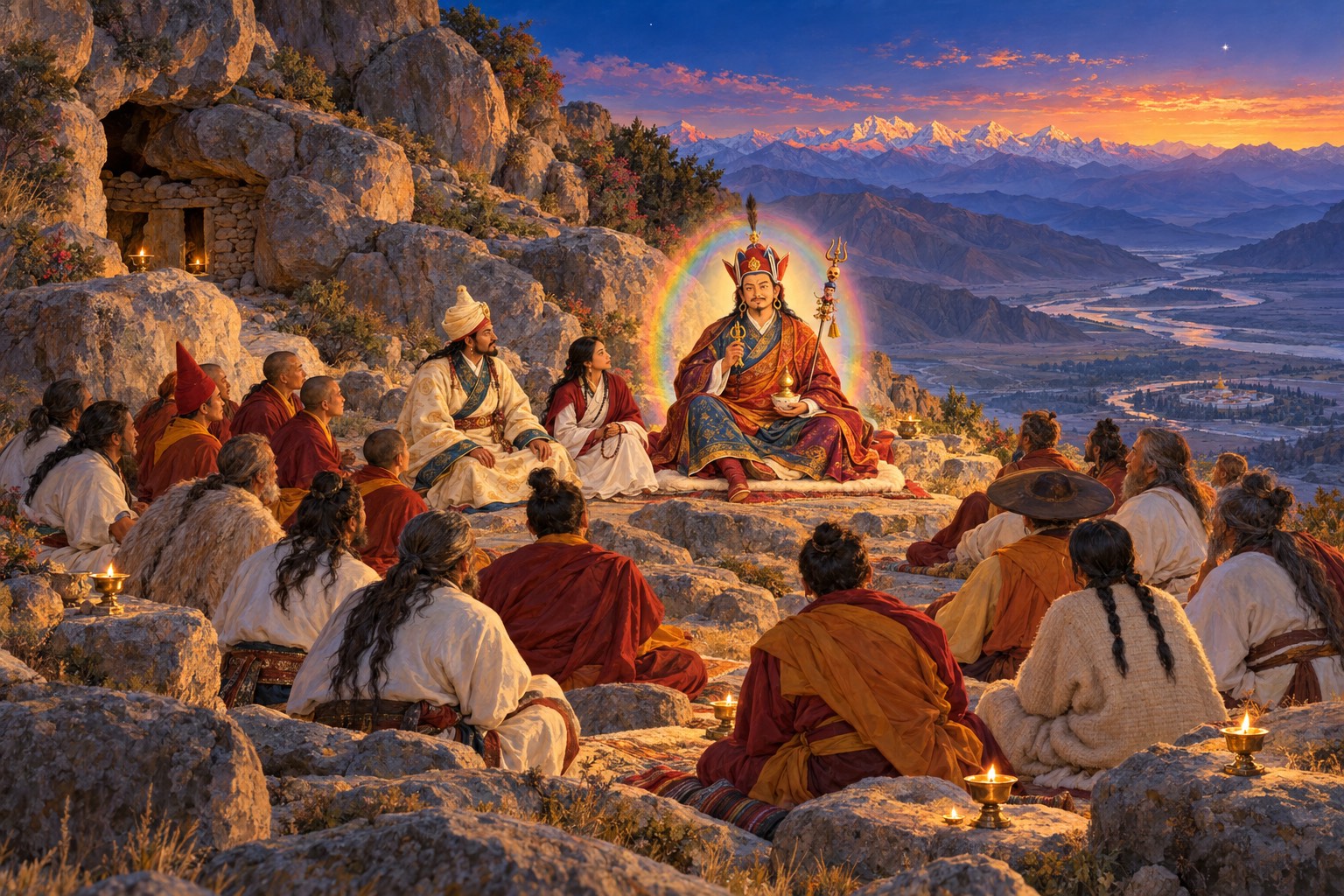
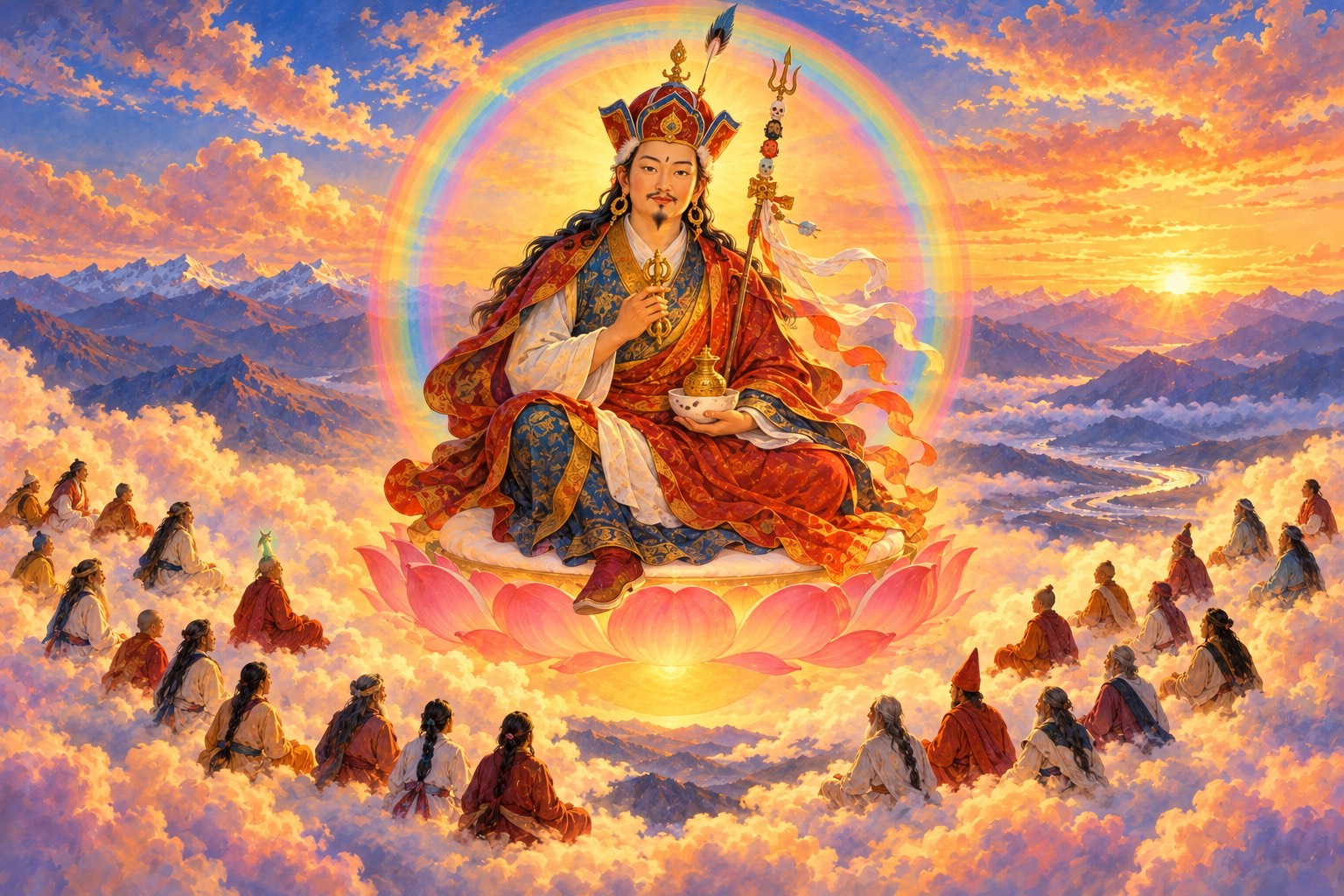
At dusk on the mountain of Chimphu, high above the temple of Samye, the old accounts picture a gathering. Guru Rinpoche sits among a small circle of Tibetans: a king, a young woman, shaven-headed monks, long-haired yogis, a minister who once rode to Nepal. Below them the sandy valley turns blue, and the first lamps are lit.
Tibetans call this circle the Jebang Nyernga, "the king and subjects, twenty-five." They were Guru Rinpoche's closest Tibetan disciples, gathered around King Trisong Detsen in the eighth century. Rigpa Wiki says simply that all of them attained supreme accomplishment.
Why the list matters
The fifth line of the Seven-Line Prayer pictures Guru Rinpoche surrounded by a retinue. The twenty-five are that retinue in human form: the first Tibetans to receive his teachings in their own language and carry them home to their own valleys.
There is a second reason they matter. The treasure tradition holds that Guru Rinpoche hid teachings, called terma, to be found in later centuries. The people who found them, the tertöns or treasure revealers, are often counted as these same disciples, born again. When a later master is called the rebirth of Vairotsana or of Nanam Dorje Düdjom, the old circle at Chimphu is being remembered.
The lists do not quite agree, and it is kind to say so. Rigpa Wiki, following Dudjom Rinpoche's history, gives a list that reaches twenty-six by counting the king separately. Himalayan Art Resources gives another, with the king inside the twenty-five, and notes that there are several systems and lists of different sizes. A few names come and go. The heart of the circle stays the same.
Here are six of them, in small portraits, told as the tradition tells them.
The minister who rode to Nepal
Nanam Dorje Düdjom was one of the king's ministers. Rigpa Wiki says he was among those sent to Nepal to invite Guru Rinpoche to Tibet. Picture the journey: weeks over high passes, carrying a king's request to a stranger beyond the mountains.
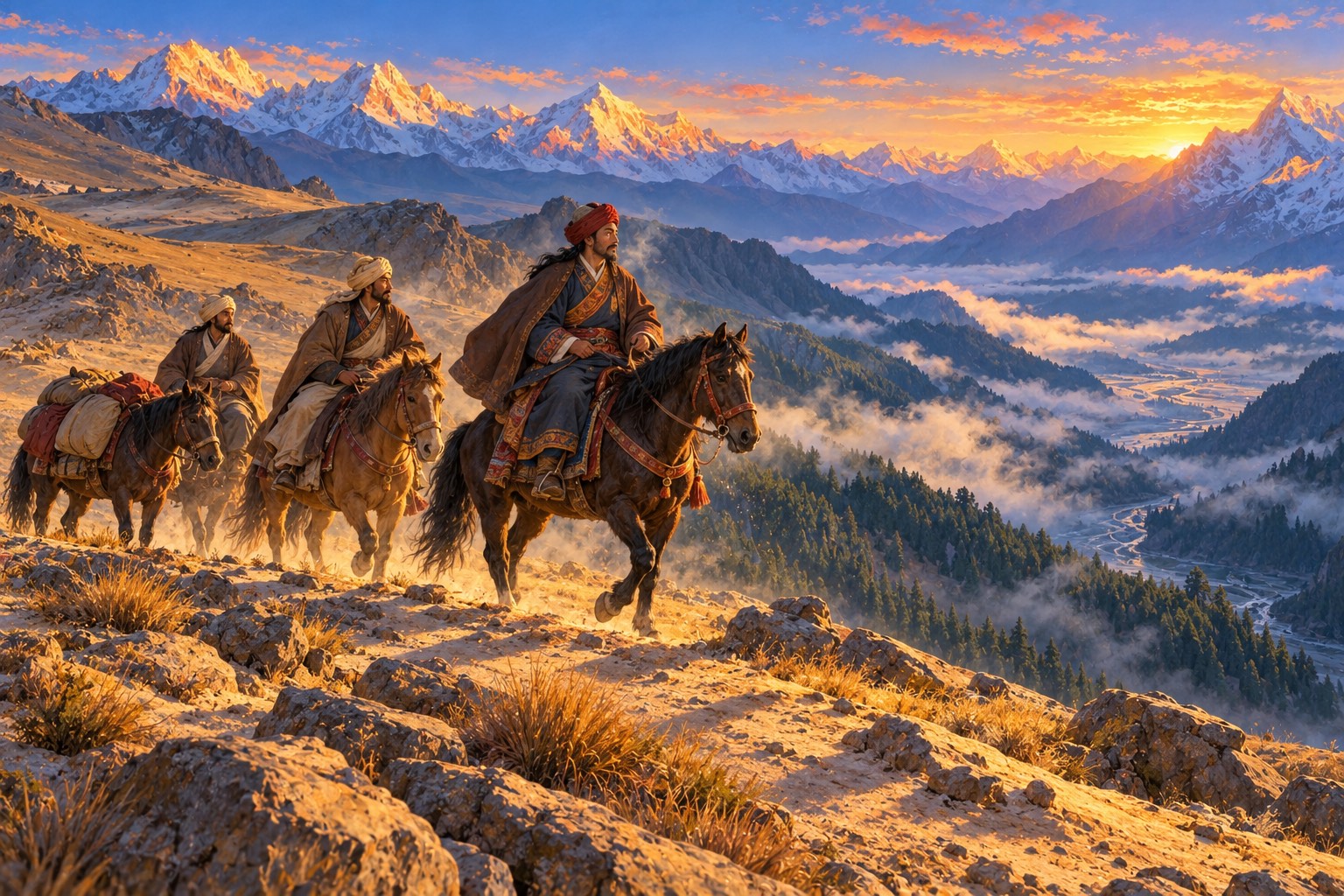
He became a disciple himself. Later, when Guru Rinpoche gave an empowerment, a ceremony that introduces a student to a meditation practice, each disciple is said to have cast a flower, and where it fell showed the practice meant for them. Rigpa Wiki says his fell on Vajrakilaya, a fierce protective deity.
His name means "Indestructible Subduer of Mara," Mara being the tradition's name for whatever obstructs awakening. The accounts say he could move as fast as the wind and pass through solid rock. Centuries later, Rigdzin Gödem, who opened the Northern Treasures, was counted as his rebirth.
Flowers at Chimphu
Chimphu is a mountainside of granite boulders and small caves, several hours' walk above Samye. Rigpa Wiki says that here, at the king's request, Guru Rinpoche opened the teachings of the Vajrayana, the tantric path, to the twenty-five, headed by the king, Yeshe Tsogyal and Vairotsana. Nine of them, it says, gained accomplishment through those practices.
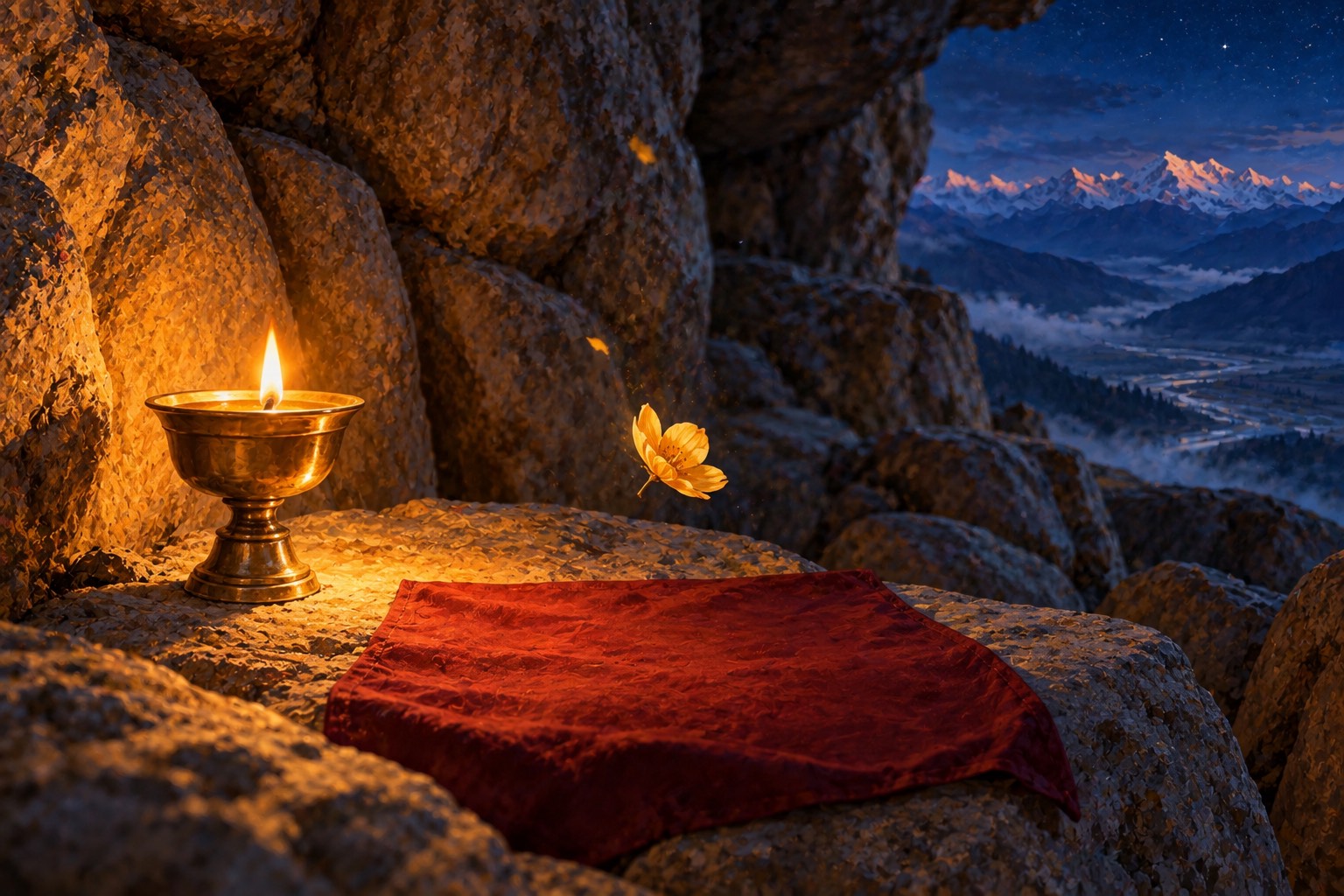
Jigme Lingpa's eighteenth-century guide to Chimphu tells it a little differently. There the king and seven others receive the empowerment, and the king's flower falls in the very centre. The same guide places a gathering of Guru Rinpoche and the twenty-five at another cave far to the north. The stories cross like footpaths on one mountain.
The monk who heard a horse
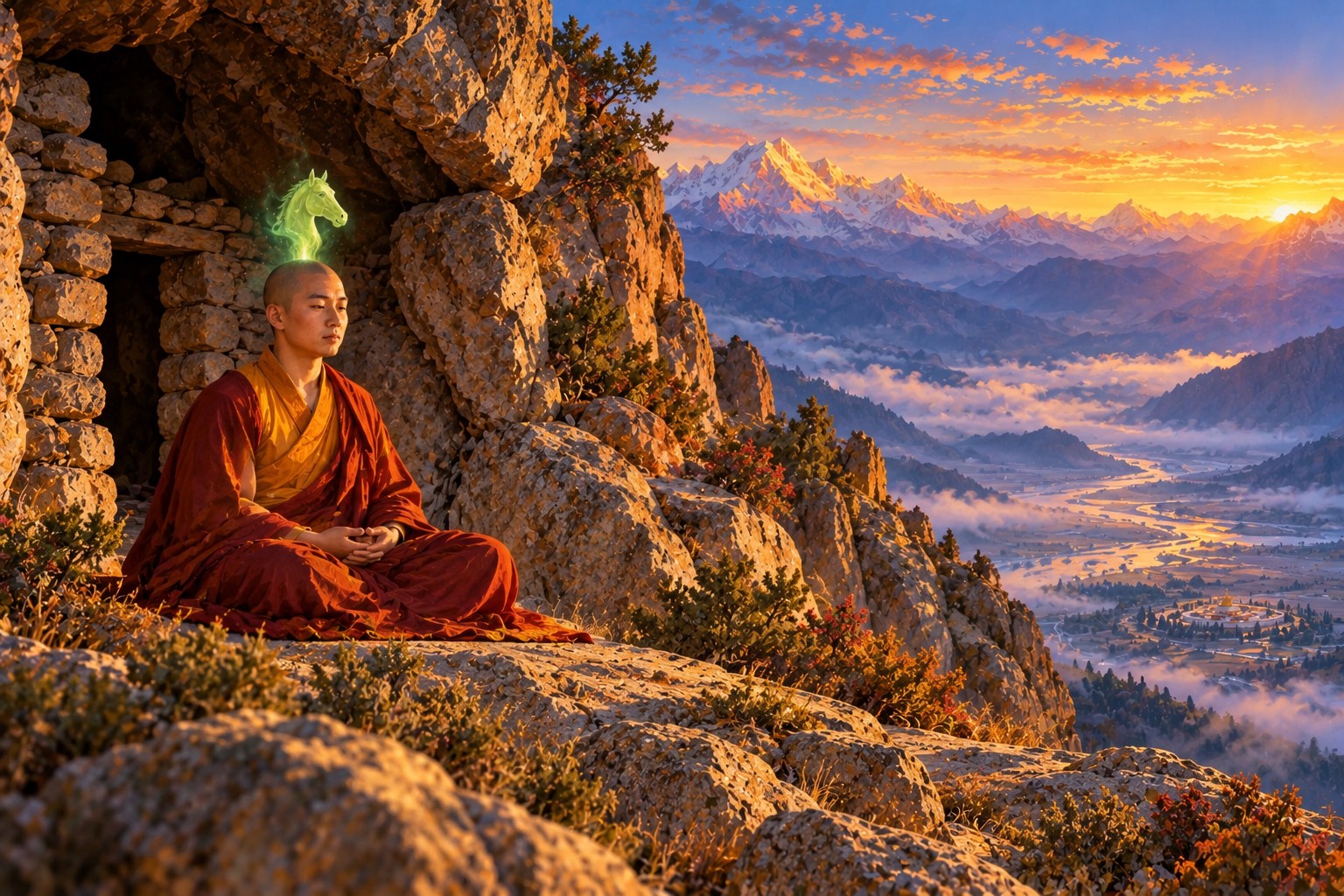
Gyalwa Chokyang was among the first Tibetans ordained as monks by the abbot Shantarakshita. Rigpa Wiki says that at Chimphu his flower fell on Hayagriva, a protector with a horse's head. He practised until, the accounts say, he could take on the deity's form, and heard a horse neigh from the crown of his head.
Painters still mark him with a small horse's head rising above his own. Later masters wrote prayers to him by name.
Vairotsana, the translator in exile
Vairotsana, of the Pagor clan, was another of the first monks. Rigpa Wiki calls him the greatest of all Tibetan lotsawas, or translators. The king sent him to India as a young man. The life stories say the road was hard and his companion died on the journey, but he found the master Shri Singha, who taught him the Great Perfection, Dzogchen, in secret.
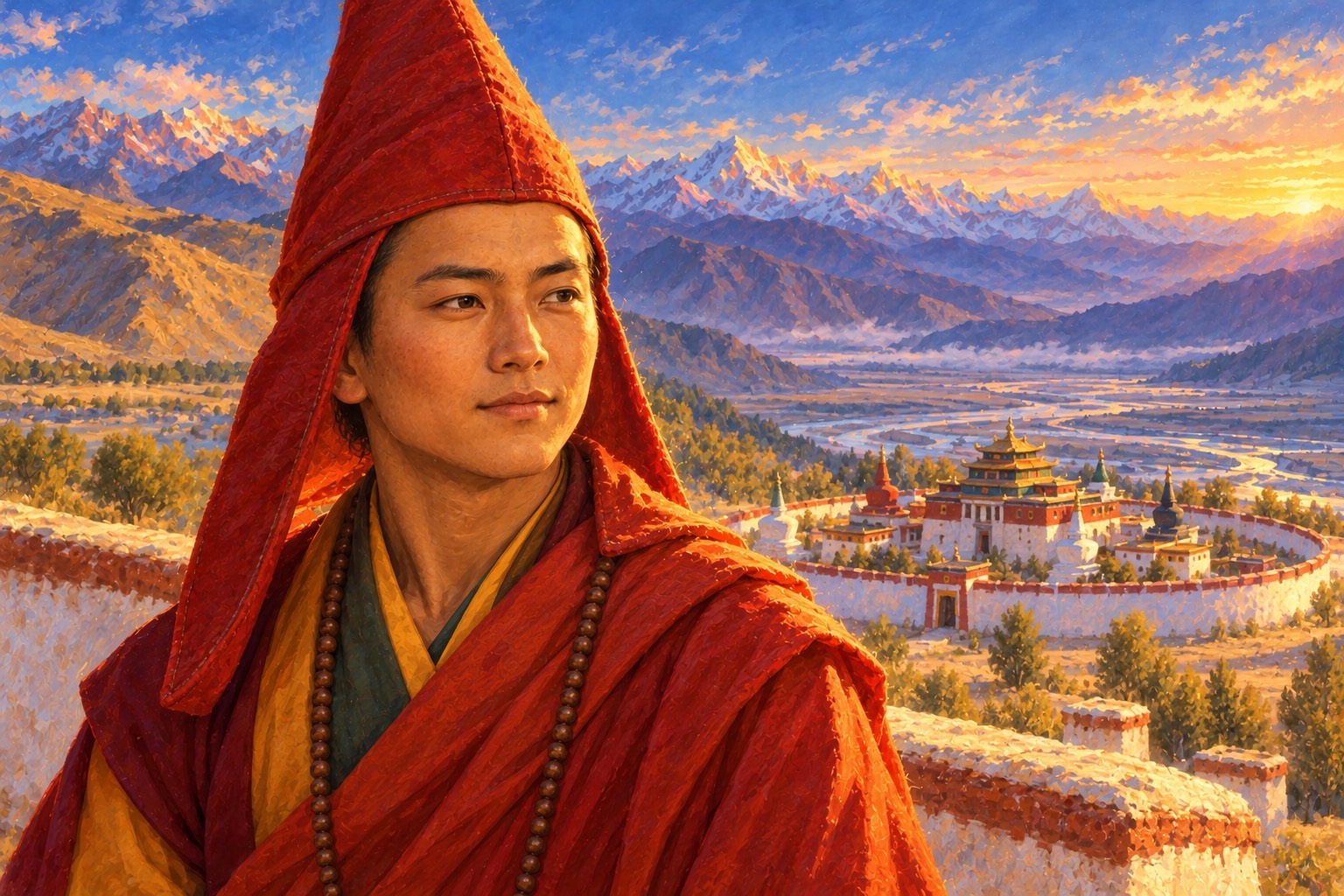
Coming home did not bring rest. As summaries of his life story tell it, rumours spread that his teaching was not true Dharma, and Queen Tsepongza and ministers hostile to Buddhism had him exiled to Gyalmorong, a land of forested gorges on Tibet's far eastern edge.
He made a home there anyway. He taught the local king and took as his student a young prince, Yudra Nyingpo, who became a great translator and is himself counted among the twenty-five. In time the Indian master Vimalamitra persuaded the king to call Vairotsana back.
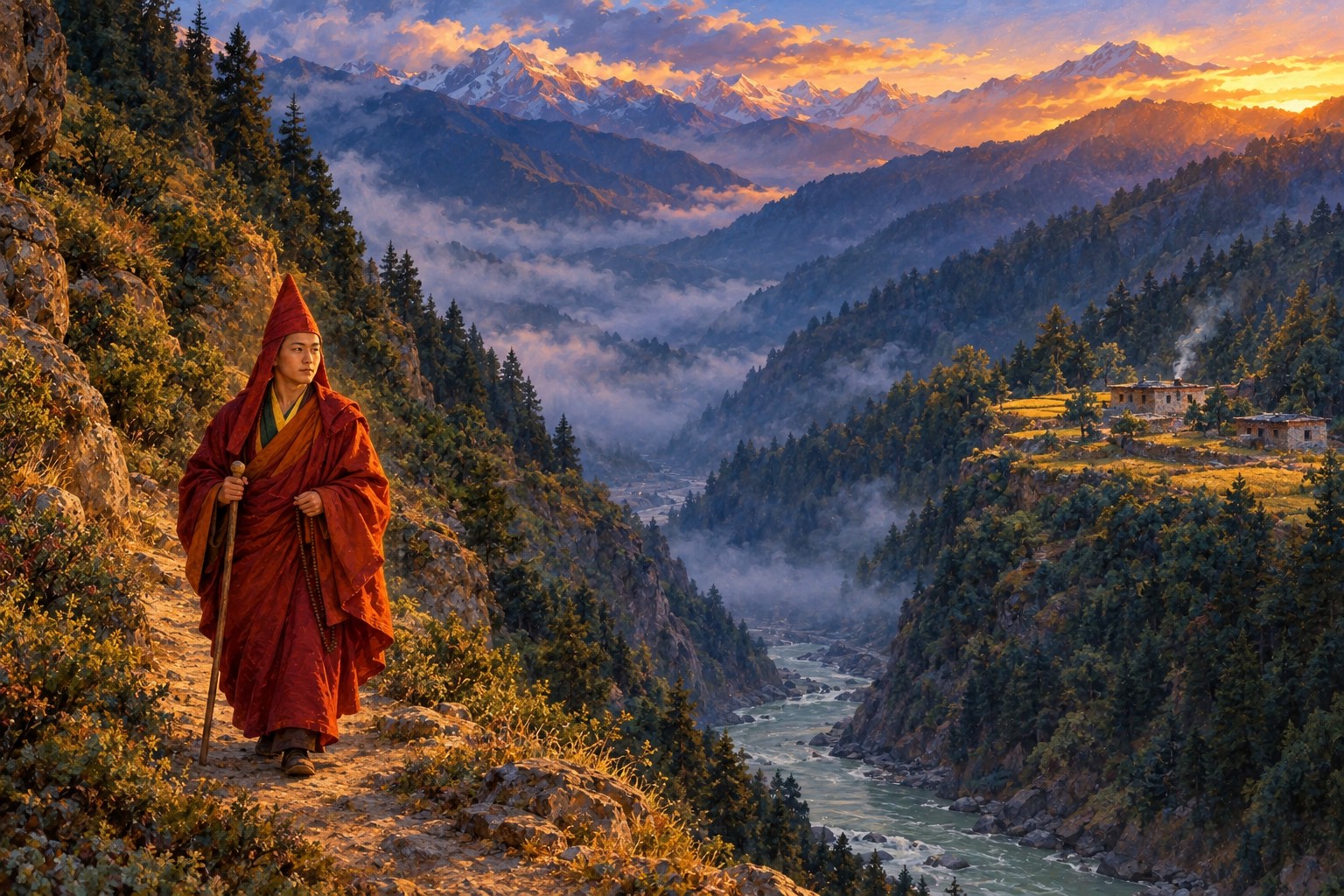
Some three centuries later the translator Ngok Loden Sherab compared him to the boundless sky, and said that beside such masters later translators were only fireflies. Among those counted as his later rebirths is Jamgön Kongtrul, the great nineteenth-century compiler of the treasures.
Namkhai Nyingpo, who rode the sunlight
Namkhai Nyingpo, of the Nub clan, was also one of the first monks. In the account of the Pema Kathang, a treasure biography of Guru Rinpoche, the king sent him to India too, where he studied with the master Humkara. At home he served as the king's teacher and healer.
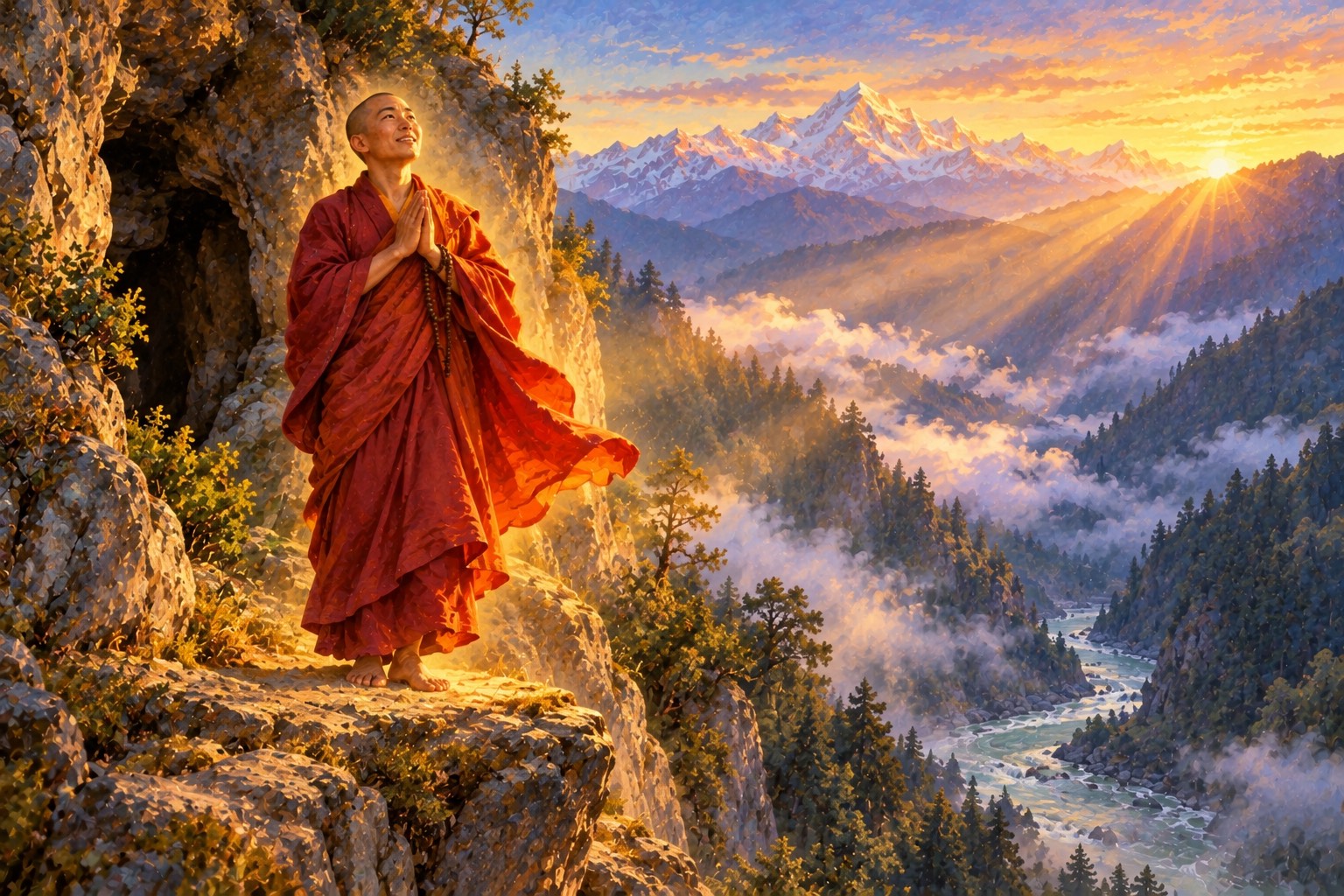
Ill-wishing ministers had him exiled as well, south to the caves of Lhodrak Kharchu, and he went into retreat there. As a sign of his realization, Rigpa Wiki says, he could fly through the sky riding the rays of the sun, which is how painters show him.
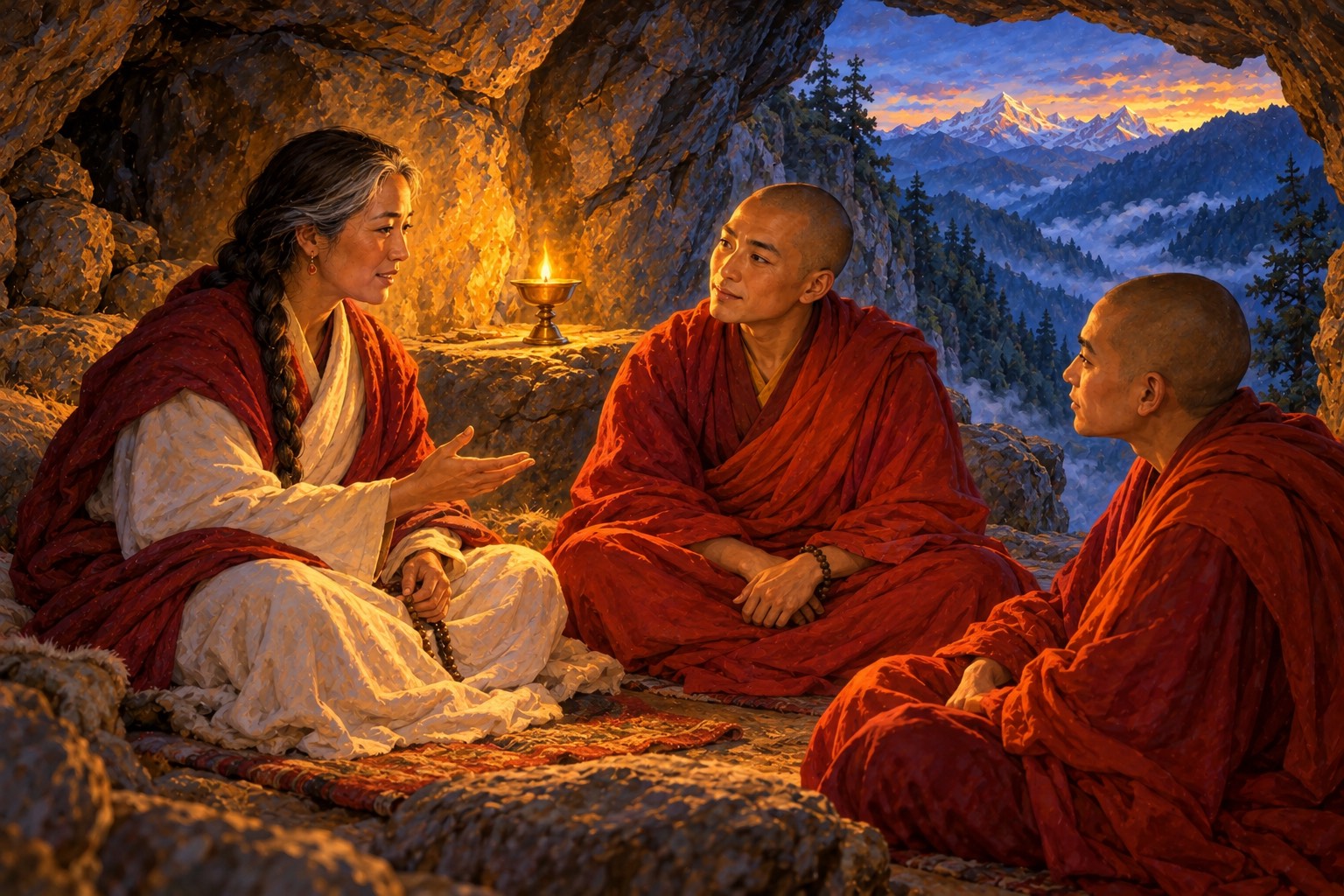
Yeshe Tsogyal came to Kharchu too. One account, as Rigpa Wiki summarizes it, says she visited him in his retreat and gave him instruction. Her life story says she later told her life there to Namkhai Nyingpo and Gyalwa Changchub, who wrote it down and hid it as a treasure. Her own story is told on its own page. Here she is simply what she always was in this circle: a friend in practice, and the keeper of everything Guru Rinpoche taught.
Lady Dorje Tso
One of Pema Lingpa's treasure texts, as Rigpa Wiki summarizes it, tells how Namkhai Nyingpo followed a prophecy to Shang Tanak and met a woman named Shelkar Dorje Tso. He introduced her to practice and brought her to Guru Rinpoche, who accepted her as a consort, a spiritual companion. She is not on the lists of twenty-five given above, but she belongs to the same circle.
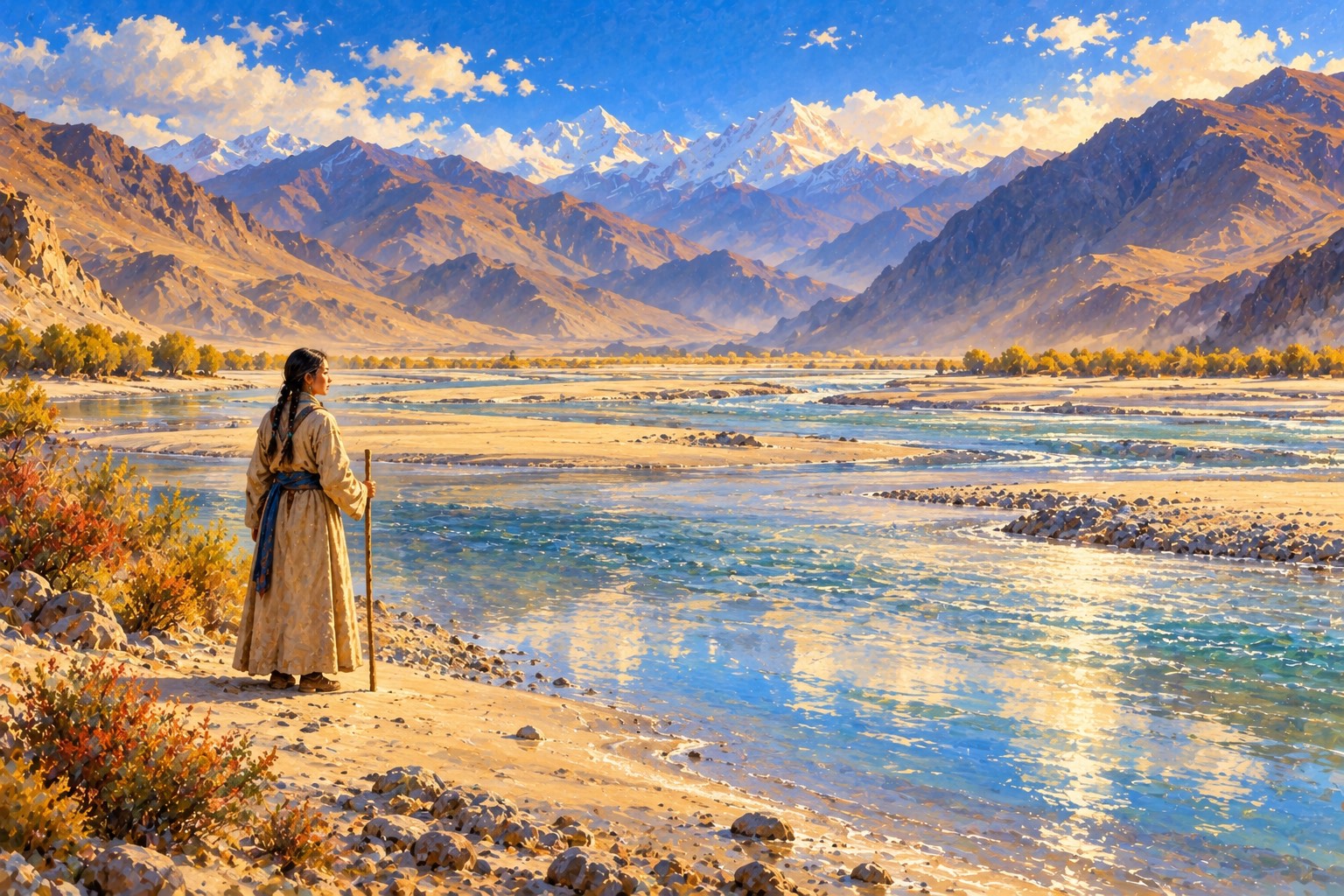
The teacher Tulku Thondup records that she crossed the great Tsangpo river standing on a bamboo walking stick. The early twentieth-century woman treasure revealer Sera Khandro is counted among her later lives.
Nubchen and the long night
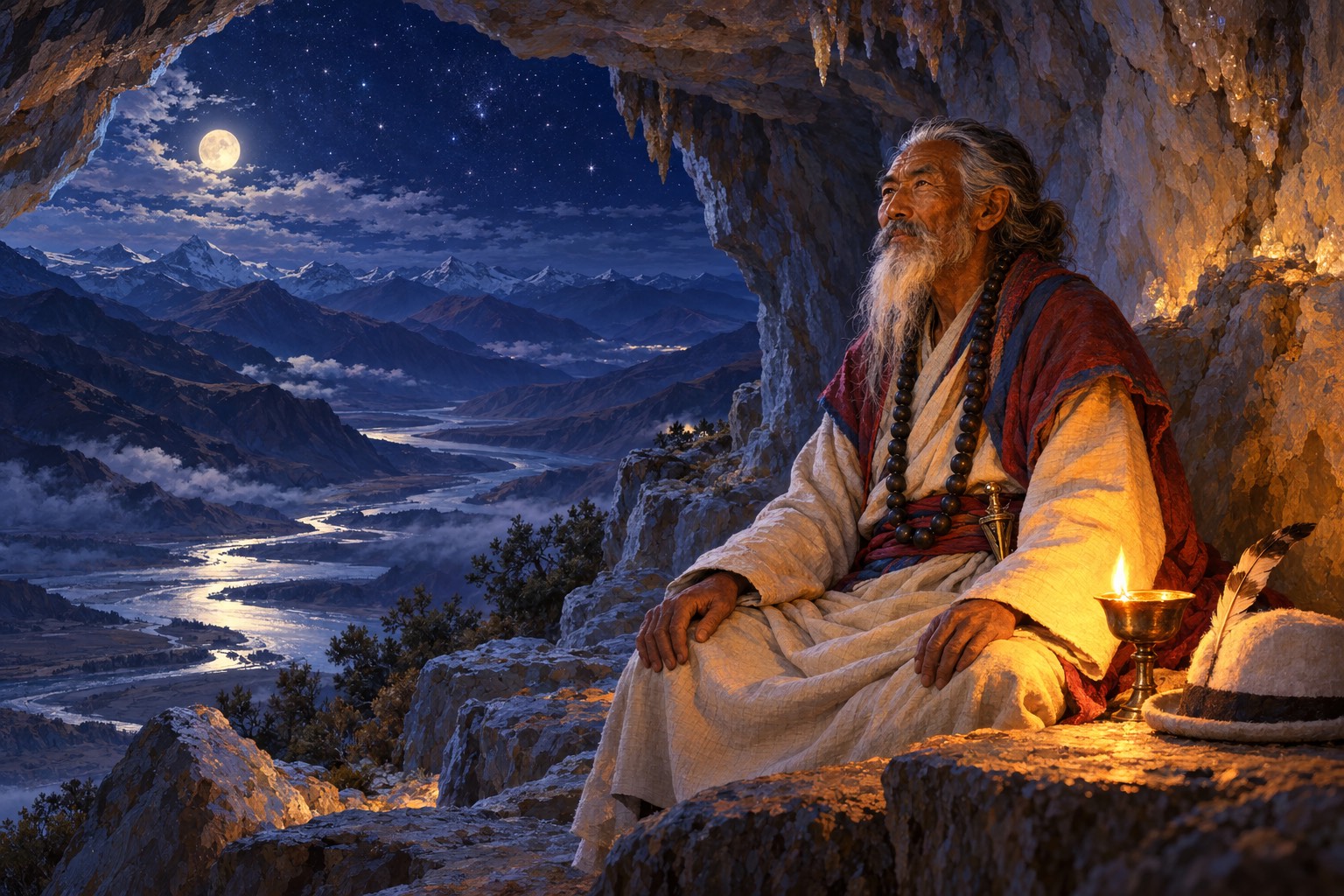
Nubchen Sangye Yeshe, another son of the Nub clan, is remembered for bringing to Tibet the teachings called Anuyoga. The pilgrimage guide Nekhor says Guru Rinpoche entrusted a practice to him at Chimphu, which he kept in the cliff caves of Drak Yangdzong, above his home valley.
Here the sources gently part ways. Rigpa Wiki says he lived 110 years or more, and some histories say 130. The Treasury of Lives gives his birth as perhaps 844, long after Guru Rinpoche's time, so historians doubt the two could have met. The tradition counts him among the twenty-five all the same. Both can be held with an open hand.
He lived into dark years. After King Langdarma turned against the monasteries in the ninth century, legend says Nubchen's powers persuaded the king to leave the lay practitioners alone, and teachings survived in households and hermitages. His book Armour Against Darkness helped shape the later Nyingma school.
Coming back
After Guru Rinpoche left Tibet, the twenty-five scattered to caves across the country: Chimphu, Kharchu, Yangdzong and many more. The tradition says that was not the end. In later centuries, treasure revealers and lineage masters were recognized as their rebirths, coming back to find what had been hidden.
Rigdzin Gödem is counted as Nanam Dorje Düdjom returning. Jamgön Kongtrul is counted as Vairotsana. Rigpa Wiki lists the treasure revealer Changchub Lingpa and Katok Tsewang Norbu among the rebirths of Namkhai Nyingpo.
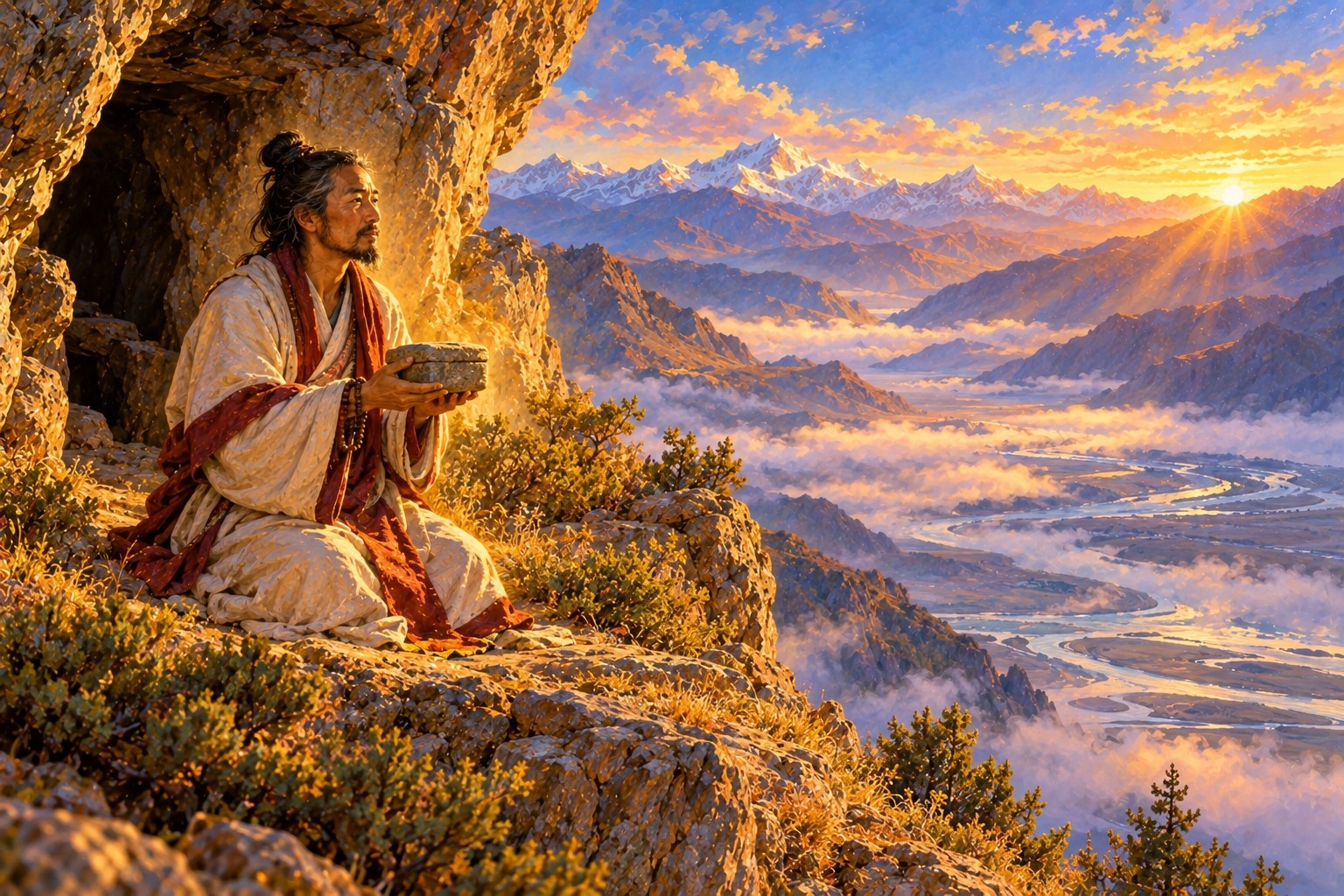
Seen this way, the circle at Chimphu never quite broke up. Prayers by later masters, such as Jamyang Khyentse Wangpo's The Heart of Blessings, still call on them by name, one after another, as if they were all still sitting together around their teacher.
About the art
Guru Rinpoche appears in his main form: the lotus hat crowned with a half-vajra, a sun and moon and a single vulture feather; layered robes; a five-pronged vajra at his heart; a skull cup holding a long-life vase in his lap; and the khatvanga, a slender staff topped with a trident, resting against his left shoulder. In the final image he sits on a lotus with sun and moon discs inside a rainbow sphere, the way he is painted at the centre of sets showing the twenty-five, which Himalayan Art Resources says usually gather all of them around him in one painting or across three.
The disciples follow the old portraits, especially a set of small initiation cards from the Shechen Archives on Himalayan Art Resources. Vairotsana wears a tall, pointed red scholar's hat, and painters mark him with a small vertical third eye on his forehead. Gyalwa Chokyang has a tiny horse's head rising from his crown, for Hayagriva, the horse-headed protector. Namkhai Nyingpo is painted flying on a ray of sunlight; here he stands in sunrise rays instead. Nubchen appears as a long-haired, bearded lay yogi with a long mala and a ritual dagger, a phurba, tucked away in his sash. The cards also show a scorpion in his hand, which is left out here.
Nanam Dorje Düdjom is shown as he was when he rode to Nepal, a minister in eighth-century court dress. The old cards show him later in life as a yogi in a broad, flat hat, riding the clouds. No traditional portrait of Shelkar Dorje Tso was found, so her plain wool robe and braids are an illustrator's choice. The treasure revealer in the eleventh image stands for many later masters and is not a portrait of any one of them. No lettering appears in any image.
Why this matters for practice
The fifth line of the Seven-Line Prayer sees Guru Rinpoche surrounded by a retinue, and the twenty-five are that retinue with human faces: a king, a minister, translators in exile, a woman who crossed a river, an old man who kept a lamp lit through dark years. They were ordinary people who chose to follow him, which is just what the sixth line asks for. Reciting the prayer can be a way of taking a quiet place in that same circle.

If something in this story stirred you, you might picture that small circle around Guru Rinpoche at dusk, and recite the Seven-Line Prayer once, as one more voice joining theirs. Anything beyond recitation is best explored with a teacher.
Sources and further reading
- Twenty-five disciples of Guru Rinpoche, Rigpa Wiki (archived snapshot)
- Vairotsana, Rigpa Wiki (archived snapshot)
- Berotsana, Tibetan Buddhist Encyclopedia
- Vairotsana, Wikipedia
- Namkhé Nyingpo, Rigpa Wiki (archived snapshot)
- Nupchen Sangye Yeshe, Rigpa Wiki (archived snapshot)
- Nubchen Sanggye Yeshe, The Treasury of Lives (archived snapshot)
- Nanam Dorje Dudjom, Rigpa Wiki (archived snapshot)
- Gyalwa Chokyang, Rigpa Wiki (archived snapshot)
- Shelkar Dorje Tso, Rigpa Wiki (archived snapshot)
- Samye Chimphu, Rigpa Wiki (archived snapshot)
- The Kalaviṅka's Call: A Guide to Glorious Samye Chimphu, by Jigme Lingpa, Lotsawa House (trans. Kaleb Yaniger, Samye Translations)
- The Heart of Blessings, by Jamyang Khyentse Wangpo, Lotsawa House (Rigpa Translations)
- Prayer to the Abbot, Master and King, by Jokyab Pema Trinle Nyingpo, Lotsawa House (Samye Translations, Stefan Mang)
- Padmasambhava: Twenty-five Disciples Page, Himalayan Art Resources (Jeff Watt)
- Padmasambhava: Twenty-five Disciples (Single Painting), Himalayan Art Resources
- Initiation Cards: 25 Disciples of Padmasambhava, Himalayan Art Resources (Shechen Archives)
- Teacher: Vairotsana/Vairochana (25 Disciples), Himalayan Art Resources (Jeff Watt)
- Lhodrak Kharchu, Nekhor
- Drak Yangdzong, Nekhor
This retelling is waiting to be read by a knowledgeable practitioner. Where the traditional accounts differ, the story says so; if you notice a mistake, please tell us through Share Your Story.