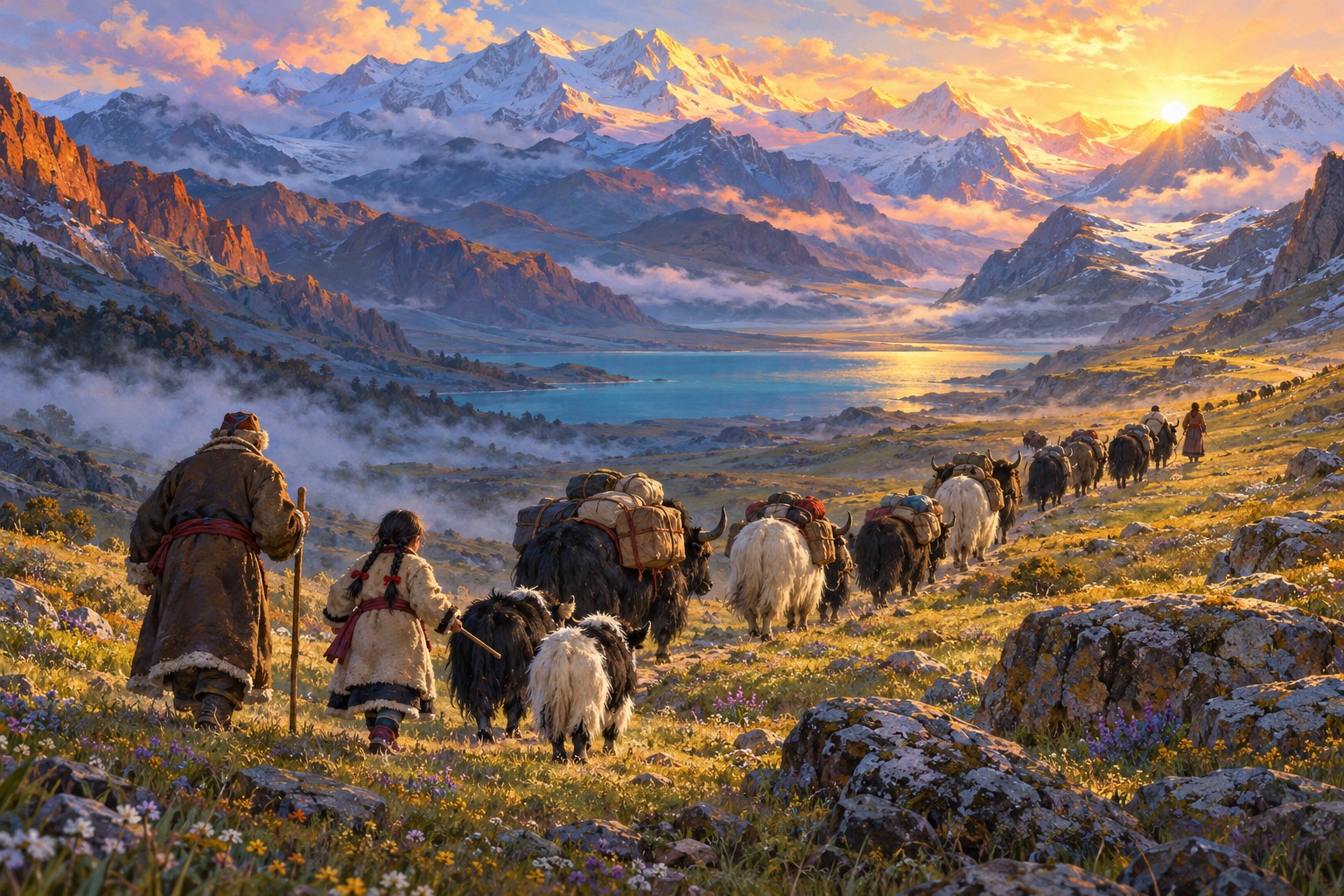
This is an original story, written for this site. It is fiction, not a teaching or a traditional account. The village, its school and everyone in it are invented.
The wind
Rashmi Shrestha was twenty-three and had never lived anywhere but Patan, the old city across the river from Kathmandu, in a house where you could hear three temples and a motorcycle workshop from the kitchen. In April she went to Lo, the high, dry country of Upper Mustang that runs north towards Tibet, to teach for one year in a village school.
She flew to Jomsom, where the valley squeezes between enormous mountains, then rode north most of a day in a shared jeep on a road of dust and stones. Sertang was thirty whitewashed houses packed close together against the wind, with firewood stacked along the roof edges, small fields of barley, a line of willows by the stream, and cliffs in bands of red and ochre.
 Illustration in preparation
The wind came up the valley every afternoon as if it had an appointment. On the first night, in the small room behind the school, she lay under two blankets with an altitude headache and cried, quietly, so the walls would not hear.
Illustration in preparationBefore lessons
The school had two classrooms, nineteen pupils between five and twelve, and one other teacher, Ngodup Sir, who had grown up in the village. Every morning the children lined up in the yard in their blue uniforms and mismatched fleeces and sang the national anthem. Then they put their palms together and recited the Seven-Line Prayer, all together, before anyone opened a book.
It is a short prayer of seven lines to Guru Rinpoche, the “Precious Teacher”, the eighth-century master whom Tibetans remember for helping Buddhism take root in their country. It is said in homes and temples across the Himalaya. In Sertang it was simply how the day began, like the anthem and the wind.
Rashmi stood at the side with her hands folded and moved her lips a little, the way you do in a song you do not know. She had walked round the great stupa at Boudha with school friends, but nobody had ever taught her this.
Illustration in preparationWhat names mean
Her first English lesson was “My name is”. The children tried “Rashmi”, and it came back to her as Rasmi, Rashu and, from the smallest boy, Mimi.
Then she asked what their names meant, and the room went up like a flock of birds. Dawa was the moon, because she was born on a Monday. Nyima was the sun, and Sunday. Lhakpa was Wednesday. Pemba was Saturday, and everyone agreed this was why he was always late. Pemba said Saturday was the holiday, and he was practising.
“Miss. What does your name mean?”
Rashmi said it was a Sanskrit word, and her grandmother had chosen it. It meant a ray of light: the first one, when the sun is just coming over the hill. The children considered this. “Not the sun,” said Lhakpa, to be sure. “No. Just a bit of it.” That seemed to satisfy everyone.
Illustration in preparationDawa
Dawa was eight. She had two short plaits, a red fleece two sizes too big and the bearing of a small headmistress. On the third Monday she came up to Rashmi at lunch and said, in careful Nepali with some English in it, “Miss, you don’t know the prayer.” It was not a question. “I will teach you.”
So every day at lunch they sat on the low wall of the yard, out of the wind, and Dawa taught her, a sound at a time, the way she had learned it herself, by ear, from her grandmother. She was very strict.
Illustration in preparationRashmi’s worst trouble was the Tibetan “ö”, which has no proper home in Nepali. “Make your mouth like you will whistle,” said Dawa, “and then don’t.” When Rashmi got a word right, Dawa nodded once. When she got it nearly right, Dawa said, “Very good, but again,” which Rashmi realised, with some alarm, was exactly what she said in class.
The fourth line
By June the barley was green and Rashmi could get through three lines without stopping. She asked what they meant. Dawa explained with her hands, in her three languages: a land far away in the north-west, a lotus on a lake, a child born in the heart of it who grew up to do wonderful things.
The fourth line gave his name, Pema Jungné, the Lotus-Born. Dawa was particular about its last word, drak, which she finished with a crisp click, like a dry stick breaking. It means the name is famous, she said. Everybody knows it.
Illustration in preparation“He has a lot of names, though,” said Rashmi, who had heard him called Padmasambhava in Kathmandu and Guru Rinpoche here. Dawa shrugged. “My grandmother has three names,” she said, “and she has only been to Pokhara.”
Rays of the sun
Ngodup Sir did better, one windy afternoon under the willow, with the whole school listening in. The old stories give Guru Rinpoche different names at different times in his life, he said, for the different things he did. There is a set called the eight names, tsen gyé: the Lake-Born Vajra, the Lotus King, the Lion’s Roar and others. The old books do not all list the same eight, he added, which pleased the older children enormously.
One of them is Nyima Özer. Nyima, everyone knew, was the sun. Özer means its rays, the light that comes off it.
There was a pause while nineteen children did the same sum. Then Dawa turned round on the bench and pointed at Rashmi. “Özer,” she said. “That’s you.”
Illustration in preparationThe school was delighted. Rashmi Miss was in Guru Rinpoche’s name. Pemba asked whether this meant she could skip the prayer. Ngodup Sir said mildly that it was only half a name, and borrowed, and that his own was in the prayer itself: ngödrup, the third line’s word for accomplishment. “Only one word,” he said. “But still.”
After that Dawa called her Özer Miss, and by the end of the week so did everyone, including two of the dogs’ owners.
Illustration in preparationOne bar
The barley was cut in September. In October came Dashain, the great autumn festival, when all of Kathmandu goes home. Rashmi did not; the journey was too long for the holiday. At dusk she climbed the hill above the village, where the phone found one bar of signal beside the chorten, and listened to her mother describe the cousins and the food and the bamboo swings, and said she was fine, and was not.
When she came down, Dawa was sitting on a rock at the foot of the path in a woollen hat, as if by appointment. She did not ask anything. “Say it,” she said. “I will listen for mistakes.”
So Rashmi said the whole prayer, all seven lines and the short mantra at the end, out loud in the cold, to an eight-year-old and the first stars. She made two mistakes. “Two,” said Dawa. “Very good.” A pause. “But again.”
Illustration in preparationThe second time there was one. It did not make her less homesick. It gave her something to do with her mouth while she was homesick, which turned out to be different.
The last morning
In late November the stream froze at the edges, and families began to go down to the lower valleys for the winter, as people in Lo have long done. The school would close until spring. Rashmi’s year was nearly over, and nobody knew yet who would be sent next.
On the last morning the children lined up in the low winter sun, breath smoking, hands up their sleeves. Rashmi did not stand at the side. She stood at the end of the second row, next to Dawa. They sang the anthem, and then they put their palms together.
Illustration in preparationShe said it with them at their speed, which was fast. She could feel Dawa watching her mouth. At the fourth line she gave the last word its proper crack, and Dawa nodded once, without looking up.
Down the valley
The jeep left at dawn. Nineteen children and several dogs saw it off, and Pemba was on time. Rashmi did not know whether she would come back. If she was honest, she did not know what she believed about Guru Rinpoche, or names, or rays of light. She knew the prayer. She knew it the way the children did: sounds first, with the meanings coming along after.
Illustration in preparationIn Patan a week later her grandmother asked what she had learned up there. Rashmi thought about it. “My name,” she said, and then, because her grandmother was waiting, she explained.
About the art
This is an original story, written for this site; it is fiction, not a teaching or a traditional account. Sertang, its school and everyone in it are invented, so the pictures show invented people, painted as gentle storybook figures and never as likenesses. The adults appear from behind, at a distance or in soft three-quarter view; the children are painted at mid-distance, with one close portrait of Dawa, and always as capable, funny pupils in their own school, not as objects of pity. Guru Rinpoche does not appear anywhere on the page, and nothing shown is a vision: the light is ordinary sunrise, noon and dusk.
The village is drawn to fit Lo, the northern part of Mustang District in Nepal: whitewashed flat-roofed houses of mud brick and stone packed close against the wind, firewood stacked on the roofs, small irrigated fields of barley with willows along the streams, and eroded cliffs banded red, ochre and grey below the snow peaks. The chorten on the hill, a stupa painted in bands of colour, is a common sight in the region. The children wear a plain school uniform with fleeces and woollen hats, as children in cold mountain schools do.
Following the site's rule against text in images, nothing on these pages carries writing: the blackboard is blank except for a child's chalk sun, with long rays and a small heart, and a crescent moon; no books lie open; the phone's screen is turned away; and the few prayer flags far off on the roofs are shown plain and unprinted, because real prayer flags carry printed prayers.
Why this matters for practice
The fourth line of the Seven-Line Prayer gives Guru Rinpoche's name, the Lotus-Born, and says it is renowned; the tradition remembers him by many names, each linked to something he did. This story is fiction, and nothing in it is a miracle: a child teaches a homesick adult some sounds, and the meanings come along afterwards. You do not need to know what you believe, or to pronounce every word perfectly, to say the prayer once.
If something in this story made you smile, you might pause wherever your own mornings begin and recite the prayer once, as carefully as a strict eight-year-old would like.
Sources and further reading
- Seven-Line Prayer (topic page), Lotsawa House
- Seven Line Prayer, Rigpa Wiki (via web.archive.org)
- Padmasambhava, Rigpa Wiki (via web.archive.org)
- Eight Manifestations of Guru Rinpoche, Rigpa Wiki (via web.archive.org)
- Tibetan name, Wikipedia
- Rashmi, Wikipedia
- Mustang District, Wikipedia
- Upper Mustang, Wikipedia
- Lo Manthang (Lomanthang Rural Municipality), Wikipedia
This retelling is waiting to be read by a knowledgeable practitioner. Where the traditional accounts differ, the story says so; if you notice a mistake, please tell us through Share Your Story.