This is an original story, written for this site. It is historical fiction, not a teaching or a traditional account. Chungdak the ferryman, his passengers and his landing are invented. The Yarlung Tsangpo, Samye, the yak-hide boats of central Tibet and the Seven-Line Prayer are real, and what is said about them comes from the sources listed below.
The river below Samye
In central Tibet the Yarlung Tsangpo runs east through a wide valley of sand and stone. Below Samye, the first Buddhist monastery in Tibet, it spreads broad and slow around pale sandbars; a traveller in 1882 put it at half a mile wide.
There was no bridge. To reach Samye from the south, you stood on the bank and shouted, and a boatman came for you.
In the 1930s, one of those boatmen was a man called Chungdak. He was about fifty-five, broad in the shoulders, with a voice like gravel. He could not read. He knew the river, the weather, and one prayer.
The boat
His boat was a kowa, a coracle: yak hides sewn together and stretched over a frame of bent willow, nearly square, with rounded corners, light enough for one man to lift. It had no keel. On the water it turned like a leaf, and Chungdak steered it with a single broad paddle, reading the current the way a herder reads the sky.
 Illustration in preparation
Every crossing drifted downstream, so afterwards he lifted the empty boat onto his back, upside down like a great brown shell, and walked it back up the shingle. From the far bank it looked as if the boat were walking home on two legs.
Illustration in preparationMany boatmen sang as they worked. The traveller of 1882, Sarat Chandra Das, was ferried over by three women and two men “who sang lustily as they pulled.” Chungdak had no voice for songs. When he pushed off from the bank he said the Seven-Line Prayer, once, under his breath. Then he paddled.
One prayer
Nobody had taught it to him. His mother had said it at the hearth every morning, and he had soaked it up the way children learn the sound of rain. It was addressed to Guru Rinpoche, the teacher from India whom the old accounts remember coming to this valley over a thousand years before to help build Samye.
The seven lines named the far country Guru Rinpoche came from, and the lotus he was born in. They spoke of the great attainment he reached, and gave his name, the Lotus-Born. They pictured the dakinis, the “sky-goers”, gathered around him. Then they promised to follow in his footsteps, and asked him to come and bless.
The prayer had first come to light in the thirteenth century, and lamas could find a great deal more in it. Chungdak knew none of that. He knew the words, he meant them, and they were about the right length for pushing off from a bank.
The official
The season began in spring, when the passes opened and pilgrims came toward Samye. One windy morning an official arrived from Lhasa on government business, in a silk robe and a fox-fur hat, with two servants. His ponies would have to go downstream to the big wooden ferry boat. He would not wait for them.
He looked at the coracle as if it were a basket of washing, and at Chungdak much the same way. He sat down in the middle and said, “Be quick.”
Chungdak pushed off and began, under his breath. The official frowned. “What are you muttering? Watch the water.”
Chungdak watched the water. He finished the prayer anyway, at the same pace as always. The wind threw sand off the dunes across the river, and the coracle spun once, and straightened, and came in to the far bank.
Illustration in preparationThe official stepped out and tossed a coin onto the shingle. Three weeks later he crossed back. He sat in the same place, and when Chungdak pushed off and began to murmur, he did not tell him to stop. Halfway over, Chungdak glanced up and saw that the man's eyes were closed.
Neither of them mentioned it. Chungdak supposed he was tired.
Illustration in preparationHigh water
In summer the rains came up from the south. The Tsangpo rose, turned the colour of strong tea and swallowed the sandbars. On the days Chungdak could cross at all, he first walked the coracle a long way upstream, then let the river carry him slanting over.
Illustration in preparationOne such afternoon a farmer from Tsang, to the west, brought his daughter Metok, whose name means “flower”. She was seven and had never been in a boat. She would not let go of the willow rim. When the coracle swung out into the brown water she began to cry, quietly, the way children do when they are trying not to.
Chungdak moved the paddle to one hand and held out his other arm. “Hold my sleeve,” he said. “As tight as you like.” She took it in both fists.
Illustration in preparationHe said the prayer a little louder than usual, so she could hear it over the river, and a little slower. Halfway across she asked who he was talking to.
“The one who came to Samye, long ago,” he said. “I tell him where he came from, and how he was born, and his name. Then I ask him to come. It's not long. When it's finished, I start again.”
He said it four times on that crossing. Metok did not learn it. But by the fourth time she had stopped crying and was listening for the place where it began again. When they bumped the far bank, she let go of his sleeve by herself.
The river was no gentler than before. She had simply found something steady to hold, and a sound to wait for.
The lamp in the house
Chungdak lived in a one-room house of stone and mud above the landing. In the evenings he mended the hides with an awl and rubbed fat into the seams, and propped the boat against the wall to dry, as boat people did all along the rivers.
Before he slept he lit a small butter lamp and said the prayer once more, listening to the river go by in the dark. He did not ask for anything in particular.
Illustration in preparationThe old woman
At the end of summer, in the gold of an evening, a family came down to the landing carrying their grandmother. Her name was Tsamchö. She was very old and very ill, and weighed, her elder son said, about as much as a sack of barley. All her life she had meant to see Samye, and they had carried her for days so that she could.
Illustration in preparationHer son lifted her into the coracle and sat holding her. When Chungdak pushed off and began, he heard a second voice, thin as a reed. The old woman knew the prayer too. She said it along with him, a little behind, her worn prayer beads moving one at a time through her fingers.
Illustration in preparationOn the far bank the sons made a chair of their arms, and Chungdak watched them carry her off across the sand toward the white wall of Samye and its glinting roofs, until they were very small.
Illustration in preparationTen days later the family crossed back without her. She had seen Samye, her son said. They had carried her around the great wall, the way pilgrims walk it, and two nights later she had died there, quietly, with monks chanting nearby. He said it plainly, and wiped his eyes.
Chungdak said the prayer for her on that crossing, as he would have for anyone. He did not know what else to do.
The yogi
In autumn the river dropped and cleared, and the barley turned yellow. One bright morning a wandering yogi came down to the landing: a lean man with long hair wound on top of his head and a red-bordered white shawl. He had nothing to pay with. Chungdak took him across anyway.
Pushing off, Chungdak felt shy. Here was a man who must know a hundred prayers. He said his one all the same.
The yogi sat with his eyes half closed and listened. When it was finished, he asked to hear it again. Then again. Chungdak said it the whole way over, and the yogi said nothing at all.
Illustration in preparationAt the far bank the yogi climbed out, turned, and put his palms together. “You say it the same in the middle of the river as at the edge,” he said. “Most of us don't.” Then he walked off toward Samye, and Chungdak never saw him again.
Chungdak thought about that for a long time. He had not known there was another way to say it.
First frost
By the tenth month of the Tibetan year the pilgrims had thinned out. There was ice in the still places at the river's edge in the mornings, and the wind had teeth. Chungdak made his last crossings and carried the coracle up to the house for the winter.
He had carried a great many people that season: a proud man, a frightened child, a dying woman and her sons, a yogi with no money, and many whose names he never learned. He had not made one crossing shorter, or the river kinder. He had said the same seven lines at the start of every one, in wind and flood and clear weather, the way he set his feet on the stones.
Illustration in preparationIn spring he would do it again.
About the art
This is original historical fiction, written for this site; it is not a teaching or a traditional account. Chungdak, the official, Metok, Tsamchö and her family, and the yogi are invented and modelled on no one, so the pictures show invented people, painted as gentle storybook figures and never as likenesses: small in wide river landscapes, at mid-distance in the boat, from behind, as a pair of hands, and once, Chungdak, in a soft three-quarter close portrait with his eyes on the water. The child is always shown from behind.
The boat is a Tibetan coracle, called kowa or ku-dru: yak hides sewn together over a frame of bent willow, flat-bottomed and nearly square, paddled from the front with a single paddle. Hide boats like this carried travellers across the rivers of central Tibet into the twentieth century, alongside larger wooden ferry boats for animals and freight, and were propped against house walls to dry. The exact size, the number of hides, and the custom of carrying the boat back upstream on the back are drawn from photographs and general descriptions, and are marked for checking.
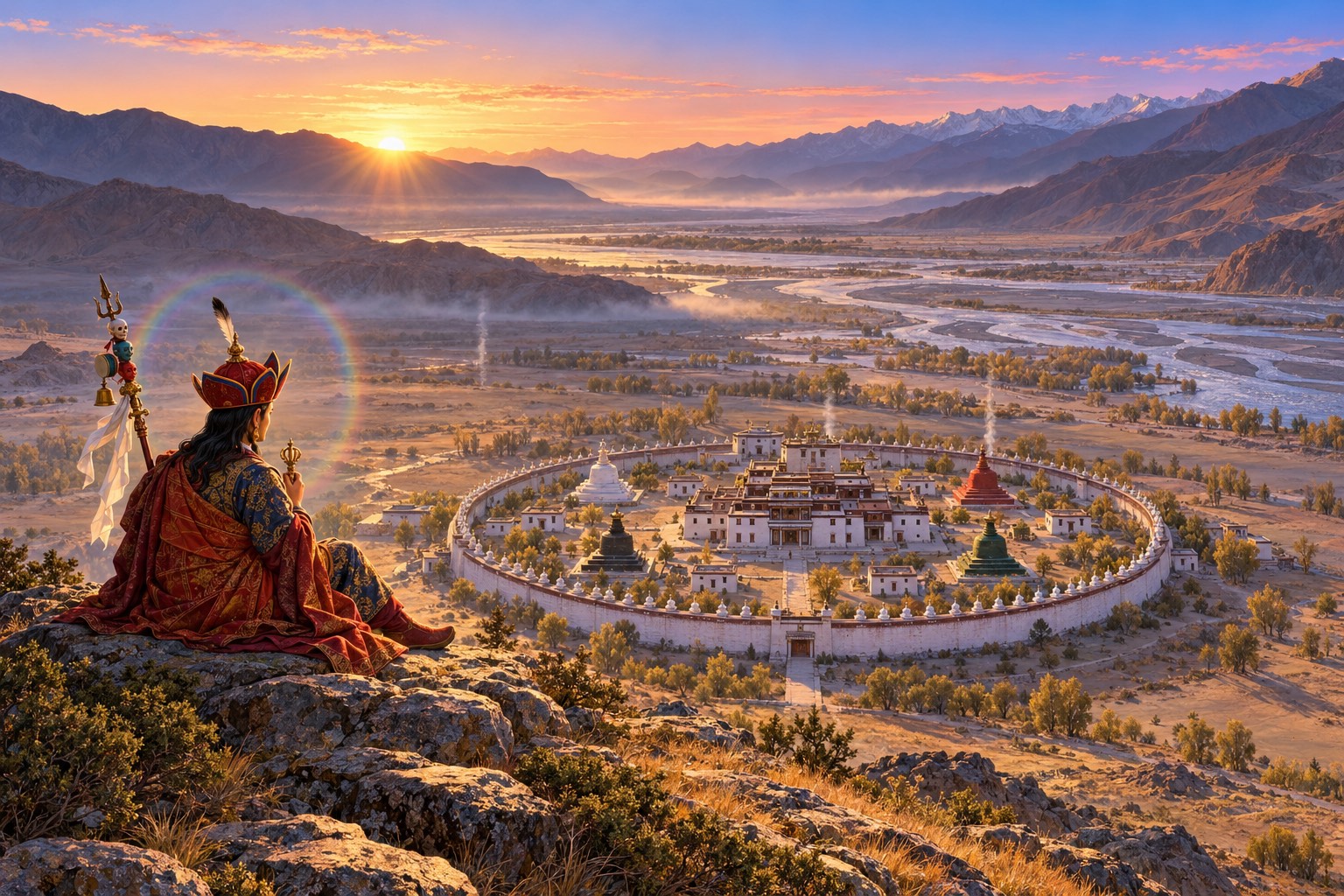
Samye appears as it might have looked in the 1930s, seen across the sands north of the river: the circular whitewashed wall, the three-storey central temple with gilt roofs on its upper storey, and the four stupas in white, red, black and green. Clothes follow the period: homespun wool chubas wrapped left over right with a sash, a silk robe and fox-fur hat for the official, and a white shawl with a red border and uncut hair for the wandering yogi, a look associated with non-monastic practitioners. The old woman's beads are a mala of 108, with one larger bead where the ends meet.
Following the site's rule against writing in images, there is none anywhere: no marks on the boat, coins, bags, gates or stones. Prayer flags, which carry printed prayers, are left out of every scene. No one has a halo or rainbow light, nothing miraculous happens on the water, and Guru Rinpoche is not shown: the only image in the story, on Chungdak's shelf, is a small soft shape beside his butter lamp.
Why this matters for practice
The sixth line of the Seven-Line Prayer is a promise to follow in Guru Rinpoche's footsteps, and following is mostly made of small things done again and again. Chungdak is invented, and nothing in his story promises safety or reward: the river stays the river. What he has is one prayer, said the same way in every kind of weather, and that steadiness is something anyone can begin with a single, unhurried recitation.
If something in this story stayed with you, you might let tonight be a small crossing of your own: pause wherever you are, and recite the prayer once.
Sources and further reading
- Seven-Line Prayer (topic page), Lotsawa House
- Seven Line Prayer, Rigpa Wiki (via web.archive.org)
- Samyé, Rigpa Wiki (via web.archive.org)
- Samye, Wikipedia
- Yarlung Tsangpo, Wikipedia
- A Journey to Lhasa and Central Tibet (1902), chapters 5 and 9, Wikisource (Sarat Chandra Das)
- Coracle, Wikipedia
- Lhasa River, Wikipedia
- Chushul Chakzam, Wikipedia
- Bundesarchiv Bild 135-BB-082-12, yak-hide boats at the Chaksam ferry (1938), Wikimedia Commons
- Chuba, Wikipedia
- Tibetan nobility, Wikipedia
This retelling is waiting to be read by a knowledgeable practitioner. Where the traditional accounts differ, the story says so; if you notice a mistake, please tell us through Share Your Story.