Between Garab Dorje, the first human teacher of the Great Perfection, and Guru Rinpoche, the Nyingma tradition remembers a short chain of teachers. Each one received the teaching whole, kept it safe, and placed it in the hands of the next. This story follows two links in that chain: the scholar Manjushrimitra and his student Shri Singha, whose name means "Glorious Lion".
The Great Perfection, Dzogchen in Tibetan, teaches that the mind's own nature is already pure and awake. This page will say no more than that. Its practice is given in person by a qualified teacher, and the Find a Teacher page is a place to begin.
These lives reach us as sacred history. The page mainly follows The Jewel Rosary History by the fourteenth-century master Longchenpa, translated by Adam Pearcey, and sets later summaries beside it. Where the tellings differ, it says so.
The scholar who sorted the teachings
How Manjushrimitra, a learned brahmin from west of Bodhgaya, came to Garab Dorje and received his last testament is told in the story of Garab Dorje. This one begins just after, with a disciple left alone with everything his teacher had given him. One encyclopedia summary says they had been together for seventy-five years.
Now, the accounts say, Manjushrimitra gathered the teachings and arranged them into three series, called Mind, Space and Pith Instruction. The names are enough for this page. What they hold is for a teacher to explain.
 Illustration in preparation
The innermost part he divided again, Longchenpa says, into a spoken transmission and an explained one. The first he set down in notes. For the second he could find no one ready, so he hid the texts as a treasure inside a boulder marked with a crossed vajra, north-east of the Vajra Seat at Bodhgaya, where the Buddha awoke.
Illustration in preparationA crossed vajra is two diamond sceptres laid across each other, a sign of what cannot be broken. Then Manjushrimitra went to live in a charnel ground called Sosadvipa, to the west of Bodhgaya. A charnel ground is a place where the dead were laid out or burned. In the tantric tradition it is a place of practice, because nothing there can be pretended away.
A boy from the far east
Far to the east, in a town Longchenpa calls Black Shokhyam in China, a householder and his wife had a son.
The accounts do not agree on where this was. Rigpa Wiki places Shri Singha's home in Khotan, an oasis kingdom on the Silk Road, now in western China. A museum note says simply that he was born in China. Another telling makes his parents a king and a queen.
Illustration in preparationLater summaries say he studied with teachers named Haribhala and Bhelakirti and soon became known for his learning. Then, the tradition says, Avalokiteshvara, the bodhisattva of compassion, appeared to him with a message: if he truly sought awakening, he should go to the charnel ground of Sosadvipa in India.
The mountain of five terraces
Here the tellings part again. In one summary, Shri Singha was not yet ready to go.
He went first to Wutai Shan, the five-terraced mountain of northern China honoured as the earthly home of Manjushri, the bodhisattva of wisdom. There, it says, he became a monk and studied for thirty years. Rigpa Wiki, following Tulku Thondup, speaks of seven years with his teacher and then thirty years of monastic discipline.
Longchenpa says only that the same prophecy came to him a second time, in a bathing pool to the east of Wutai Shan. Either way, the mountain stands in his story: broad, flat, grassy summits above the trees, cold enough for snow in summer.
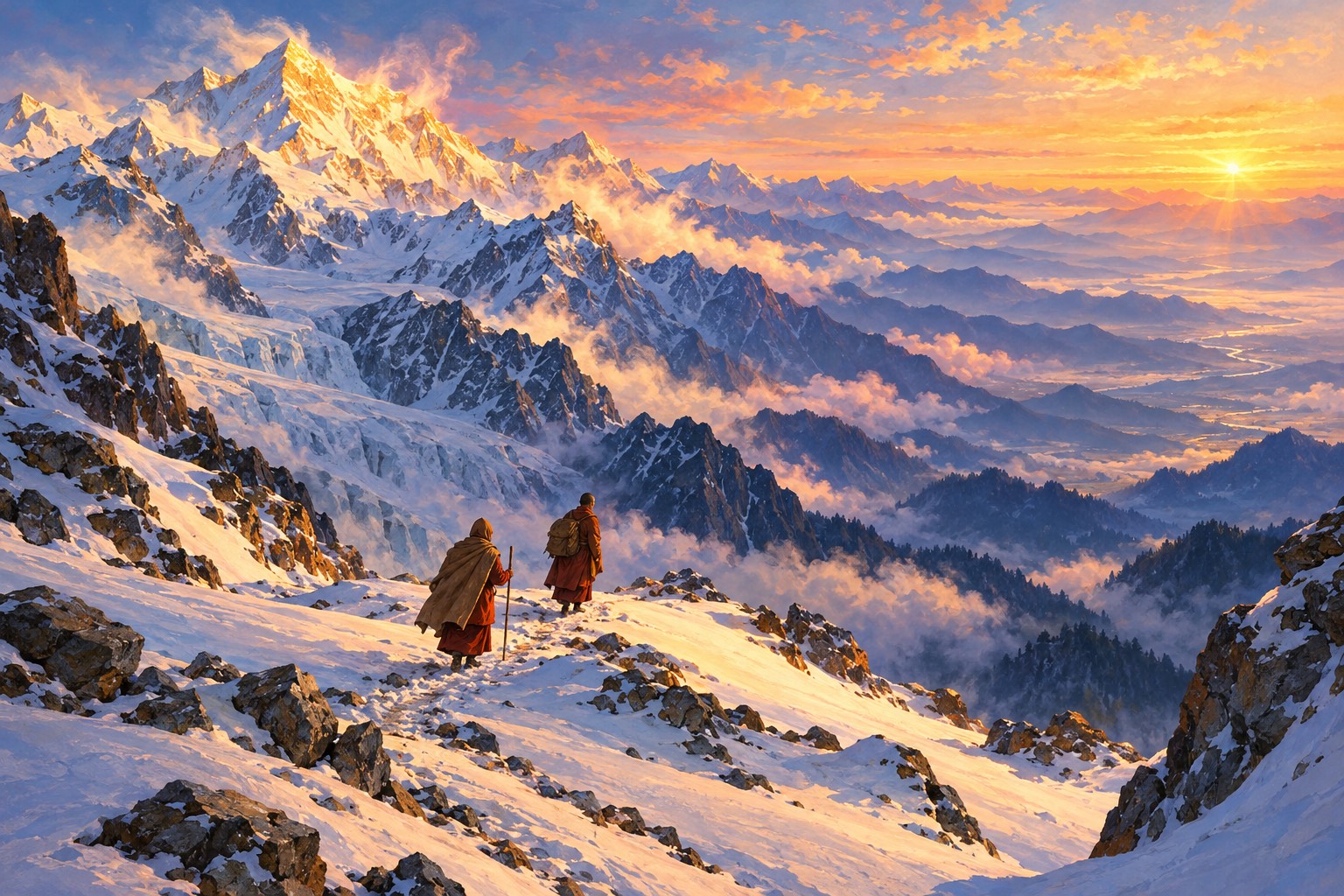
Illustration in preparationThis time he went. The journey took nine days, Longchenpa writes, and in all that time his feet never touched the ground; he travelled a forearm's height above it. Another summary credits him with the yogic power of swift walking. However it is told, the man who once delayed did not delay again.
Illustration in preparationAt the charnel ground
At Sosadvipa he found Manjushrimitra. He bowed to him, walked around him in respect, and asked to be guided and cared for. The master accepted him. One summary says he stayed twenty-five years.
Illustration in preparationWhen the teaching was complete, the accounts say, Manjushrimitra rose into the sky above the charnel ground and dissolved into light. Shri Singha cried out in grief, as his teacher once had. And as before, a tiny casket came to him, holding a last testament known as The Six Meditation Experiences. In Longchenpa it falls from the sky; in another summary his teacher appears once more and places it in his hands.
Illustration in preparationHidden in a pillar
Shri Singha went back to the boulder near Bodhgaya and took out the texts his teacher had hidden. He carried them east. At a place Longchenpa calls the Tree of Awakening in China, he arranged the innermost teachings into four cycles, called outer, inner, secret and unsurpassed secret.
Longchenpa says he hid the first three cycles in the top of a pillar in a temple called Gateway to Myriad Auspiciousness. Later, following a prophecy from a dakini, a female being of wisdom, he hid the fourth there too. Another summary divides the hiding places between two temples. Then he went to live in a charnel ground called Siljin, in China.
Illustration in preparationTwo scholars at Bodhgaya
Meanwhile, two scholars were living at Bodhgaya: Vimalamitra, from western India, and Jnanasutra, from the east. Longchenpa says both had mastered all the learning of their day.
One day they walked a short way west, to a marshy thicket full of flowers. There, the account says, Vajrasattva, a buddha of purity, appeared in the sky. He told them that after five hundred lifetimes as scholars they had still not reached the goal, and that if they wished to be free in one life, they should go to Siljin in China.
Illustration in preparationVimalamitra set out at once and received much of the teaching from Shri Singha. Back in India he met his old friend and told him, in Pearcey's translation, that he had met "an emanation of a buddha". So Jnanasutra went too. Shri Singha taught him everything, Longchenpa says, including the fourth and unsurpassed cycle.
Illustration in preparationWhen Shri Singha in his turn dissolved into light, the casket that came to Jnanasutra held The Seven Nails. Lotsawa House marks that text as restricted, and this page leaves it there. Another summary places Shri Singha's passing on a road, as he went to visit the king of Khotan.
Jnanasutra later passed the whole teaching to Vimalamitra, who carried it to Tibet. Rigpa Wiki says that after thirteen years there Vimalamitra left for Wutai Shan, where the tradition holds that he remains in a body of light. The mountain where Shri Singha's journey began is also where his student's student is said to dwell.
Guru Rinpoche and Vairotsana
The tradition remembers two more of Shri Singha's students. Rigpa Wiki, following Nyoshul Khenpo's history of the lineage, says Guru Rinpoche went to a charnel ground called Parushakavana, where Shri Singha gave him the teachings of all three series. He stayed twenty-five years, receiving them and reflecting on them.
Wikipedia says Shri Singha conferred the Dzogchen tantras on him. Longchenpa's chapter does not mention this meeting, and some accounts trace Guru Rinpoche's share of the teaching through Vimalamitra instead, or through a vision of Garab Dorje himself.
Illustration in preparationThe other was the Tibetan translator Vairotsana, who crossed the Himalaya to find him. Where he found Shri Singha, and how the teaching was kept secret, is told in the story of Vairotsana.
What historians say
Historians cannot fix these masters' dates, and the chain as told is hard to fit into ordinary time. One encyclopedia gives Manjushrimitra's death as 740. Another notes that if he knew Garab Dorje, he would have lived centuries earlier.
One scholar places Shri Singha's later home in Andhra, in south India; Namkhai Norbu Rinpoche once suggested Burma. The tradition is content to hold the story as it was handed down.
One pair of hands to the next
What stays is its shape. Each teacher gave everything. Each student waited, travelled, bowed and asked.
The third line of the Seven-Line Prayer speaks of Guru Rinpoche's wondrous, supreme accomplishment. Behind that one line the tradition sees long years of patient receiving, in charnel grounds and on mountains, by teachers who were students first.
Illustration in preparationAbout the art
Shri Singha keeps the look he has on the Vairotsana page, taken from a nineteenth-century painting in the Rubin Museum and a photograph in the Shechen Archives: hair in a topknot tied with flowers, a moustache and short beard, a long green scarf, and the right hand raised with one finger pointing upward. Paintings also show him as a monk in a pointed red hat; we use the adept form so that he stays easy to recognise from page to page. A cream shawl has been added for modesty, and he is shown younger and older as the story moves through his life.
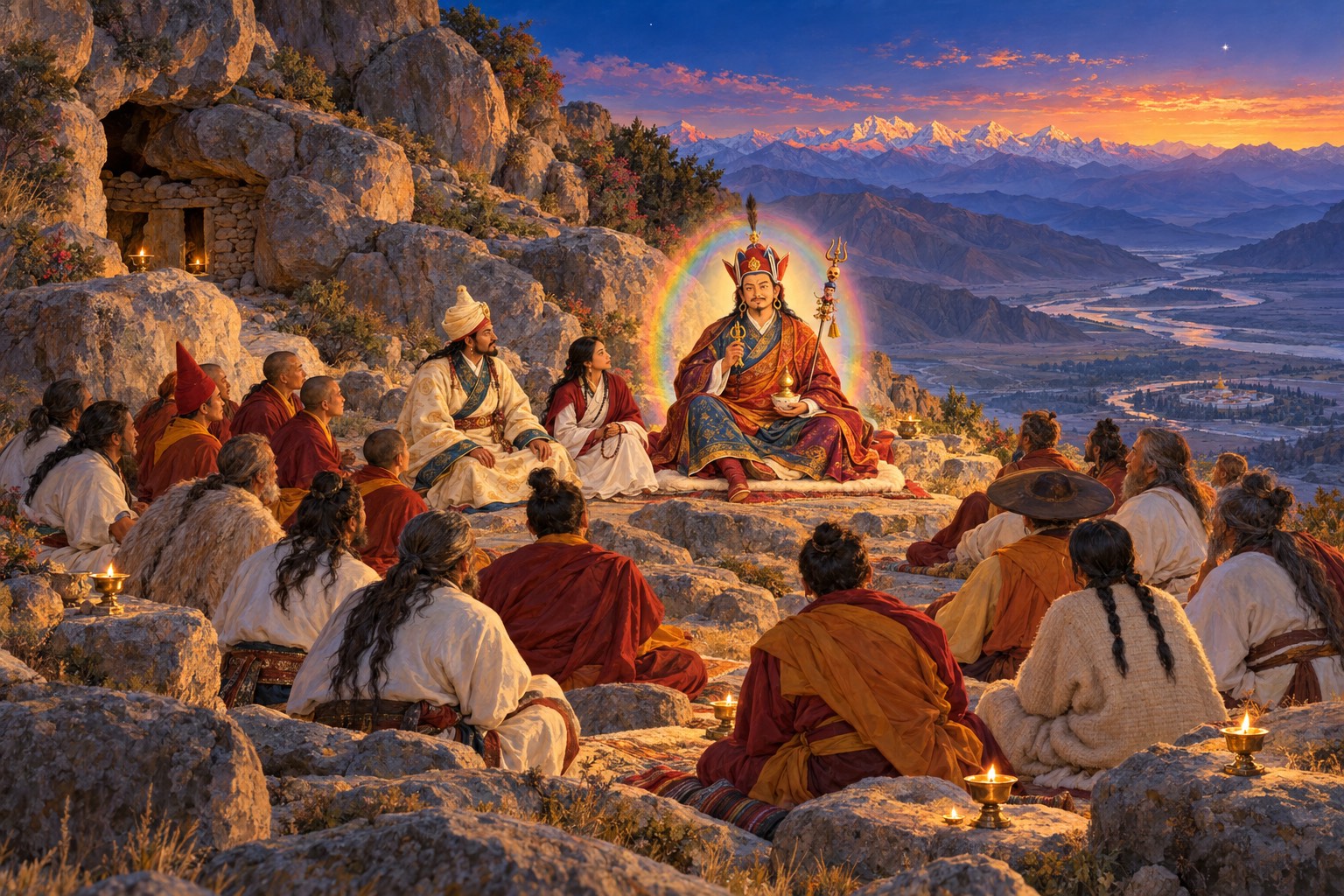
Manjushrimitra follows the sheet from the Garab Dorje page: a clean-shaven Indian scholar with a topknot, a cream shawl and a red sash, here with grey at his temples, because the accounts give him many years with his teacher. Jnanasutra and Vimalamitra are drawn as young Indian monk-scholars in ochre robes; their own portraits, which show them later in life, are not used here. Guru Rinpoche appears as a young yogi while he studies, and in his familiar main form, with the lotus hat, vajra and skull cup, only in the closing image.
Several wonders are only suggested: the visions of Avalokiteshvara and Vajrasattva are soft light with no figure drawn, and the caskets are tiny and completely blank, because this site never puts writing or syllables into its images. The crossed vajra on the boulder is two vajras laid across each other, a sign of the indestructible. Wutai Shan is shown as its broad, flat, grassy summits, with no temples, and the temple pillar in China is kept plain, since the sources say little about either place in that age.
Why this matters for practice
The third line of the Seven-Line Prayer recalls Guru Rinpoche's wondrous, supreme accomplishment, and this story shows one way the tradition understands it: as something received, patiently, from teachers who had received it themselves. Manjushrimitra and Shri Singha are remembered for waiting, travelling and asking, and for giving everything they had. Reciting the prayer is a simple way to join that long line of asking; the teachings themselves are given by a qualified teacher.
If something in this story touched you, you might think of everyone who carried these teachings from one pair of hands to the next, and recite the prayer once. For the Great Perfection itself, the right guide is a qualified teacher.
Sources and further reading
- Symbolic Transmission of the Vidyādharas, from The Jewel Rosary History, by Longchen Rabjam (trans. Adam Pearcey, 2025), Lotsawa House
- Śrī Siṃha Series, Lotsawa House
- Shri Singha, Rigpa Wiki (archived snapshot)
- Mañjushrimitra, Rigpa Wiki (archived snapshot)
- Jñanasutra, Rigpa Wiki (archived snapshot)
- Vimalamitra, Rigpa Wiki (archived snapshot)
- Wutai Shan, Rigpa Wiki (archived snapshot)
- Padmasambhava, Rigpa Wiki (archived snapshot)
- Shri Singha, Tibetan Buddhist Encyclopedia
- Manjushrimitra, Tibetan Buddhist Encyclopedia
- Sri Singha, Wikipedia
- Mañjuśrīmitra, Wikipedia
- Jnanasutra, Wikipedia
- Garab Dorje, Wikipedia
- Mount Wutai, Wikipedia
- Indian Adept (siddha): Shrisimha, item 510 (Rubin Museum), Himalayan Art Resources
- A Marvelous Garland of Rare Gems, by Nyoshul Khenpo (trans. Richard Barron, 2005), and Masters of Meditation and Miracles, by Tulku Thondup (1996)
This retelling is waiting to be read by a knowledgeable practitioner. Where the traditional accounts differ, the story says so; if you notice a mistake, please tell us through Share Your Story.