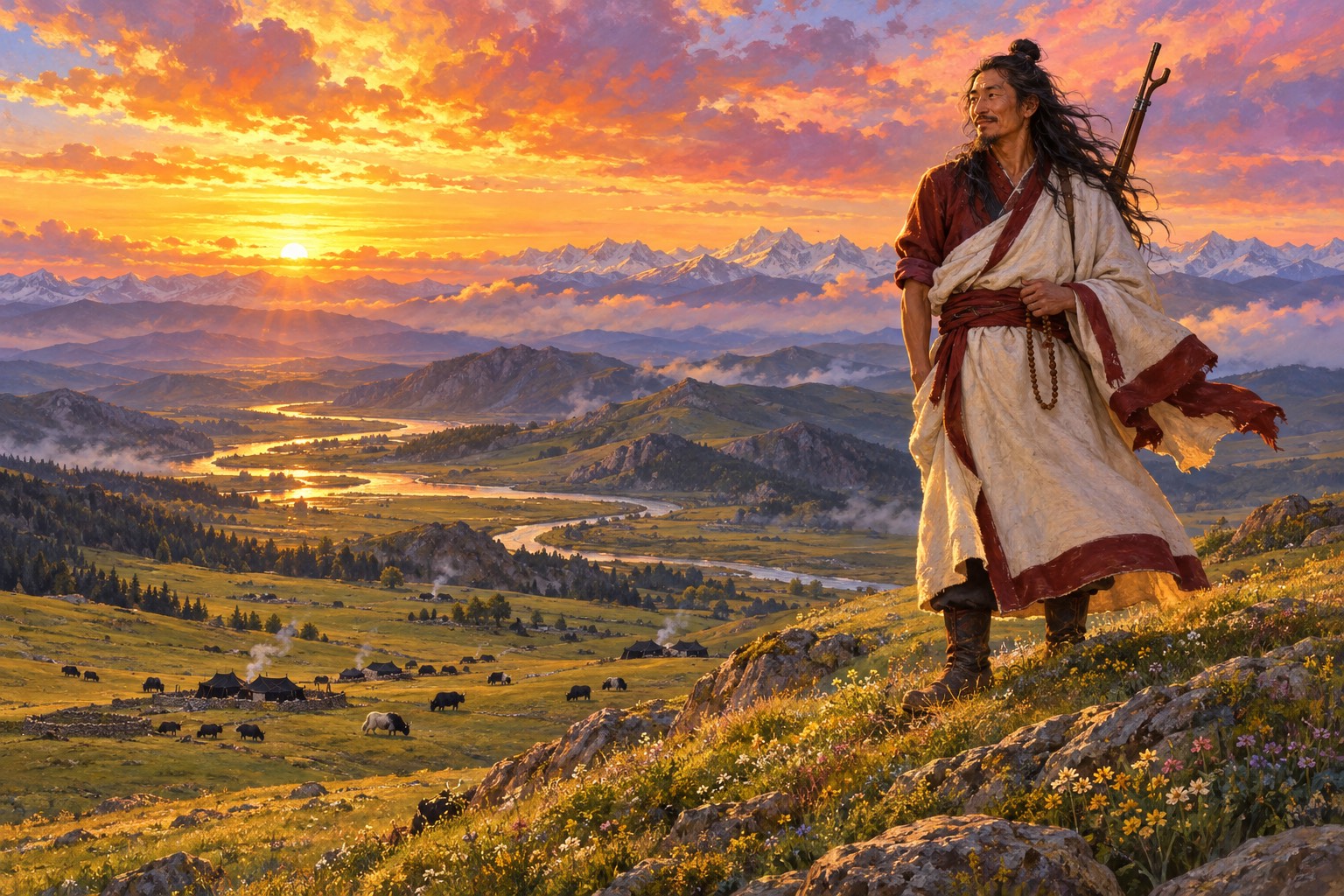
Above the forests of Nyarong, in the eastern Tibetan region of Kham, a pale peak of bare rock stands over green meadows. Its name is Lhangdrak. In its cliffs and the hills around it, in the nineteenth century, lived a yogi who called himself, in one of his songs, an old beggar.
He is remembered as Nyala Pema Dündul (1816–1872). A yogi is someone who gives their life to meditation. He was also a tertön, a revealer of the teachings the tradition says Guru Rinpoche hid for later times. And the tradition holds that when he died he attained the rainbow body, leaving behind only his hair, his nails and his clothes.
His meeting with the boy Tertön Sogyal is told in Story 58. This is the old beggar's own story.
A house that fell
He was born in lower Nyarong in 1816, on the tenth day of the ninth month of the Fire Mouse year. His father was Khangtsek Gönpo and his mother Sönam Kyi. The accounts name his village differently: Treasury of Lives gives Shanglang Drakkar, Rigpa Wiki Delong Gyalnya Tang. He was the eldest of three boys, and an uncle who was a lama named him Tashi Döndrub.
The family was wealthy at first. At seven, Treasury of Lives says, the boy was recognized as an embodiment of Longsel Nyingpo, a seventeenth-century treasure revealer of Katok Monastery.
Then the house fell. His father died, and his mother spent much of what they had on the forty-nine days of prayers offered for the dead. His father's brothers turned the widow and her sons out of their home, and the family went to live in a small stable.
 Illustration in preparation
More losses followed. The middle son died, and most of their fields were sold to pay for his funeral rites. Tashi Döndrub caught smallpox, and the neighbours made him live apart. He survived by begging, the biography says, and was often driven away. His youngest brother, Alo, died of hunger.
Treasury of Lives notes how this echoes the youth of Milarepa, Tibet's great poet-yogi, whose family was also robbed by relatives.
Seeking
At fifteen, perhaps because of all he had lived through, he began to seek the Dharma, the Buddha's teaching, in earnest. His uncle taught him the practices of Tara, the female buddha of swift compassion. When he was twenty-one, fighting spread through Nyarong with the rise of the warlord Gönpo Namgyal, and he had to flee his village.
The trouble brought a gift. Do Khyentse Yeshe Dorje, the wandering yogi of Golok told of in Do Khyentse, the Wild Wisdom of Golok (Story 29), had come to the region to make peace, and the young man received teachings from him.
Illustration in preparationIn 1840, in Tromkhok, the yogi Pema Gyurme Sangye gave him the name Pema Dündul. Pema means "lotus," and Dündul means "tamer of demons." In Buddhist teaching the demons a yogi tames are above all inner ones: pride, craving and fear.
Back home in retreat, the accounts say, small papers in the coded script of the dakinis, female embodiments of awakened wisdom, came into his hands.
The White Rock
In 1846 he met Chöying Rangdröl, the first Tsopu Drubchen, a Katok-trained yogi who lived in retreat. Faith rose in him so strongly, Treasury of Lives says, that he resolved to give his own life to practice.
From Chöying Rangdröl he received the teachings of Dzogchen, the "Great Perfection," which the Nyingma tradition holds to be its deepest teaching on the nature of mind. Such teachings pass from a qualified teacher to a student; this page only names them, and the Find a Teacher page can help anyone drawn to them.
Illustration in preparationThe young yogi wanted to set off on a long pilgrimage to India and China. His teacher said no. Stay, he advised, and practise what you have received, at a place called Lhanglhang Drakkar, the White Rock of Lhanglhang.
He stayed nine years. He began in a small cave called Norbui Drak, the Jewel Rock, and later moved to one barely big enough to hold his body. The biography says that for long stretches he lived on plain water and pills made from minerals, a hermit's discipline called "extracting the essence."
Illustration in preparationWhen at last he came down to his local monastery, his mother hurried to see him. She was grieved: all those years in bare caves, she said, without food or proper clothes. He did not argue with her. The account says only that he felt a deep compassion for her.
Illustration in preparationThe old beggar
Students began to gather. He answered their questions in verse and song, and many of the songs were collected with his biography.
In one, "The Heaven of Solitude," he sets the noise of market towns and the bustle of busy monasteries against the quiet of a mountain hermitage, and calls the hermitage a heavenly realm. He signs it as "the old beggar with the name of Dündul" (trans. Adam Pearcey).
Illustration in preparationIn another song he tells how, while meditating on Avalokiteshvara, the bodhisattva of compassion, he had a vision that made him give up eating meat. He urged others to give up meat, alcohol and snuff as well.
Great offerings came to him: gold, turquoise, coral, horses and yaks. Treasury of Lives says he called them "illusory stuff" and gave them away to monasteries and beggars, especially those who recited the mantra of Avalokiteshvara, which he urged the nomads to recite and carve on stones.
Illustration in preparationIn 1857, the biography says, he drew a great many treasures from a large rock beside his hermitage, in full view of his disciples. Among his revelations is a cycle called Khakhyap Rangdröl, "Self-Liberation Pervading Space."
Illustration in preparationKalzang
By the end of the 1850s his disciples, led by Lama Thayé, persuaded him to found a monastery. In 1860 he consecrated a site in Nyarong beneath Mount Lhangdrak. Rigpa Wiki says that during the consecration he saw the thousand buddhas of this age dissolve into the land, and so he named it Kalzang Sangye Chöling, "Dharma Sanctuary of the Buddhas of the Fortunate Age."
Fifty students and many local families built it over five years: four temples and a three-storey assembly hall, Treasury of Lives records. He also founded a nunnery named for Yeshe Tsogyal, and helped bring some peace to his troubled valley.
Illustration in preparationHe taught monks and nuns and many lay yogis, the ngakpas: householders who keep tantric vows and often wear their hair long. He told the young Adzom Drukpa to stay a layman and let his hair grow, as Adzom Drukpa and the Camp by the River (Story 95) relates. The great yogini Ayu Khandro was among his students too.
His teaching passed on through two chief disciples, Rangrik Dorje and Lama Sönam Thayé, whose lines came to be called the "sun" and the "moon." Through Lama Sönam Thayé it reached Tertön Sogyal.
Illustration in preparationThe sewn tent
Around 1870 he fell ill and ate nothing for three weeks. His disciples begged him to stay, and he promised them another year or two.
In the fourth month of 1872, Saga Dawa, the month that honours the Buddha, he gathered his closest disciples for final teachings and feast offerings. Here too the accounts differ. Rigpa Wiki places this in the empty Nyin Valley, in lower Tromkhok. Treasury of Lives says he was travelling toward Katok and gathered them near a place called Yetse Lha or Sumdo, on the day of the new moon.
His last advice, as Rigpa Wiki gives it, was plain: let go of the concerns of this life, of fame and gain and practice that is only talk, and take compassion to heart. He reminded them that for those with faith, Guru Rinpoche is never far away, and so they would never be apart. Then he asked them to sew shut the door of his small tent and leave him alone for seven days.
Illustration in preparationThe tellings of that week differ as well. Some say it rained hard the whole time and rainbows appeared. Others say that as the week ended the earth shook three times, and the sky filled with rainbows and spheres of light, with music and a wonderful fragrance.
On the eighth day the disciples opened the tent. The tradition holds that they found only his hair, his nails and his clothes; Treasury of Lives adds his mat.
Illustration in preparationThis is what the tradition calls the rainbow body: the belief that a great master of Dzogchen can, at death, dissolve the body into light. It is told here as the tradition tells it, with reverence. It is not something this page can explain or promise.
Patrul Rinpoche, the wandering teacher of Story 11, soon wrote to Jamyang Khyentse Wangpo: learning was alive in the young Dodrupchen, teaching at eight, and realization in Nyala Pema Dündul, who had just attained the rainbow body. The Buddha's teaching, he said, had not yet declined.
Treasury of Lives says he was held to be the last of Katok's many yogis to attain the rainbow body. His disciples built a gilded reliquary stupa at Kalzang and placed in it what little remained, with his vajra and other sacred things.
Illustration in preparationA boy who begged at the edge of his village. A hermit in a cave too small to lie down in. An old beggar who gave away gold and asked for a tent with its door sewn shut.
About the art
Pema Dündul is shown as a lay yogi, a ngakpa: long hair wound into a topknot, a white robe and a white shawl with a broad dark-red border, and a plain mala. White is the colour long associated with householder yogis, who keep tantric vows without becoming monks, so he never wears monastic robes on this page. His look follows the sheet used for him in the story of Tertön Sogyal, so that he appears the same on both pages. The painting of him on his Lotsawa House page shows a younger, beardless face, a small gold ornament on the topknot, round earrings, an orange-red robe under the white shawl and a halo; the halo is left out here, because on this site rainbow light belongs to Guru Rinpoche and to wonders.
As a boy he wears a patched sheepskin robe, the everyday dress of Kham, and as a young man an undyed wool robe that slowly turns to the white of the yogi. The White Rock is drawn from a photograph of Mount Lhangdrak, the pale limestone peak above Kalzang. The butter lamps are small bowls of clarified butter with a cotton wick, the light of every Tibetan shrine and hermitage. Books are long loose pages wrapped in cloth between boards, and as everywhere on the site no script appears in any image.
The rainbow light in the last two images marks what the tradition says happened, not a picture of it: the folded robe, the mat and the mala stand for the clothes his disciples found. Nothing more is shown, out of respect.
Why this matters for practice
The third line of the Seven-Line Prayer speaks of Guru Rinpoche's wondrous supreme accomplishment. The tradition remembers Nyala Pema Dündul, a beggar boy who became a great yogi, as one who reached the summit of that accomplishment, and he told his students that for those with faith Guru Rinpoche is never far away. Reciting the seven lines, even once, is a simple way to turn toward that faith; anything beyond recitation is best learned from a teacher.
If something in this story moved you, the little tent on the hillside or the teacher who promised he would never be far, you might pause tonight and recite the prayer once.
Sources and further reading
- Nyakla Pema Dudul, by Samten Chhosphel (October 2012), Treasury of Lives (Internet Archive snapshot, October 2014)
- Nyala Pema Dündul, Rigpa Wiki (Internet Archive snapshot, January 2025)
- Kalzang Monastery, Rigpa Wiki (Internet Archive snapshot, 2025)
- Nyala Pema Dündul Series, Lotsawa House
- The Heaven of Solitude, by Nyala Pema Dündul, trans. Adam Pearcey, Lotsawa House
- Song of Advice for Giving Up Meat Eating, by Nyala Pema Dündul, Lotsawa House
- Matthew Kapstein, 'The Strange Death of Pema the Demon-Tamer', in The Presence of Light (University of Chicago Press, 2004)
This retelling is waiting to be read by a knowledgeable practitioner. Where the traditional accounts differ, the story says so; if you notice a mistake, please tell us through Share Your Story.