Some teachers are remembered for building temples. Others are remembered for keeping a lamp burning after the temples went dark. Nubchen Sangye Yeshe is one of the second kind.
His personal name, Sangye Yeshe, means "Buddha Wisdom". "Nubchen" means "the great one of Nub", after his family clan. Tibetans count him among the twenty-five closest disciples of Guru Rinpoche. Historians tend to place him a little later, in the ninth and tenth centuries. This page tells the story as the tradition tells it, and says gently where the historians see it differently.
A son of the Nub clan
He was born into the Nub family in the Drak valley, south of the great Tsangpo river in central Tibet. High above that valley stand the limestone cliffs of Drak Yangdzong, whose caves would one day be his place of retreat.
His teachers were many, and long lists of their names survive. Among the Tibetans were Sokpo Palgyi Yeshe and Odren Palgyi Zhönnu, who had learned from the great translator Nyak Jñanakumara. Rigpa Wiki adds that he studied with Vimalamitra, the Indian master of the Great Perfection, and with many others.
 Illustration in preparation
Over the mountains
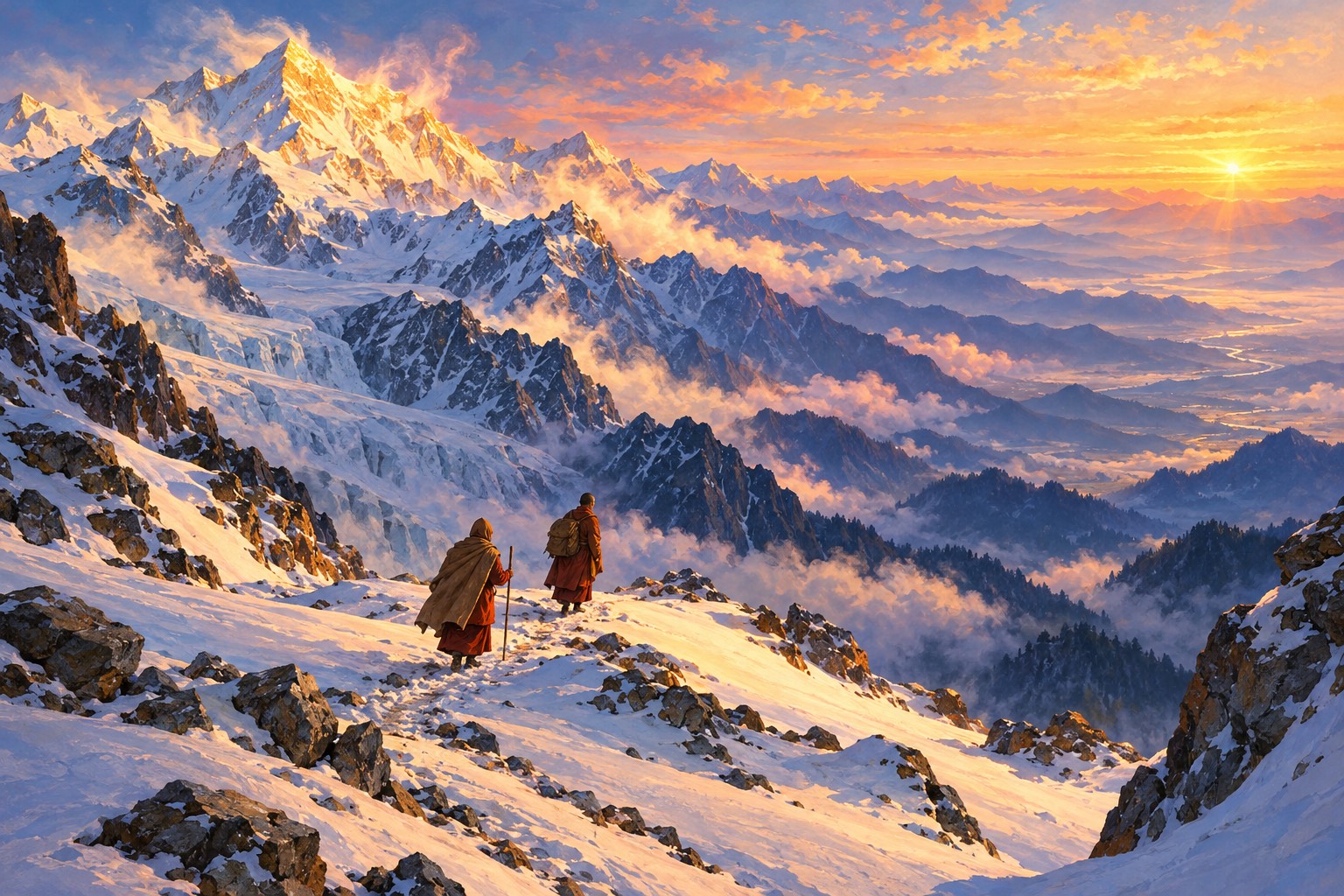
Then he went looking further. The Treasury of Lives says he studied in India, in Nepal, and in Gilgit, a mountain kingdom in the far northwest that Tibetans called Drusha. One summary of the old histories says he made the journey to India and Nepal seven times.
Each crossing meant weeks on foot over the high passes, with gold for offerings, and the hope of coming home with teachings Tibet did not yet have.
Illustration in preparationAn old painting now in the Rubin Museum of Art's collection names two of his foreign teachers. One is Vasudhara, a master from Nepal, painted as a layman. The other is an Indian adept known in Tibetan as Dragtung Nagpo.
Illustration in preparationThe teaching called Anuyoga
The Nyingma tradition, the "old school" of Tibetan Buddhism, arranges the Buddha's teachings in nine vehicles, nine ways of different depth. The eighth is called Anuyoga. Its root text is known as the Sutra that Gathers the Intentions.
Rigpa Wiki remembers Nubchen as the one who brought the Anuyoga teachings to Tibet. The scholar David Germano, writing about the history of these texts, likewise credits him with beginning the Anuyoga tradition there. He studied the sutra with its translators, among them Chetsenkye, and later wrote a vast commentary on it called Armour Against Darkness.
What those teachings contain belongs in the hands of a qualified teacher. For this story it is enough to know that he gave years of his life to making sure they would not be lost.
Illustration in preparationIn the circle of the Lotus-Born
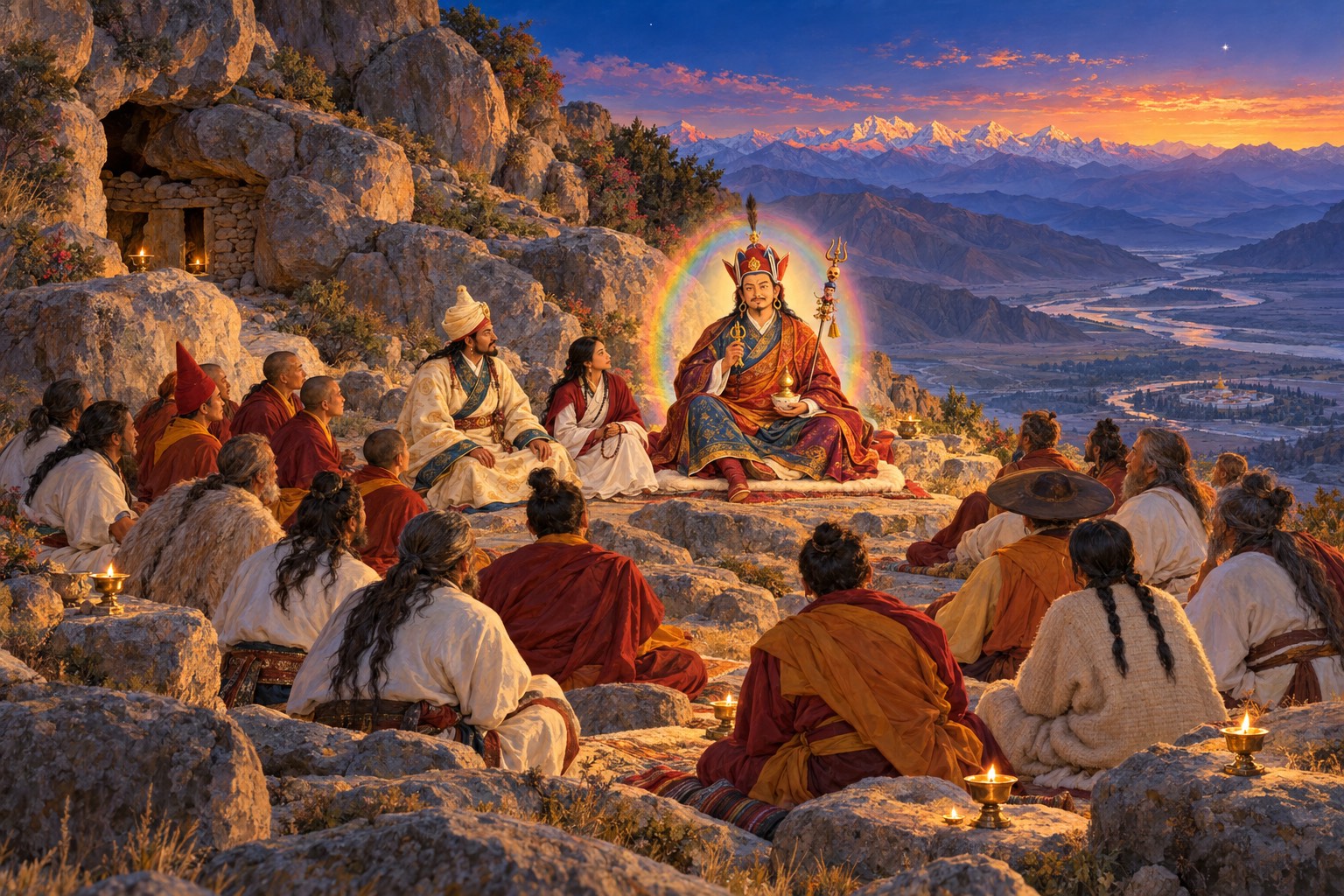
The tradition places him in the circle of Guru Rinpoche himself, in the days of King Trisong Detsen and the first monastery at Samye. It is said he received teachings and empowerments from the Lotus-Born master, and, according to a summary of the Treasury of Lives biography, Nubchen himself spoke of having met him.
Illustration in preparationWhen the lamps went out
In the 840s the great Tibetan empire broke apart. The later histories lay the blame on King Langdarma, who, they say, turned against the monasteries. Royal support for the monks ended, monks and nuns were sent away, and temple halls fell quiet. Some modern historians think the persecution was smaller than the histories remember, but all agree that a long, uncertain time followed.
Tibetans call the century after the empire's fall a dark age. Through those years the teachings were often carried by households rather than monasteries: lay practitioners, men and women in white robes with long uncut hair, who practised at home and in mountain hermitages. Nubchen was one of them.
Illustration in preparationBefore the king
Here the tradition tells its best-known story about him. When the king threatened the tantric practitioners, the old accounts say, Nubchen came before him. He did not argue. Instead he showed the king a display of power, a sign of what his practice had made possible, so overwhelming that the king was badly frightened.
The king, the story goes, promised to leave the lay tantric practitioners unharmed. Rigpa Wiki puts it simply: legend says it was through Nubchen's powers that Langdarma spared them. The monasteries had emptied, but the white-robed householders went on practising.
It is remembered as a story of protection rather than of battle. A frightened ruler stepped back, and a fragile community was left in peace.
Illustration in preparationThe story also holds a gentle puzzle. Langdarma's reign ended in 842, and the Treasury of Lives gives Nubchen's birth as perhaps 844. A summary of its biography adds that the old sources place his birth in a year of the mouse, which could fall in the 770s or, more likely in its view, in the 830s or 840s.
On the earlier dates he could have known both Guru Rinpoche and the king. On the later ones, historians doubt that he could have met either, and they wonder whether the stories gathered around his name over time. His life was long in any case: Dudjom Rinpoche's history gives him 111 years, and another source 130, reaching into the reign of King Pelkhortsan in the early 900s.
The tradition, for its part, keeps him among the twenty-five. Thoughtful people hold both views, and you are free to hold them side by side.
Illustration in preparationA lamp for the eye
Nubchen also wrote. One of his books is the Samten Mikdrön, the Lamp for the Eye of Meditation. It surveys the ways of meditation known in Tibet in his day: the gradual path taught by Indian masters, the sudden approach of Chinese Chan (the school later known in Japan as Zen), the tantric path of Mahayoga, and finally the Great Perfection, Dzogchen, the teaching on the mind's own open and awake nature, which he places highest.
The book has a small mystery of its own. Far to the northeast, at Dunhuang on the Silk Road, a small cave crammed with manuscripts was walled up early in the eleventh century and opened again in 1900. Tens of thousands of documents were inside, many in Tibetan, because Dunhuang was under Tibetan rule from 787 to 848.
Some writers, among them Elías Capriles, say the Lamp itself was found in that cave. Others describe the copy we have as one handed down in Tibet. Either way, scholars read the two side by side: the cave preserved writings of the Chan master Moheyan and other early teachings that Nubchen discusses, and his book helps them understand what the cave kept.
In 2022 the scholar Dylan Esler published a full English translation and study of the Lamp. For historians it is a rare window onto how Tibetans meditated before the later schools took shape.
Illustration in preparationThe long life
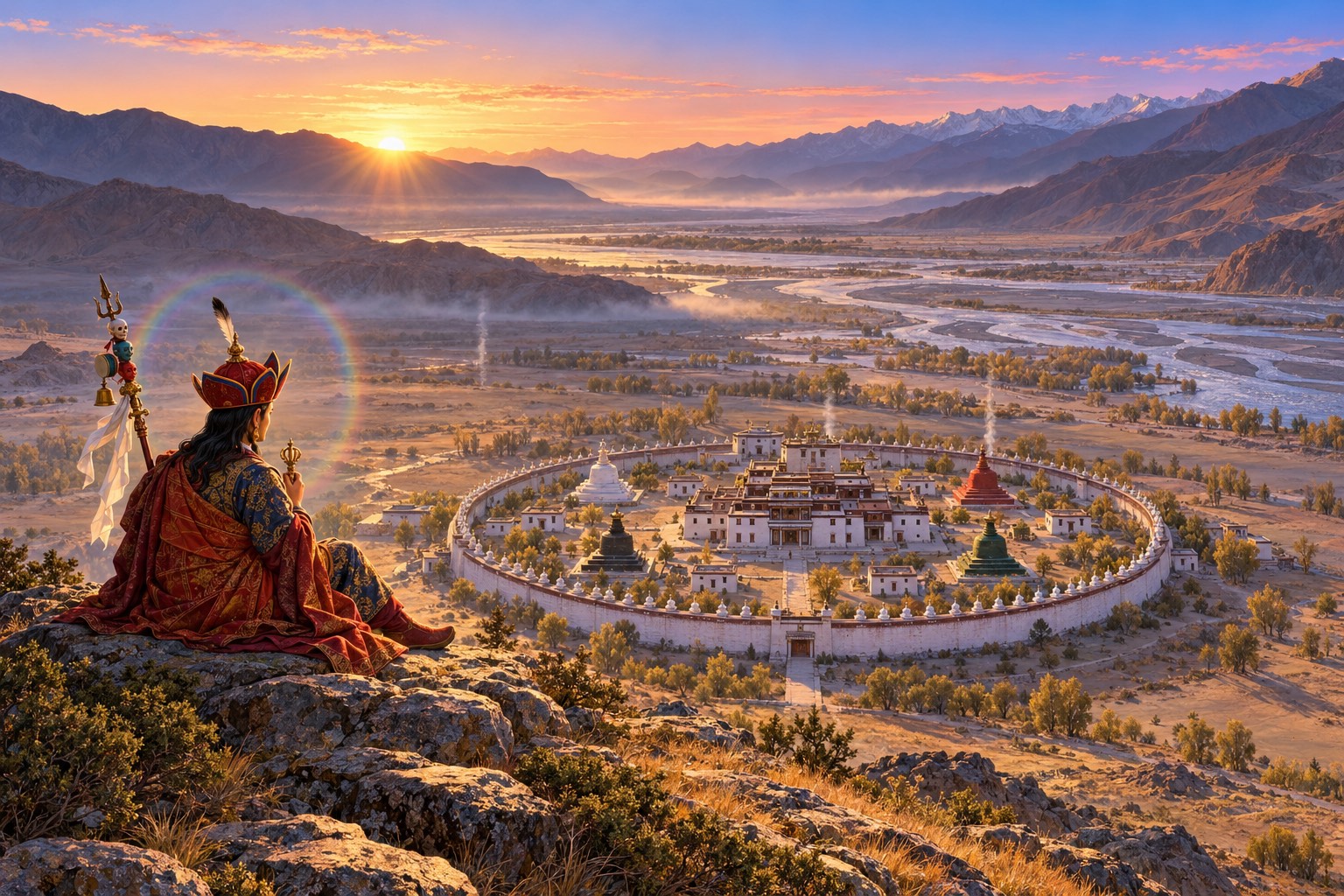
In his old age, the tradition says, Nubchen stayed near the caves of Drak Yangdzong and taught. The Treasury of Lives calls him the second of three great holders of the early tantras, between Nyak Jñanakumara before him and Zurchen Shakya Jungne after. Through them the Kama, the Nyingma lineage passed on by word of mouth from teacher to student, reached the centuries that followed.
Illustration in preparationThe sixth line of the Seven-Line Prayer asks to follow in Guru Rinpoche's footsteps. Nubchen's life shows what following can look like when times are hard: no grand gestures, only study, patience, and keeping faith in a quiet room until the light returns.
Illustration in preparationAbout the art
Nubchen is painted here as he appears on a small initiation card from the Shechen Archives (Himalayan Art Resources): a lay tantric yogi, a ngakpa, with long uncut hair and a beard, a white robe with a short coloured shawl, a long mala of large beads and a round white hat with a feather plume. White robes and long hair mark the lay practitioners who, in this story, carried the teachings through the dark years. On the card he also holds a ritual dagger and a scorpion; here the dagger stays tucked in his sash and the scorpion is left out. Other paintings show him differently: a Drigung painting in the Rubin Museum's collection places him among his lineage dressed as a monk in a red scholar's hat.
The confrontation with the king is drawn as the tradition frames it, as awe rather than combat: Nubchen stands with an empty, open hand, and the display of power is a storm of light behind him. The king is not a portrait. No reliable likeness of Langdarma exists, so his face stays in shadow.
Guru Rinpoche appears in his main form, the one named in the Seven-Line Prayer: the lotus hat with a single vulture feather, a five-pronged vajra at his heart, a skull cup holding a long-life vase, and the khatvanga staff in the crook of his left arm, inside a sphere of rainbow light. The Dunhuang cave is shown as a small chamber packed with cloth-wrapped scrolls. On this page every book, scroll and page is closed or wrapped, so no lettering appears in any image.
Why this matters for practice
The sixth line of the Seven-Line Prayer expresses the wish to follow in Guru Rinpoche's footsteps, and Nubchen's life shows what that following can look like when the world turns against it: patient study, long journeys, and quiet practice in ordinary homes. The tradition remembers that his steadiness protected others. For someone returning to practice after years away, his story is a reminder that a single lamp, kept lit, counts for a great deal; reciting the prayer once can be that lamp.
If something in this story stayed with you, you might think of everyone who kept the teachings alive through dark years, and recite the prayer once. For the deeper teachings Nubchen spent his life protecting, a qualified teacher is the right guide.
Sources and further reading
- Nubchen Sanggye Yeshe, The Treasury of Lives (Alexander Gardner, 2009; archived snapshots)
- Nupchen Sangye Yeshe, Rigpa Wiki (archived snapshot)
- So, Zur, and Nub, Rigpa Wiki (archived snapshot)
- Nubchen Sangye Yeshe Series, Lotsawa House
- Drak Yangdzong, Nekhor
- Yamari, Krishna (Drigung Tradition), item 661, Himalayan Art Resources
- Initiation Cards: 25 Disciples of Padmasambhava, item 52848958, Himalayan Art Resources
- Nubchen Sangye Yeshe, Wikipedia
- Samten Migdrön, Wikipedia
- Anuyoga, Wikipedia
- Moheyan, Wikipedia
- Langdarma, Wikipedia
- Era of Fragmentation, Wikipedia
- Ngagpa, Wikipedia
- Mogao Caves (Library Cave), Wikipedia
- Nubchen Sangye Yeshe, Encyclopedia of Buddhism
- The Lamp for the Eye of Contemplation (Oxford University Press, 2022), and On the Life of gNubs-chen Sangs-rgyas ye-shes, Dylan Esler
- The Nyingma School of Tibetan Buddhism, Dudjom Rinpoche, trans. Gyurme Dorje and Matthew Kapstein (Wisdom, 1991/2002)
This retelling is waiting to be read by a knowledgeable practitioner. Where the traditional accounts differ, the story says so; if you notice a mistake, please tell us through Share Your Story.