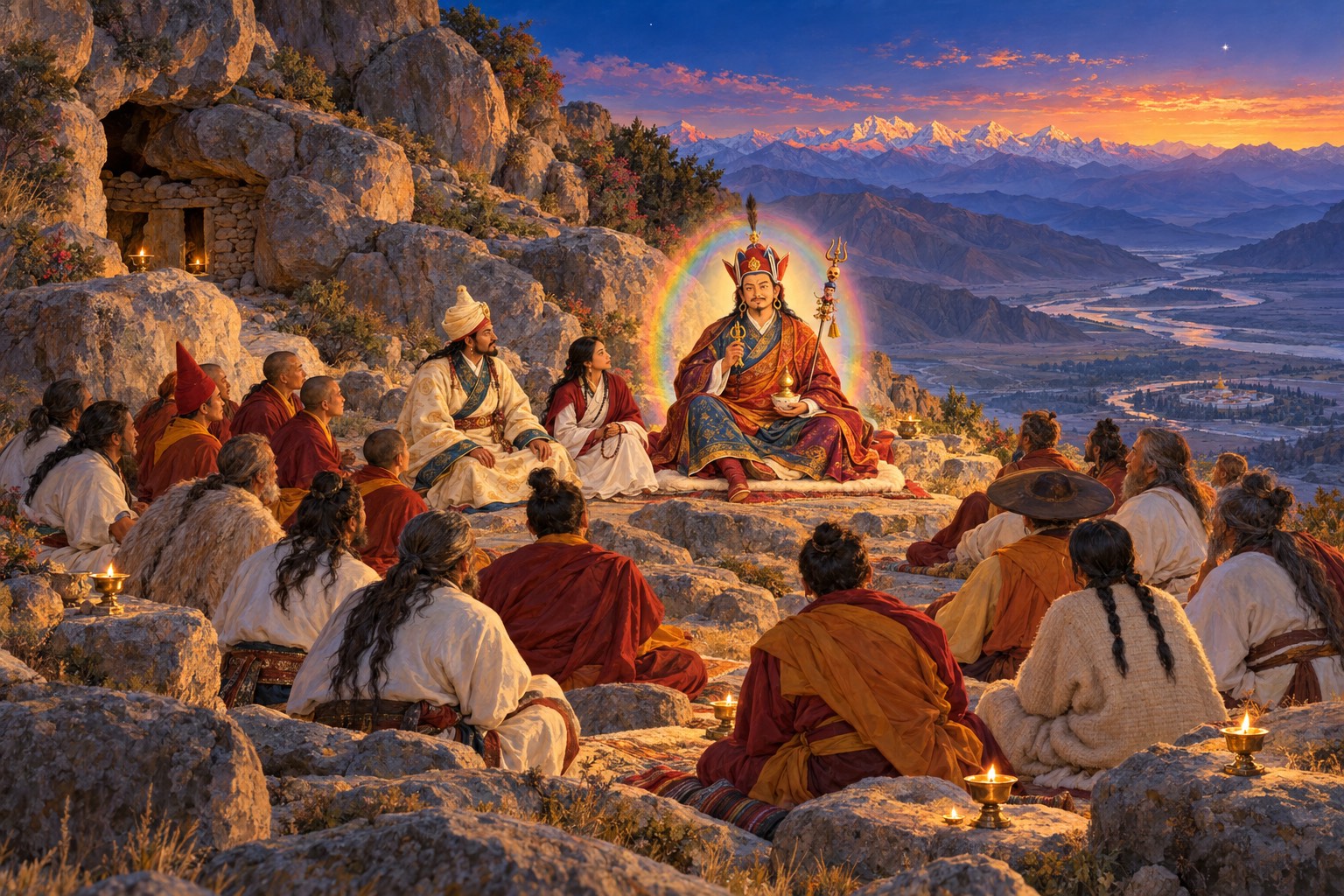
Above the temple of Samye in central Tibet stands a low, rocky hill called Hepori. At dusk the wind comes up the wide sandy valley and runs over its crest, bending the dry grass. The old accounts remember a man who sat up there, practising, and who was said to move like that wind.
His name was Nanam Dorje Düdjom. He was a minister of King Trisong Detsen in the eighth century, one of the envoys who went to bring Guru Rinpoche, the "Precious Teacher" Padmasambhava, to Tibet, and later one of the master's twenty-five closest Tibetan disciples. His wider circle is told in The King and the Twenty-Five. This page stays with him.
A young man at court
The Treasury of Lives, an online encyclopedia of Himalayan masters, says he was born into the Nanam clan in Tsangrong, and became a minister to the king while he was still young. It gives another name for him too, Ba Trishi.
Dorje Düdjom means, as Rigpa Wiki renders it, "Indestructible Subduer of Mara." Mara is the tradition's name for whatever stands in the way of awakening. It is a large name for a court official. The stories that follow try to show how he grew into it.
 Illustration in preparation
When the walls of Samye would not stand, the abbot Shantarakshita advised the king to send for Padmasambhava of Oddiyana. How that came about is told in The Building of Samye. Nanam Dorje Düdjom was among those sent.
The road to Nepal
The Treasury of Lives follows the Pema Kathang here, the fourteenth-century life of Guru Rinpoche revealed by Orgyen Lingpa. In that telling Dorje Düdjom travelled with two companions, Shakyaprabha of the Chim clan and Pelgyi Sengé. They first won permission from a king the text calls Surya, and then went down to Nepal together with the master.
In Nepal, the account says, Guru Rinpoche sent the Tibetans on ahead and stayed behind for three months. Picture them climbing home without him, over the high passes, carrying a promise rather than a teacher.
Illustration in preparationGold on the wind
Then he lingered again, in Mangyul on the Nepal border. So the king sent the envoys back to meet him there, with gold dust as an offering to bring him the rest of the way.
What happened next is one of the old stories' gentle shocks. Guru Rinpoche threw the gold into the wind. The envoys were dismayed: it was the king's gold, and they had carried it a long way.
Illustration in preparationThen, the account goes on, he turned the rocks and soil around them into gold and jewels. The Treasury of Lives says this is what won their faith. In the tradition's way of reading it, the lesson is not about wealth at all. A teacher who could make gold from earth did not need theirs. What he wanted was their trust.
Illustration in preparationThe accounts do not agree on who made the journey, and it is kind to say so. Rigpa Wiki says the minister Ba Salnang, who had earlier helped invite Shantarakshita, was sent again and met Guru Rinpoche in Nepal. The Treasury of Lives adds that some sources seem to have mixed Dorje Düdjom up with Ba Trizik, an early translator who travelled to India. Perhaps there were several parties, perhaps the names blurred over the centuries. The heart of the story stays the same: Tibetans went out, and he came.
A flower falls
Once Guru Rinpoche was in Tibet, Dorje Düdjom became his student. When the master gave an empowerment, a ceremony that introduces a student to a meditation practice, each disciple is said to have cast a flower, and where it fell showed the practice meant for them.
Here the sources part again. Rigpa Wiki says his flower fell on Vajrakilaya, a fierce deity of awakened activity. The Treasury of Lives says it fell on Jikten Chötö, "Worldly Offering and Praise." Both are honoured in the Nyingma tradition. Such practices are given by a qualified teacher, so this page only names them; the Find a Teacher page can help.
Illustration in preparationThrough the rock
The Treasury of Lives tells three signs of his practice. In the first he sat in retreat in a pitch-dark cave. There, the story says, he saw in a vision that the building of the temple at Samye was almost finished.
He got up to go and see. He came out through a tiny crack in the rock, and behind him, it is said, the crack had become a wide passage.
Illustration in preparationIllustration in preparationThe second sign belongs to Hepori, the hill above Samye. Practising there, the account says, he cut through thought at its very root. As a sign of it he drove his kila, a ritual dagger with a three-sided blade, into the solid rock, where it stood.
Illustration in preparationThe third is the one he is best remembered for. He is said to have travelled through the sky as fast as the wind, and to have passed without hindrance through a mountain near Samye. Rigpa Wiki says simply that he could fly with the speed of the wind and pass through solid rock.
A sixteenth-century prayer to the twenty-five by Changdak Tashi Tobgyal gives each disciple one line. His is "Dorje Düdjom, unhindered like the wind" (trans. Samye Translations). The third line of the Seven-Line Prayer speaks of Guru Rinpoche's wondrous accomplishment. Stories like these are the tradition's way of showing that the accomplishment was passed on, and that ordinary Tibetans received it.
Illustration in preparationQuiet years
Later in his life, the Treasury of Lives says, he went home to Tsangrong and practised at a place called Drakmar Ke'u Tsang, the Red Rock Cave. He also practised at Yardrok, near the great turquoise lake of Yamdrok, at a site with the same name. He is said to have translated many tantric texts there.
He is also listed as a student of Kharchen Pelgyi Wangchuk, another of the twenty-five. And his teaching did not stop with him. The Blue Annals, a fifteenth-century history, records that the eleventh-century scholar Rongzom received his line of the Mind Class teachings of Dzogchen, the Great Perfection. Rongzom has his own page on this site.
Illustration in preparationThe prayer he asked for
One of the best-loved Guru Rinpoche prayers keeps his voice. The Le'u Dünma, the "Prayer in Seven Chapters," gives each chapter to a different disciple who asked for it. The fifth, as translated on Lotsawa House, is his.
In it he does not ask for powers. He asks for a prayer telling how Guru Rinpoche came and what he did, something people in the future could lean on, to make faith grow. The answer is a long, simple remembering of the master's life, beginning with the lotus birth, and at the close Guru Rinpoche tells him to remember that life and recite.
The treasure revealer who found the Le'u Dünma, and the way it came down with the Northern Treasures, are told in Rigdzin Gödem and the Hidden Valleys.
Illustration in preparationComing back
The tradition holds that Dorje Düdjom did not stop with one life. Rigpa Wiki lists his rebirths as Rigdzin Gödem, who opened the Northern Treasures in the fourteenth century; Lekden Düdjom Dorje; and Pema Trinlé of Dorje Drak monastery, who lived from 1641 to 1718. It also calls him the root of the line of Tertön Sogyal.
The Treasury of Lives gives a slightly different list: Rigdzin Gödem, a Rigdzin Lekdenje whom it places in the fifteenth century, Jamyang Khyentse Wangpo of The Treasure Friends of Kham, and Tertön Sogyal. Rigpa Wiki dates Lekden to the sixteenth century. As often with these old lines, the names overlap more than the dates do.
Tertön Sogyal's story, told on its own page, includes an iron chest he drew from a cliff in Kham, holding things the tradition says had once belonged to Nanam Dorje Düdjom. A minister's road to Nepal, it seems, was long enough to run through a thousand years.
About the art
Nanam Dorje Düdjom appears in two forms. As a young minister he wears eighth-century Tibetan court dress like the king's, but plainer: a cloth turban with no crown panel and a long robe with wide triangular lapels, after the Dunhuang murals described in the Trisong sheet. In his later life he is painted from a nineteenth-century initiation card of the twenty-five disciples from the Shechen Archives, shown on Himalayan Art Resources: a broad, flat, round hat with a small plume, a red-orange robe, flying green and yellow scarves. On the card he rides on clouds; here he stands among them, and the flying is left to the words.
The small dagger in his sash and in the stone on Hepori is a phurba or kila, with a three-sided blade. It is linked with Vajrakilaya, the practice Rigpa Wiki says was his, and stands for cutting through obstacles. It is drawn plain, without the fierce heads and ornaments of ritual daggers made for practice. The card also shows a fierce face on his apron, which is left out here.
Guru Rinpoche appears in his main form: the lotus hat with its half-vajra and single vulture feather, layered robes, the vajra at his heart, a skull cup holding a long-life vase, and the khatvanga staff resting against his left shoulder. On the road he walks and stands rather than sitting on his lotus throne. The temple of Samye follows the site's eighth-century setting: a circular wall, a three-storey central temple and four coloured stupas, without the gilded roofs of today. No image contains writing.
Why this matters for practice
The third line of the Seven-Line Prayer honours Guru Rinpoche's wondrous accomplishment, and Nanam Dorje Düdjom's story shows the tradition's conviction that this accomplishment was handed on to ordinary Tibetans, even to a court minister. Yet when he asked for something, it was not a power but a prayer for remembering the Guru's life. Reciting the Seven-Line Prayer is that same kind of remembering, open to anyone.
If something in this story moved you, the gold thrown to the wind or the man who asked only for a way to remember, you might pause tonight and recite the Seven-Line Prayer once, as he was told to: remembering, and asking Guru Rinpoche to come.
Sources and further reading
- Nanam Dorje Dudjom, Rigpa Wiki (Internet Archive snapshot, 2024)
- Nanam Dorje Dudjom, by Arthur Mandelbaum (2007), Treasury of Lives (Internet Archive snapshot, November 2014)
- Le'u Dünma, Chapter 5: The Prayer Requested by Nanam Dorje Dudjom, Lotsawa House
- Prayer to the King and Twenty-Five Disciples, by Changdak Tashi Tobgyal, Lotsawa House (Samye Translations, 2016)
- Initiation Cards: 25 Disciples of Padmasambhava, item 52848967 (Shechen Archives), Himalayan Art Resources
- Ba Salnang, Rigpa Wiki (Internet Archive snapshot, 2024)
- Twenty-five disciples of Guru Rinpoche, Rigpa Wiki (Internet Archive snapshot, 2024)
- Lekden Dudjom Dorje, Rigpa Wiki (Internet Archive snapshot, 2024)
- Orgyen Lingpa, The Life and Liberation of Padmasambhava (Padma bka' thang), trans. Toussaint, Douglas and Bays (Dharma Publishing)
This retelling is waiting to be read by a knowledgeable practitioner. Where the traditional accounts differ, the story says so; if you notice a mistake, please tell us through Share Your Story.