Some holy places are named for a deity, some for a miracle. Maratika is named for a hope. In Tibetan it is called Chiwa Tarché, "the one that brings death to an end."
This is the story of a cave in the forested hills of eastern Nepal where, the traditional accounts say, Guru Rinpoche and the Indian princess Mandarava went into retreat and came out beyond the reach of death. It is also the story of how that same cave came to be loved, centuries later, by two great traditions at once.
If you have read "Mandarava and the Lotus Lake" on this site, you already know how they came here: a princess of Zahor who would not marry, a king's fire that the accounts say turned into a lake. That story ends at the mouth of this cave. This one goes inside.
Into the hills
 Illustration in preparation
The accounts do not linger on the road. They say only that after Zahor the master and the princess, by then a nun and his disciple, went together to Maratika to practise.
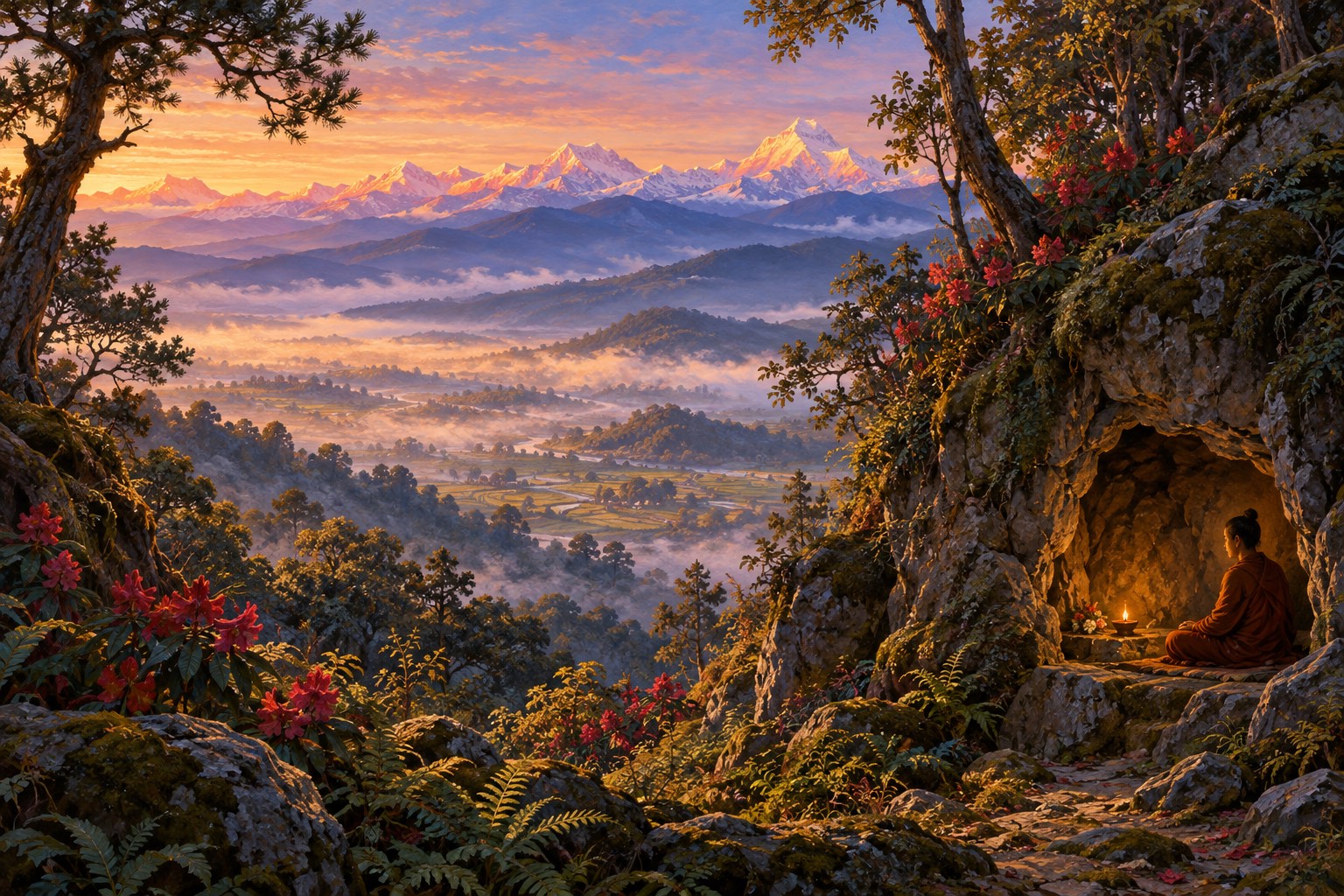
The place they came to is a ridge of three low, rounded hills, wrapped in steep pine forest, with rivers cutting deep valleys on either side and, on clear days, a line of snow peaks far to the north.
Inside the middle hill the rock opens into a great natural hall. Chatral Rinpoche, a twentieth-century master who knew it well, wrote that it could hold a thousand people, and that a round opening in its roof lets the sky look in.
Illustration in preparationThree months, or three years
What did they do there? The sources agree on the heart of it. They practised for long life, in the presence of Amitayus, the Buddha of Boundless Life.
Amitayus is closely linked with Amitabha, the Buddha of Boundless Light, so closely that Tibetan texts sometimes mix the two names. Himalayan Art Resources describes how he is usually painted: red, crowned and jewelled like a prince, his hands resting together in his lap and holding a vase filled with the nectar of long life.
Illustration in preparationHow long they stayed, the tellings do not agree. A classical summary often quoted on Rigpa Wiki gives three months. The twentieth-century teacher Gyatrul Rinpoche spoke of three years. The Treasury of Lives, a scholarly encyclopedia, names other deities in their practice altogether.
Those practices themselves are received from a qualified teacher, not learned from a page like this one. What the stories want us to notice is simpler: two people, in the dark of a mountain, keeping faith with a purpose far larger than themselves.
Illustration in preparationThe accounts do not treat Mandarava as a companion waiting at the edge of his story. She is a practitioner in her own right, and what happened next, they say, happened to both of them.
The Buddha of Boundless Life
Illustration in preparationThe traditional accounts say that Amitayus appeared to them in the cave, face to face. Gyatrul Rinpoche insisted it was not a dream. Amitayus empowered them for long life and blessed them as inseparable from himself.
Pilgrims' guides add that he set his vase of long life upon their heads. A verse in the Le'u Dünma, the "Prayer in Seven Chapters" that many Nyingma practitioners still recite, remembers this cave by name, as the place where Guru Rinpoche received Amitayus's blessing and attained a body free from birth and death.
Tradition calls what they reached the level of a vidyadhara (Tibetan rigdzin), a "holder of awareness," with mastery over life. It counts four such levels, and this is the second.
What does deathless mean? Rigpa Wiki gives the classical description: the body itself purified into a subtle form that does not die. The Treasury of Lives reads it as a realization of the mind's true nature that never changes. The tradition holds both readings side by side.
Illustration in preparationChatral Rinpoche's verse guide says that the two of them remain even now, beyond birth, age, sickness and death, sending out emanations to help beings for as long as the world of suffering lasts. This is why, in paintings, Mandarava so often holds the vase of long life.
One cave, two names
Illustration in preparationMost Tibetan teachers today identify Maratika with the caves above the village of Haleshi, in Khotang district, between the Dudh Koshi and Sun Koshi rivers. Rigpa Wiki says only that it is "thought to be" this cave. Ancient sites are often found again this way, held by faith rather than proof.
For Hindus the same cave is Haleshi Mahadev, a holy place of Shiva, called Mahadev, the "Great God." Their tradition tells that Shiva once hid in this cave from a demon named Bhasmasura.
Some call it the Pashupatinath of the east, after Nepal's great Shiva temple in Kathmandu. Crowds gather for Shivaratri, the Great Night of Shiva, and for other festivals through the year, some coming from across the border in India.
The Kirati Rai people of these hills hold Haleshi dear for their own reasons. Their oral tradition, the Mundhum, remembers an ancestor who once lived inside the cave.
Illustration in preparationThese are not one story told twice. They are different stories, from different traditions, that happen to share a hillside. Each tells its own account of how the cave became holy, and this page will not try to settle who came first.
Chatral Rinpoche watched brahmin priests make their offerings in the cave: bells, tridents, flowers, milk and butter, and thousands of lamps, with no blood ever offered. His advice to Buddhist pilgrims was plain: "We must train in pure perception, with respect, and speak nicely."
Masters who came later
Tibetan memory of Maratika runs long. Chatral Rinpoche's guide retells a legend of a monk named Akarma, sent out in the seventh century to find sacred substances for a statue in Lhasa, who reached the cave by miraculous means and sang its praises.
Later, the tradition says, tertöns, revealers of teachings that Guru Rinpoche hid for the future, brought out long-life practices traced back to this retreat. One is the Chimé Soktik, revealed in Bhutan in 1904 by Zilnön Namkhé Dorjé. Through Dudjom Rinpoche it became the main long-life practice of his lineage.
Illustration in preparationDudjom Rinpoche (1904–1987) came to Maratika himself to do long-life practice. While he was in the cave he wrote a short prayer of fervent devotion, which he called the Drumbeat of the Deathless Vajra. Trulshik Rinpoche also wrote a pilgrims' guide to the site.
Chatral Rinpoche (1913–2015), a wandering Dzogchen yogi known for his strict simplicity, stayed at Maratika too. When his daughter Saraswati asked him for a praise of the place, he wrote his guide between practice sessions in a Fire Tiger year, most likely 1986.
He described the cave with a yogi's humour as well as reverence, likening the bats on its roof to great meditators in hiding, reciting without pause. Pilgrims still read his guide before they set out, and he is remembered as one of the masters who made Maratika known again to Buddhists from far beyond Nepal. He passed away in 2015, aged 102.
Maratika today
Illustration in preparationReaching it is still a journey: about eight hours by jeep from Kathmandu on hill roads, or a short flight to the airstrip at Lamidanda and a drive of some hours more. Buddhists come especially around Losar, the Tibetan New Year, and Hindu crowds swell at Shivaratri.
Three hills are named for three bodhisattvas, Manjushri, Avalokiteshvara and Vajrapani. A stairway leads down into the upper cave in the middle hill, where Hindu shrines to Shiva stand near the corner where Buddhists sit to pray.
Buddhist pilgrims look there for a rock shaped like a vase, honoured as the vase of long life, and squeeze through narrow gaps in the stone that are said to purify the karma of those who pass through.
Illustration in preparationBelow, a lower cave rises inside the hill toward its own wide opening to the sky. A drive away, near the village of Arkhole, a small cave remembered as Mandarava's own place of practice is honoured by Hindus as Gupteshwor Mahadev. Pilgrims crawl into it on hands and knees.
There is one small Tibetan monastery, a scatter of guesthouses and tea shops, and plain prayer flags on the quieter western hill. People collect the water that seeps from the rock and carry it home as nectar.
Illustration in preparationLong life, in this tradition, has never meant simply clinging to years. Shenphen Dawa Rinpoche, as Rigpa Wiki records his words, taught that lengthening life really means lengthening the chance to awaken and to help others.
About the art
Guru Rinpoche appears in his main form, with the lotus hat that the King of Zahor is said to have given him, because Maratika comes after Zahor in the life stories. He holds a five-pronged vajra at his heart, and the khatvanga, a slender staff topped with a trident, rests in the crook of his left arm. In the walking scenes he stands rather than sits; the implements stay the same.
Mandarava is shown in two ways. During the retreat she is a young nun with a shaven head and ochre robes, as she was when she left the palace. After the blessing she appears as she is usually painted beside Guru Rinpoche: an awakened dakini in rose and gold silks, holding a long-life arrow hung with a mirror and silk streamers, and a vase of long life (Himalayan Art Resources, item 8253).
Amitayus, the Buddha of Boundless Life, is painted as Himalayan Art Resources describes him: red, youthful, crowned and jewelled like a prince, seated cross-legged with his hands together in his lap holding a vase of the nectar of long life. He appears alone, in his peaceful form. The rainbow sphere around him is the site's sign for a vision.
The eighth-century scenes show only forest, rock and cave, with clay oil lamps and no buildings. The present-day scenes show what pilgrims see now: a stairway, a small Tibetan monastery, plain prayer flags, and the lamps, bells, marigolds and small tridents that Hindu devotees offer. No deity image from the Hindu shrines is drawn, and no faces of present-day people are shown. Chatral Rinpoche and Dudjom Rinpoche are recent teachers, so they appear only in the words of the story, never in the pictures.
Why this matters for practice
The third line of the Seven-Line Prayer speaks of Guru Rinpoche's wondrous supreme accomplishment, and Maratika is one of the places where the tradition says that accomplishment was sealed. Remembering it as you recite can lend the words a quiet steadiness: whatever our years, the life we have is a chance to awaken and to help. Long-life practices themselves are received from a teacher; the prayer is open to anyone, any night.
If something in this story moved you, a cave whose very name means the end of death, or two traditions lighting their lamps in the same darkness, you might pause and recite the Seven-Line Prayer once, and remember the master and the princess who, the accounts say, are still at work in the world.
Sources and further reading
- Maratika cave, Rigpa Wiki (Internet Archive snapshot)
- Chimé Soktik, Rigpa Wiki (Internet Archive snapshot)
- Mandarava; Vidyadhara; Vidyadhara with power over life; Amitayus; Chatral Sangye Dorje, Rigpa Wiki (Internet Archive snapshots)
- Melodious Tambura of Delight: A Guide to Māratika Cave, Supreme Site of Immortality, by Chatral Sangyé Dorjé Rinpoche (Samye Translations, 2017), Lotsawa House
- Drumbeat of the Deathless Vajra, by Dudjom Rinpoche (Samye Translations, 2019), Lotsawa House
- Le'u Dünma, Chapter 5: The Prayer Requested by Nanam Dorje Dudjom (Rigpa Translations), Lotsawa House
- Maratika (Halesi), Nekhor
- Mandāravā, by Sarah Jacoby (2007), The Treasury of Lives (Internet Archive snapshot)
- Amitayus Buddha Main Page; items 268, 345 and 524, Himalayan Art Resources
- Padmasambhava (Main Form) with Mandarava and Yeshe Tsogyal, item 8253, Himalayan Art Resources
- Halesi-Maratika Caves, Wikipedia
- The Great Maratika Cave of Immortality, by Dorje Phuntsok, Levekunst (Internet Archive snapshot)
- The Halase-Maratika Caves (Eastern Nepal): A Sacred Place Claimed by Both Hindus and Buddhists, by Katia Buffetrille (Pondy Papers in Social Sciences 16, 1994), Scholarship (known only through the Wikipedia citation; not read)
This retelling is waiting to be read by a knowledgeable practitioner. Where the traditional accounts differ, the story says so; if you notice a mistake, please tell us through Share Your Story.